Pennsylvania: ranks 26th in residential — 49th in overall renewables growth
Pennsylvania trajectory
2014: 314 GWh solar generation
2023: 1,480 GWh (+371% over the decade ≈ 1.187× per year)
2024: doubled previous year's installed additions
SREC market: PA's program is essentially closed (oversupplied)
Interventions with measured effect sizes
SolarAPP+ (instant permitting): reduces project times by ~12 days; targets $1/W (≈25%) cost reduction; used in 160+ jurisdictions including Pima County AZ, Tucson, parts of CA
IRA Investment Tax Credit (30%): 752,300 households claimed it in 2023 (avg $5,000); extended through 2032 by IRA — ended for new residential ownership Dec 2025 by OBBBA July 2025
NEM 3.0 (CA, April 2023):negative intervention — cut export compensation by 70–80%; CA distributed solar contracted 41% (2,315 → 1,375 MW); 17,000 jobs lost
MA SMART program: 1,600 MW target (2018), doubled to 3,200 MW (2020), now 3.0 with 900 MW/yr; built MA's per-capita lead
NJ SREC program: active — drove NJ residential adoption; PA's parallel program oversupplied and effectively closed
Sources
SEIA, Solar Market Insight 2024 Year in Review (Mar 2025) — link
All figures cited verbatim in slide source. Numbers used in problems are simplified to 2 sig figs for student arithmetic.
Reading the Solar Curves
A
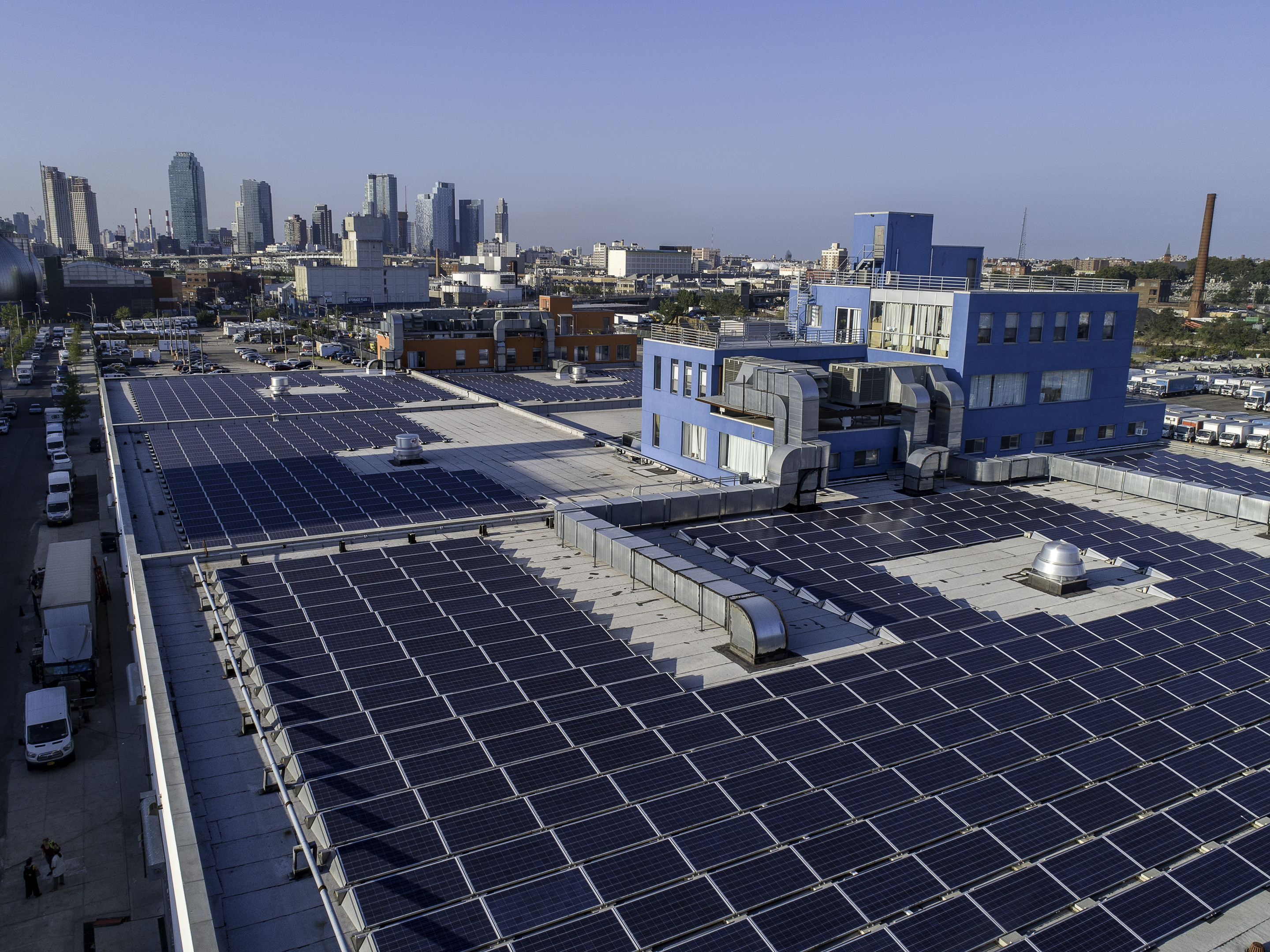
rooftop solar array
on Broadway Stages in Brooklyn, NY. New York added 940 MW of distributed solar in 2024 — second only to California.
A nearly identical roof in Pennsylvania, 90 miles away, would have waited months for a permit instead of days. Photo by EY418, CC BY-SA 4.0.
California's rooftop solar grows on a different curve than Pennsylvania's.
Same sun. Same panels. Same federal tax credit.
So whose state writes the base?
Standards: HSF-LE.A.4, HSF-BF.B.4.a, HSA-SSE.B.3. This redesigned lesson preserves the IM math objectives — coordinating exponential and logarithmic forms — while replacing isotope decay and abstract bases with state-by-state solar growth bases. Each state has a different base \(b\); students will write the same relationship two ways for each state and discover that the exponent that matters (years to a target) is \(\log_{b}\) of a ratio.
Prep Checklist
☐ Open the Data + Intervention Packet (top-right ▸) before launch.
☐ Activity 1 uses base-2 arithmetic — no calculators per IM guidance.
☐ Activity 2 introduces general base \(b\); calculator allowed for sanity-checks only.
☐ Lesson Synthesis reaches the agency move (PA's base vs TX's base) — protect 6 minutes for it.
Big Question
If \(\log_{10}\) tells you about powers of 10,
what does \(\log_{1.30}\) tell you about —
and when would that ever matter?
Today every state with rooftop solar is growing on its own base. We will write the same relationship two ways for each state, then ask why some states' bases are bigger than others.
Big Question slide. Read aloud. Don't resolve. The question primes both halves of the lesson: (a) different bases describe different real growth patterns, (b) the size of the base is a political choice, not a physical constant. Save SWBAT for the lesson synthesis.
Warm-Up5 min
Do Now — Reading Logs
The expression \(\log_{10}(1000) = 3\) can be read two ways: Log reading: “log base 10 of the value 1,000 gives us the exponent 3.” Exponential reading: “10 raised to the power of 3 equals the value 1,000.”
Complete on your own. Then confirm your answers with a partner.
Read out loud and interpret: \(\log_{10}(100{,}000{,}000) = 8\).
Read out loud and interpret: \(\log_{10}(1) = 0\).
Read out loud and interpret: \(\log_{2}(16) = 4\).
Read out loud and interpret: \(\log_{5}(25) = 2\).
5 min total for warm-up (slides 3–4). Pairs read each equation aloud in both forms, then interpret. The transfer move is from base 10 to bases 2 and 5 — structure is identical, only the base changes. Listen for both readings: “log base [b] of the value [x] gives us the exponent [y]” (log form) and “[base] raised to the power of [exponent] equals the value [value]” (exponential form). Holding both is the spine of the lesson.
Do not resolve here — let pairs disagree about phrasing. Synthesis on the next slide settles wording.
Warm-Up · Synthesis~3 min
Reading Logs — Discussion
Same sentence frame, different bases. The structure carries from base 10 to base 2 to base 5 to any base \(b\).
“\(\log_{10}(100{,}000{,}000) = 8\)”Log reading: “log base 10 of the value 100,000,000 gives us the exponent 8.” Exponential reading: “10 raised to the power of 8 equals the value 100,000,000.” Check: \(10^{8} = 100{,}000{,}000\). ✓
“\(\log_{10}(1) = 0\)”Log reading: “log base 10 of the value 1 gives us the exponent 0.” Exponential reading: “10 raised to the power of 0 equals the value 1.” Check: \(10^{0} = 1\). ✓ — true for any base: \(\log_{b}(1) = 0\) because \(b^{0} = 1\).
“\(\log_{2}(16) = 4\)”Log reading: “log base 2 of the value 16 gives us the exponent 4.” Exponential reading: “2 raised to the power of 4 equals the value 16.” Check: \(2^{4} = 16\). ✓ — same structure, different base.
“\(\log_{5}(25) = 2\)”Log reading: “log base 5 of the value 25 gives us the exponent 2.” Exponential reading: “5 raised to the power of 2 equals the value 25.” Check: \(5^{2} = 25\). ✓
click to advance discussion ▶
Try Saying
\(\log_{b}(x) = y\) reads two ways: Log: “log base ___ of the value ___ gives us the exponent ___.” Exponential: “___ raised to the power of ___ equals the value ___.”
The thing to land: the structure carries. \(\log_{b}\) is the question “what exponent on \(b\)?” for any \(b\). When we get to Activity 2 students will see bases like 1.187, 1.30, and 1.05 — weird-looking, but the meaning is identical: what exponent on this state's growth factor produces the target?
Activity 1 · Launch3 min
Texas Residential Solar — in doublings
Between 2019 and 2024, residential solar systems on Texas homes doubled in count roughly every 2 years. Suppose Texas had \(N_{0}\) systems in 2019. Then after \(d\) doublings, the count is \(N(d) = N_{0} \cdot 2^{d}\).
Doublings, \(d\)
\(2^{d}\) (factor)
\(\log_{2}\) of factor
0
1
\(\log_{2}(1) = 0\)
1
2
\(\log_{2}(2) = 1\)
2
4
\(\log_{2}(4) = 2\)
3
8
\(\log_{2}(8) = 3\)
4
16
\(\log_{2}(16) = 4\)
5
32
\(\log_{2}(32) = 5\)
2.3219
5
\(\log_{2}(5) \approx 2.3219\)
Real Texas numbers
2019: ~25,000 residential systems 2021: ~50,000 systems (1 doubling) 2023: ~100,000+ systems (2 doublings) — over 100,000 new systems were installed in 2023 alone.
\(\log_{2}(5) \approx 2.3219\). What does that decimal mean? It is not a whole number of doublings — so what is it?
Launch (~3 min). Project the table. Walk down the left and middle columns first — integer doublings. Then point at the third column: every row is a base-2 logarithm. The last (purple) row is the lesson's hook: \(\log_{2}(5)\) is between 2 and 3 doublings, because 5 is between \(2^{2}=4\) and \(2^{3}=8\). It is a fractional doubling.
Source: SEIA TX residential figures — ~100,000 new residential systems installed in 2023 alone.
Reference · How ToActivity 1 · Work Time12 min
Reference · How To — Read a base-2 log
Step
What to do
Example
1
Read \(\log_{2}(x)\) as: “the exponent on 2 that gives \(x\).”
\(\log_{2}(8)\) asks: “\(2^{?} = 8\).” Answer: 3.
2
If \(x\) is a power of 2, the answer is exact.
\(\log_{2}(32) = 5\), because \(2^{5} = 32\). Exact.
3
If \(x\) is not a power of 2, the answer is between two whole exponents.
\(5\) is between \(2^{2}=4\) and \(2^{3}=8\), so \(\log_{2}(5)\) is between 2 and 3.
4
From the table: read off the approximation.
\(\log_{2}(5) \approx 2.3219\) — about 2.32 doublings.
★
The exact form \(\log_{2}(5)\) and the decimal 2.3219 mean the same thing — one is exact, one is approximate.
\(2^{2.3219} \approx 4.99996...\) — close, but the symbol is the only exact name.
Activity 1 · Work Time
Use the table on slide 5. No calculator.
Find \(\log_{2}(2)\).
Find \(\log_{2}(32)\).
If Texas residential solar starts at 25,000 in 2019 and doubles every 2 years, how many systems is \(25{,}000 \cdot 2^{3}\)? (3 doublings.)
Solve: \(2^{x} = 16\). Then write the same equation in log form.
Solve: \(2^{x} = 5\). Write the exact answer using \(\log_{2}\). Then give the decimal approximation from the table.
12 min · Activity 1 Work Time. Leave this slide on screen during work time. No calculators per IM guidance — the table is the lookup.
Problem 1: 1, because \(2^{1} = 2\). Problem 2: 5, because \(2^{5} = 32\). Problem 3: 200,000 systems (\(25{,}000 \cdot 8\)). Sanity-check against real TX numbers in slide 5. Problem 4: \(x = 4\). Log form: \(\log_{2}(16) = 4\). Problem 5: Exact: \(x = \log_{2}(5)\). Approx: \(x \approx 2.3219\). Both are correct — only the symbol is exact.
Amplify · 5 inputs
Order per problem: Text → Math Response (named answer1, answer2, answer3, answer4, answer5) → Note (CL in </>).
content:
  when answer1.submitted and answer1.numericValue > 0.999 and answer1.numericValue < 1.001
    "Correct! 2^1 = 2, so log base 2 of 2 is 1."
  when answer1.submitted and answer1.numericValue > 1.999 and answer1.numericValue < 2.001
    "Almost — 2 is the base, not the exponent. The exponent on 2 that gives 2 is 1 (since 2^1 = 2)."
  when answer1.submitted and not isBlank(answer1.latex)
    "Not quite — log base 2 of 2 asks: 2 to what power equals 2? Try again."
  otherwise ""
Problem 2: log base 2 of 32.
content:
  when answer2.submitted and answer2.numericValue > 4.999 and answer2.numericValue < 5.001
    "Correct! 2^5 = 32, so log base 2 of 32 is 5."
  when answer2.submitted and answer2.numericValue > 31.999 and answer2.numericValue < 32.001
    "Almost — 32 is the input, not the exponent. We want the power on 2: 2^5 = 32."
  when answer2.submitted and answer2.numericValue > 15.999 and answer2.numericValue < 16.001
    "I see what happened — that is half. Try one more doubling: 16 → 32 means one more power of 2."
  when answer2.submitted and not isBlank(answer2.latex)
    "Not quite — count the doublings: 1, 2, 4, 8, 16, 32. How many doublings from 1?"
  otherwise ""
Problem 3: 25,000 · 2^3 systems.
content:
  when answer3.submitted and answer3.numericValue > 199999 and answer3.numericValue < 200001
    "Correct! 25,000 · 8 = 200,000 systems after 3 doublings — about right for Texas residential 2019 → 2025."
  when answer3.submitted and answer3.numericValue > 49999 and answer3.numericValue < 50001
    "Almost — 50,000 is one doubling. 3 doublings means multiply by 2 three times: 25,000 → 50,000 → 100,000 → 200,000."
  when answer3.submitted and answer3.numericValue > 99999 and answer3.numericValue < 100001
    "Almost — 100,000 is two doublings. One more: 100,000 · 2 = ?"
  when answer3.submitted and answer3.numericValue > 74999 and answer3.numericValue < 75001
    "I see what happened — that is 25,000 · 3 (linear). The factor 2^3 = 8 (exponential). Try 25,000 · 8."
  when answer3.submitted and not isBlank(answer3.latex)
    "Almost — 2^3 = 8. Multiply 25,000 by 8."
  otherwise ""
Problem 4: solve 2^x = 16.
content:
  when answer4.submitted and answer4.numericValue > 3.999 and answer4.numericValue < 4.001
    "Correct! 2^4 = 16, so x = 4. In log form: log base 2 of 16 = 4."
  when answer4.submitted and answer4.numericValue > 7.999 and answer4.numericValue < 8.001
    "Almost — 16/2 = 8, but the question asks for the exponent. 2^? = 16. The answer is a smaller number."
  when answer4.submitted and not isBlank(answer4.latex)
    "Not quite — count the doublings from 1 to 16: 1, 2, 4, 8, 16. That is the exponent."
  otherwise ""
Problem 5: solve 2^x = 5 (decimal approximation).
content:
  when answer5.submitted and answer5.numericValue > 2.319 and answer5.numericValue < 2.323
    "Correct! Exact: x = log base 2 of 5. Approximate: x ≈ 2.3219. Between 2 and 3 doublings, since 5 is between 4 and 8."
  when answer5.submitted and answer5.numericValue > 2.499 and answer5.numericValue < 2.501
    "Almost — 2.5 is a guess. The table gives a precise value: log base 2 of 5 ≈ 2.3219."
  when answer5.submitted and answer5.numericValue > 4.999 and answer5.numericValue < 5.001
    "Almost — 5 is the value of 2^x, not x itself. We want the exponent. Look up log base 2 of 5 in the table."
  when answer5.submitted and answer5.numericValue > 1.999 and answer5.numericValue < 2.001
    "Almost — 2 doublings gives only 4 (= 2^2), not 5. The exponent for 5 is just over 2: log base 2 of 5 ≈ 2.3219."
  when answer5.submitted and not isBlank(answer5.latex)
    "Almost — 5 is between 4 and 8, so the exponent is between 2 and 3. The table value: log base 2 of 5 ≈ 2.3219."
  otherwise ""
Activity 1 · Synthesis5 min
From doublings to log form
For each pair below, we have the same relationship written two ways. Notice what the base, the exponent, and the value do when we switch.
“Exponential: \(2^{4} = 16\). Log form?”\(\log_{2}(16) = 4\). The base 2 stays the base. The exponent 4 moves out front. The value 16 moves into the parentheses.
“Why is \(\log_{2}(5)\) the exact answer to \(2^{x} = 5\), but 2.3219 is an approximation?”\(\log_{2}(5)\) is the exponent that satisfies \(2^{x} = 5\), by definition. The decimal 2.3219 is just a rounded version — \(2^{2.3219} \approx 4.99996\), not exactly 5. The symbol carries the truth; the decimal is convenient.
“Texas had ~25,000 residential systems in 2019. They doubled every 2 years. About when does Texas hit 5× the 2019 number?”We need \(2^{d} = 5\), so \(d = \log_{2}(5) \approx 2.3219\) doublings. Each doubling is 2 years, so it takes about \(2 \cdot 2.3219 \approx 4.64\) years — near the end of 2023. (Real data: TX residential systems crossed 5× their 2019 baseline in 2023.)
click to advance discussion ▶
Try Saying
\(2^{x} = y\) and \(\log_{2}(y) = x\) say the same thing because ___.
Sequence the discussion in this order. Question 3 is the bridge from base-2 arithmetic to a real state's curve. The lesson hinges on recognizing that the same translation move — exponential to log — works for any base, including the weird-looking growth bases of real states (1.187, 1.30, 1.05). Activity 2 will demand that move at non-integer bases.
Math As A Second Language
Equivalent forms — exponential and logarithmic
Math · We Say · Meaning
★ Math (given)
\(\log_{b}(x) = y \;\iff\; b^{y} = x\)
▲ We Say
“log base b of the value x gives us the exponent y, which means b raised to the power of y equals the value x”
● Meaning
Taking the log base b of the value x gives the exponent y that is applied to base b in order to produce the value x.
Example — \(2^{4} = 16\) is the same relationship as \(\log_{2}(16) = 4\)
The base is 2. The exponent is 4. The output is 16.
Standalone MASL slide. The biconditional symbol \(\iff\) reads “if and only if” and is the formal way of saying “these two equations carry the same information.” This is the central skill the IM lesson targets — coordinating exponential and logarithmic forms. Activity 2 puts it through every base.
Activity 2 · Launch3 min
Each state grows on a different base
Different states' rooftop solar capacities grow at different annual factors. The same federal tax credit applies to all of them — so the differences are about state policy. Here are five states' annual growth bases for distributed (rooftop) solar over the past 5 years (rounded for student arithmetic):
California
Base \(b = 1.04\) Mature market. NEM 3.0 (2023) cut this hard.
Texas
Base \(b = 1.30\) Fastest-growing residential market.
Massachusetts
Base \(b = 1.10\) Top-5 per capita. SMART program.
Florida
Base \(b = 1.20\) Utility-scale and rooftop both rising.
Pennsylvania
Base \(b = 1.05\) Ranked 49th in renewable growth.
For every state, the model is the same shape
\[\text{capacity}(t) = P_{0} \cdot b_{\text{state}}^{\,t}\]
where \(P_{0}\) is the starting capacity, \(b_{\text{state}}\) is that state's annual factor, and \(t\) is years since the start.
Same federal tax credit. Same panels. So why are the bases different?
Launch (~3 min). The bases shown are simplified for arithmetic but reflect real ratios in the trend — CA's distributed solar grew slowly post-NEM 3.0 (~4%/yr in 2024), TX exploded (~30%/yr in residential 2020-2023), PA crawled. Don't resolve the question yet — the agency move at the end of the lesson lands on this. For now: students will write each state's growth in two equivalent forms.
Sources: SEIA 2024 Year in Review; ILSR 2024 Distributed Solar Update.
Activity 2 · Work Time15 min
Same relationship, two ways
Each row shows one state's growth as either an exponential equation or a logarithmic equation. Complete the table by writing the missing form. The first row is done as an example.
#
State (context)
Exponential form
Logarithmic form
ex.
TX, doubles in 2 yrs
\(2^{1} = 2\)
\(\log_{2}(2) = 1\)
a.
TX, 3 doublings
\(2^{3} = 8\)
?
b.
FL, 2 yrs at \(b=1.2\)
\(1.2^{2} = 1.44\)
?
c.
PA, 1 yr at \(b=1.05\)
?
\(\log_{1.05}(1.05) = 1\)
d.
MA, 0 yrs
?
\(\log_{1.10}(1) = 0\)
e.
CA, “\(10^{3}\)-fold growth”
\(10^{3} = 1000\)
?
f.
FL, t years to triple
\(1.2^{t} = 3\)
?
g.
TX, t years to 4×
?
\(\log_{1.30}(4) = t\)
h.
PA, t years to double
\(1.05^{t} = 2\)
?
i.
General state, factor \(b\), exponent \(y\), output \(x\)
?
\(\log_{b}(x) = y\)
Try Writing
Each pair says the same thing because the base in the exponential equation becomes the ___ in the log equation.
15 min · Activity 2 Work Time. Leave on screen. Calculator allowed for sanity-checks only — the table is about form, not arithmetic.
Answers:
a. \(\log_{2}(8) = 3\)
b. \(\log_{1.2}(1.44) = 2\)
c. \(1.05^{1} = 1.05\)
d. \(1.10^{0} = 1\)
e. \(\log_{10}(1000) = 3\)
f. \(\log_{1.2}(3) = t\)
g. \(1.30^{t} = 4\)
h. \(\log_{1.05}(2) = t\)
i. \(b^{y} = x\)
Watch for: students who write \(\log_{1.05}(t) = 2\) for (h) — argument-vs-exponent confusion. The argument is what we want; the exponent is the answer. \(\log_{b}\)(argument) = exponent.
The hidden hook in (h): \(\log_{1.05}(2) \approx 14.2\) years for PA to double. \(\log_{1.30}(2) \approx 2.6\) years for TX to double. Same target, different base, wildly different timelines. We will use this in the synthesis.
Amplify · 8 inputs
Order per row: Text → Math Response (named answerA, answerB, answerC, answerD, answerE, answerF, answerG, answerH) → Note. Row i is text-only — discussed verbally.
Note: CL numericValue does not handle full equation strings; correctness is checked on the exponent value the student types. Each Math Response asks for just the missing exponent / argument piece. See per-problem prompts in the Text component for what to enter.
Problem a: log base 2 of 8 equals what?
content:
  when answerA.submitted and answerA.numericValue > 2.999 and answerA.numericValue < 3.001
    "Correct! 2^3 = 8, so log base 2 of 8 = 3."
  when answerA.submitted and answerA.numericValue > 7.999 and answerA.numericValue < 8.001
    "Almost — 8 is the input, not the exponent. We want the exponent on 2 that gives 8."
  when answerA.submitted and not isBlank(answerA.latex)
    "Not quite — count doublings: 1, 2, 4, 8. How many doublings to get to 8?"
  otherwise ""
Problem b: log base 1.2 of 1.44 equals what?
content:
  when answerB.submitted and answerB.numericValue > 1.999 and answerB.numericValue < 2.001
    "Correct! 1.2^2 = 1.44, so log base 1.2 of 1.44 = 2."
  when answerB.submitted and answerB.numericValue > 1.439 and answerB.numericValue < 1.441
    "Almost — 1.44 is the value, not the exponent. We want the exponent: 1.2^? = 1.44."
  when answerB.submitted and not isBlank(answerB.latex)
    "Not quite — try squaring 1.2: 1.2 · 1.2 = 1.44. So the exponent is 2."
  otherwise ""
Problem c: 1.05 to what power equals 1.05? (Enter exponent.)
content:
  when answerC.submitted and answerC.numericValue > 0.999 and answerC.numericValue < 1.001
    "Correct! 1.05^1 = 1.05, so the exponent is 1. (Any number to the first power is itself.)"
  when answerC.submitted and answerC.numericValue > -0.001 and answerC.numericValue < 0.001
    "Almost — 1.05^0 = 1 (not 1.05). To get 1.05 we need exponent 1."
  when answerC.submitted and not isBlank(answerC.latex)
    "Not quite — any base raised to the power of 1 equals itself."
  otherwise ""
Problem d: 1.10 to what power equals 1? (Enter exponent.)
content:
  when answerD.submitted and answerD.numericValue > -0.001 and answerD.numericValue < 0.001
    "Correct! Any nonzero base raised to 0 equals 1, so 1.10^0 = 1."
  when answerD.submitted and answerD.numericValue > 0.999 and answerD.numericValue < 1.001
    "Almost — 1.10^1 = 1.10, not 1. The exponent that gives 1 is 0."
  when answerD.submitted and not isBlank(answerD.latex)
    "Not quite — what exponent on any base produces 1?"
  otherwise ""
Problem e: log base 10 of 1000 equals what?
content:
  when answerE.submitted and answerE.numericValue > 2.999 and answerE.numericValue < 3.001
    "Correct! 10^3 = 1000, so log base 10 of 1000 = 3."
  when answerE.submitted and answerE.numericValue > 999 and answerE.numericValue < 1001
    "Almost — 1000 is the input, not the exponent. We want the power on 10 that gives 1000."
  when answerE.submitted and not isBlank(answerE.latex)
    "Not quite — count zeros: 10, 100, 1000. Three zeros = exponent 3."
  otherwise ""
Problem f: log base 1.2 of 3 equals what? (Sanity-check: between 5 and 7. Round to one decimal.)
content:
  when answerF.submitted and answerF.numericValue > 5.99 and answerF.numericValue < 6.05
    "Correct! log base 1.2 of 3 ≈ 6.03 — Florida takes about 6 years to triple at b = 1.20."
  when answerF.submitted and answerF.numericValue > 1.999 and answerF.numericValue < 2.001
    "Almost — 2 would be log base 1.2 of 1.44, not 3. We need a bigger exponent: about 6."
  when answerF.submitted and answerF.numericValue > 2.999 and answerF.numericValue < 3.001
    "Almost — 3 is the value (1.2^t = 3), not the exponent t itself. Try checking: 1.2^3 ≈ 1.73. Need a bigger t."
  when answerF.submitted and not isBlank(answerF.latex)
    "Almost — 1.2^? = 3. Try a few values: 1.2^5 ≈ 2.49 (too small), 1.2^7 ≈ 3.58 (too big). Answer is between."
  otherwise ""
Problem g: write the exponential form (just the exponent t, when 1.30^t = 4 — find t to one decimal).
content:
  when answerG.submitted and answerG.numericValue > 5.25 and answerG.numericValue < 5.31
    "Correct! 1.30^t = 4 means t = log base 1.30 of 4 ≈ 5.28 years for Texas to quadruple."
  when answerG.submitted and answerG.numericValue > 3.999 and answerG.numericValue < 4.001
    "Almost — 4 is the value, not t. The question asks how many years to reach 4× growth at b = 1.30."
  when answerG.submitted and answerG.numericValue > 1.999 and answerG.numericValue < 2.001
    "Almost — 1.30^2 ≈ 1.69 (not 4). Need bigger t: try 5 or so."
  when answerG.submitted and not isBlank(answerG.latex)
    "Almost — 1.30^? = 4. Try 1.30^5 ≈ 3.71 (close). Answer is about 5.3."
  otherwise ""
Problem h: log base 1.05 of 2 equals what? (Round to one decimal.)
content:
  when answerH.submitted and answerH.numericValue > 14.1 and answerH.numericValue < 14.3
    "Correct! log base 1.05 of 2 ≈ 14.2 — Pennsylvania takes 14 years to double at b = 1.05. Compare to Texas (about 2.6 years to double at b = 1.30)."
  when answerH.submitted and answerH.numericValue > 1.999 and answerH.numericValue < 2.001
    "Almost — 2 is the value, not the exponent. We want the years t such that 1.05^t = 2."
  when answerH.submitted and answerH.numericValue > 2.5 and answerH.numericValue < 2.7
    "Almost — that is Texas's doubling time (b = 1.30), not Pennsylvania's. PA at b = 1.05 takes much longer."
  when answerH.submitted and answerH.numericValue > 13.9 and answerH.numericValue < 14.4
    "Correct (within rounding)! log base 1.05 of 2 ≈ 14.2 years."
  when answerH.submitted and not isBlank(answerH.latex)
    "Almost — try 1.05^14 on a calculator: about 1.98. So the doubling time at b = 1.05 is just over 14 years."
  otherwise ""
Activity 2 · Synthesis5 min
Different bases, different doubling times
For each state, “how many years until rooftop solar doubles?” is the same question with the same shape: \(t = \log_{b}(2)\). The base \(b\) is the only thing that changes — and that one number rewrites the timeline.
State
Base \(b\)
Doubling equation
Log form
Years to double
Texas
1.30
\(1.30^{t} = 2\)
\(t = \log_{1.30}(2)\)
≈ 2.6 yrs
Florida
1.20
\(1.20^{t} = 2\)
\(t = \log_{1.20}(2)\)
≈ 3.8 yrs
Massachusetts
1.10
\(1.10^{t} = 2\)
\(t = \log_{1.10}(2)\)
≈ 7.3 yrs
California
1.04
\(1.04^{t} = 2\)
\(t = \log_{1.04}(2)\)
≈ 17.7 yrs
Pennsylvania
1.05
\(1.05^{t} = 2\)
\(t = \log_{1.05}(2)\)
≈ 14.2 yrs
“The Texas equation and the Pennsylvania equation have the same structure. What is different?”Only the base. \(1.30^{t} = 2\) and \(1.05^{t} = 2\) ask the same question (“when does this state double?”) but the bigger base solves in fewer years. Same log form (\(t = \log_{b}(2)\)), different number plugged in for \(b\).
“Pennsylvania takes 5× longer to double than Texas. Where does the gap come from?”The base \(b\) compounds. \(1.05\) and \(1.30\) look almost the same on paper — just 25¢ on the dollar of growth per year. But over \(t\) years that 25¢ turns into a factor of \((1.30/1.05)^{t}\) — an exponential gap. After 14 years, TX has doubled five times while PA has doubled once.
“California's base is even smaller than Pennsylvania's. Why?”CA's NEM 3.0 (April 2023) cut net-metering compensation by 70–80%. That immediately reduced the value of new rooftop systems for California homeowners, contracting installations 41% and erasing 17,000 solar jobs. CA's market is huge but the recent growth rate collapsed. The base shrank because the policy shrank it.
click to advance discussion ▶
Try Saying
The base \(b\) controls how long it takes to ___, even though the equation has/does not have the same shape across states.
The synthesis bridges to the agency move: bases are not handed down by physics. The base is a number that policy moves. CA's case is the strongest demonstration — one rule change in 2023 dropped CA's distributed-solar growth from a leading state to one of the slowest.
Trauma-aware note: some students may have parents in the solar industry (especially in CA) who lost jobs in 2023. If that comes up, validate — this is real, recent, and material. Then route back to the math: the policy lever and its effect are visible in \(b\).
Lesson Synthesis · Agency6 min
What policy moves Pennsylvania's base?
Pennsylvania's rooftop solar doubles every ~14 years at \(b = 1.05\). Texas's doubles every ~2.6 years at \(b = 1.30\). Same panels. Same federal tax credit (30% IRA ITC, 752,300 households claimed it in 2023). The difference is in state policy — specifically what makes solar cheap, fast, and worth installing.
Intervention 1 — SolarAPP+ instant permitting
Federal NREL software auto-approves code-compliant residential solar permits in hours instead of weeks. Used in 160+ jurisdictions. Measured effect: cuts project times by ~12 days, targets $1/W cost reduction (≈25%).
Intervention 2 — SREC market reform
Massachusetts replaced its old SREC system with the SMART program (now 3.0) — predictable per-kWh incentives, 900 MW/yr block. PA's SREC market is essentially closed (oversupplied). MA built top-5-per-capita rooftop solar on this lever.
Intervention 3 — Net-metering rules
States with strong net metering (full retail credit for exported solar) outpace those without. NJ has it; PA's is partial. Counter-example: California's NEM 3.0 (2023) cut export pay 70–80% — CA installations dropped 41% the next year.
The agency question
Pick one intervention. Estimate the new base \(b'\) it could push PA toward. Then write the new doubling-time equation in both forms. Defend your estimate using a real number from the cards above.
Try Saying
If PA adopted ___, I think \(b\) would rise from 1.05 to about ___, because ___. That would shorten PA's doubling time from 14 years to about ___ years.
I Can… (SWBAT)
Coordinate exponential and logarithmic equations that represent the same relationship — in any base, including the bases that describe real states' growth.
Recognize that the base \(b\) of an exponential model is moved by policy choices, not by physics — so the doubling time is a number we can argue about.
6 min · Agency move. This is the lesson's wrench. Popcorn discussion — not a project, not a write-up. Run it 2 minutes silent (students estimate \(b'\) and write the two forms), 3–4 minutes whole-class share-out.
What a defensible answer sounds like: “If PA adopted SolarAPP+, costs drop ~25%, which historically corresponds to growth bases of about 1.10–1.15. Doubling time: \(\log_{1.12}(2) \approx 6\) years. Cuts PA's wait by more than half.” The numbers don't have to be exact — they have to be cited.
If a student says “PA should just get TX's base”: press — what specifically would do that? Permitting? Tax incentive on top of the ITC? A state SREC restart? Each is a real lever; each has historical effect sizes.
If a student says “none of this works, fossil fuels are too entrenched”: validate the cynicism, then route back to the data — CA's NEM 3.0 measurably moved \(b\) down, which proves policy can move it. The question is which direction.
Closing line: “Whose state writes the base? — The legislature does, with every permitting bill, every net-metering rule, every SREC vote.”
Cool-Down5 min
Writing in Different Forms
Suppose Pennsylvania's distributed solar capacity \(P\) follows \(P(t) = 100 \cdot 1.05^{t}\) megawatts, where \(t\) is years since 2024. Use this model for the questions below.
Problems
Write the equation \(1.05^{t} = 4\) in logarithmic form. (PA reaching 400 MW — 4× current.)
Write the equation \(\log_{1.05}(8) = t\) in exponential form. (PA reaching 800 MW — 8× current.)
Explain why \(\log_{1.05}(1) = 0\). What does this say about Pennsylvania at \(t = 0\) (the year 2024)?
Cool-Down · 5 min. Mirrors the IM cool-down structure with PA's base instead of base 2.
Problem 1: \(\log_{1.05}(4) = t\). (Numerically \(\approx 28.4\) years — PA hits 4× by mid-2050s at this rate. No calculation required from students for the cool-down — just the form.)
Problem 2: \(1.05^{t} = 8\). (Numerically \(\approx 42.6\) years.)
Problem 3: \(1.05^{0} = 1\), so the exponent that gives 1 is 0. This says PA at \(t = 0\) is at \(1 \times\) its starting value — the model starts at 100 MW and 0 years in, has not grown yet. Universal: \(\log_{b}(1) = 0\) for any base \(b > 0\).
Amplify · Cool-Down Setup
Problem 1: Text component (full problem text + Example: log_{1.05}(4) = t) → Text Response named answer1 → Note with CL.
Problem 2: Text component (full problem text + Example: 1.05^t = 8) → Text Response named answer2 → Note with CL.
Problem 3: Text Response only — written explanation. answer3.
Note: Problems 1 & 2 use Text Response (answer.content) because we are checking form, not a number. Accepted forms listed in CL.
Problem 1: Write 1.05^t = 4 in logarithmic form.
content:
  when answer1.submitted and not isBlank(answer1.content)
    "Thanks — share your answer with a partner. Target form: log base 1.05 of 4 = t. The base 1.05 stays as the base, the exponent t becomes the right side, and the value 4 goes inside the parentheses."
  when answer1.submitted and isBlank(answer1.content)
    "Please write the equation in logarithmic form before submitting. Hint: log_{base}(value) = exponent."
  otherwise ""
Problem 2: Write log base 1.05 of 8 = t in exponential form.
content:
  when answer2.submitted and not isBlank(answer2.content)
    "Thanks — share your answer with a partner. Target form: 1.05^t = 8. The base stays the base, t goes back up as the exponent, and 8 sits on the other side as the value."
  when answer2.submitted and isBlank(answer2.content)
    "Please write the equation in exponential form before submitting. Hint: base^exponent = value."
  otherwise ""
Problem 3: Explain why log base 1.05 of 1 = 0.
content:
  when answer3.submitted and not isBlank(answer3.content)
    "Thanks — share your reasoning during the next class. Target idea: 1.05^0 = 1, so 1.05 raised to the power of 0 equals 1. At t = 0 (year 2024), PA is at 1× its starting amount — it hasn't grown yet."
  when answer3.submitted and isBlank(answer3.content)
    "Please write a short explanation before submitting."
  otherwise ""
Lesson Summary
Two ways to write the same relationship
Many relationships that can be expressed with an exponent can also be expressed with a logarithm. The two forms describe the same relationship between a base, an exponent, and a value.
Lesson Summary
Every state's solar curve has the same shape: \(P_{0} \cdot b^{t}\). The base is the part that policy moves. The log form pulls the year out of the exponent so we can ask: how long until we get there?
Lesson Summary slide. The middle (yellow) box should be familiar from Activity 2's synthesis: exponential and log forms of the “TX doubles in 2.6 years” relationship. Tomorrow students will use this property to solve exponential equations directly — they have just learned the symbol \(\log_{b}\) is the answer-name for “what exponent?” questions.