"Purges" = removals of registered voters from state rolls. Some are routine (deceased, moved, duplicates). Others remove eligible voters, especially under "use it or lose it" laws upheld in Husted v. APRI (2018, 5–4).
19 million voters purged nationally 2020–2022 — +21% over 2014–2016. (Brennan Center, citing US EAC; accessed May 2026)
Georgia 2012–2016: 1.5 million purged — twice the 2008–2012 cycle. Jul 2017: 670,000 in one sweep. (APM Reports, Oct 19 2018)
Ohio "supplemental process" (upheld Husted v. APRI 2018) targets non-voters after 2 yrs + 4 yrs. Aug 2023: 26,666 names; Sep 2023: 154,995 in one wave. (Ohio Capital Journal)
Wisconsin Dec 2019: court ordered 234,000 voters purged; eventually halted by WI Supreme Court Apr 2022. (Washington Post, Dec 14 2019)
National median removal rate:8.5% per 2-yr cycle (2020–22). 9.1% during 2024 general election cycle. (CSG / EAC EAVS)
2020–22 was +21% over 2014–16, which was already +33% over 2006–08. Compounding. (Brennan)
Preclearance gap: after Shelby County v. Holder (2013), counties formerly subject to Section 5 purged at rates 40% higher than non-covered counties. ≈ 1.1 million extra removals 2016–18. (Brennan Center 2019)
Interventions with measured effect sizes
Automatic Voter Registration (AVR) — OR: +15.9% registrations; CO: +16.0%. Oregon added 272,000+ new voters in year 1 (2016). (Brennan AVR Impact Study; Demos)
Same-Day Registration (SDR / EDR) — +3 to +6 percentage-point turnout boost. +3.1 to +7.3 pp for 18–24 yr olds specifically. (MIT Election Lab)
Pre-registration of 16/17-yr-olds — FL: preregistrants +4.7% more likely to vote in 2008. Counties with pre-reg in 2020: +9 pp youth turnout. (Duke / Hillygus 2014)
NVRA enforcement litigation (Demos, Brennan Center) — restored hundreds of thousands of erroneously purged voters across multiple states. (Brennan court cases)
ERIC participation — flagged 200,000+ deceased/duplicate records for Texas in 6 months (2022); 9 GOP states withdrew in 2023 (TX, FL, OH, MO, WV, AL, LA, IA, VA). (Votebeat, Dec 2023)
Math shape used in this lesson
Purge counts per cycle → ratio of "rolls before / rolls after" → expressed as log_b(N) where b is a yearly factor. Students sandwich these between integer powers (e.g. log_2(20) is between 4 and 5 because 2^4 = 16 < 20 < 32 = 2^5). They compare two states' log expressions without a calculator first, then verify.
Trauma awareness
Voting / civic-rights material is generally low-trauma but may surface for students whose family members have been purged or denied registration. Brief opt-in framing on slide 2 lets the teacher check in. No personally identifying questions asked of students.
Evaluating Logarithmic Expressions
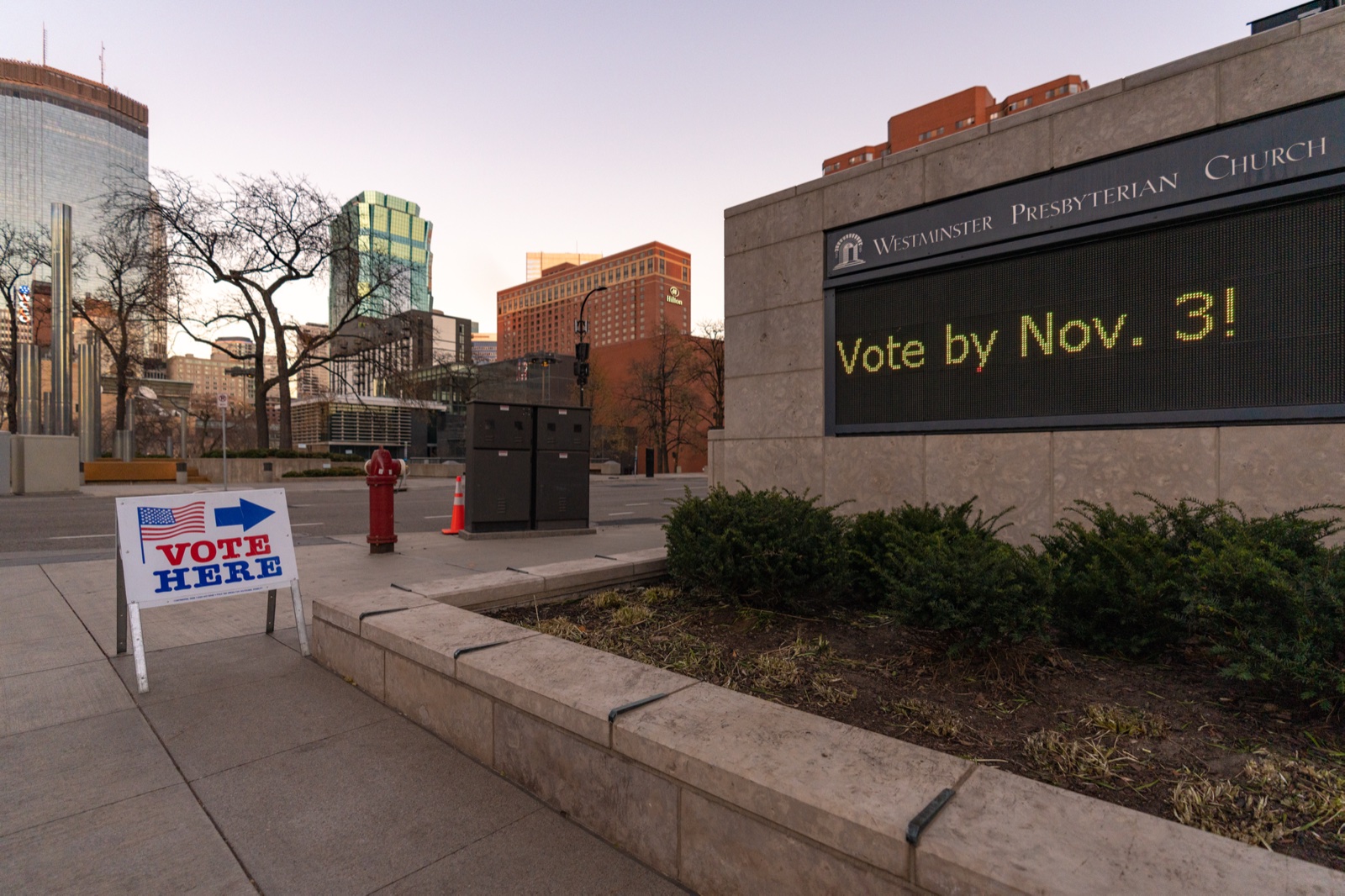
“Vote Here”
— a polling-place sign in Minneapolis on Election Day, November 2020. To vote here, your name has to be on the rolls.
Between 2020 and 2022, US states removed 19 million names from those rolls. Some were duplicates and deceased. Some were not. Photo: Chad Davis, CC BY-SA 2.0.
log(1,000,000,000) = 9.
Why does a billion collapse to a single digit?
And what does that compression let you see —
that the raw count hides?
Standards: HSF-LE.A.4, HSF-BF.B.4.a. Today's pivot — logarithms turn huge counts into one or two digits, which makes them comparable. The image is a deliberate ground line: a vote starts with a name on a roll. Today's math is about what happens when those names get removed.
Frame, briefly: “Today we'll evaluate and compare logarithms — first by hand, then by calculator. The numbers come from a real and ongoing fight about who stays on a voter roll. If that fight has touched anyone in your family, you can sit with the math and skip the discussion. Otherwise, jump in.”
Prep Checklist
☐ Scientific calculators (1 per pair).
☐ Open the Data + Intervention Packet (top right) before class — you'll reference it on slides 13–14.
☐ Optional: print Log War cards (IM blackline master) for Activity 1 if pacing allows. The slide-based version works without cards.
Warm-Up5 min
Do Now
Evaluate each logarithm mentally. For each, ask yourself: "To what exponent must the base be raised to get this number?"
Complete on your own. Then confirm your answers with a partner.
\(\log_{2} 16\)
\(\log_{10} 10{,}000\)
\(\log_{5} \tfrac{1}{5}\)
\(\log_{10} 0.001\)
5 min total. Students work independently for ~3 min, then pair-share. Listen for students who say the answer aloud and those who write the matching exponential first. Both are valid.
Watch for: students who guess on Q3 and Q4. The negative-exponent move is the day's first stumble — surface it before Activity 1.
Warm-Up · Synthesis5 min
Finding Values — Discussion
Each logarithm asks the same question: "What exponent makes this work?" Surface the matching exponential equation for every problem.
“\(\log_{2} 16 = ?\)”4, because \(2^{4} = 16\).
“\(\log_{10} 10{,}000 = ?\)”4, because \(10^{4} = 10{,}000\). Count the zeros.
“\(\log_{5} \tfrac{1}{5} = ?\)”−1, because \(5^{-1} = \tfrac{1}{5}\). When the input is between 0 and 1, the log is negative.
“\(\log_{10} 0.001 = ?\)”−3, because \(10^{-3} = 0.001\). Same idea — smaller than 1 means the exponent is negative.
click to advance discussion ▶
Try Saying
\(\log_{b} x = n\) because \(b^{n} = x\).
Surface that 0.1, \(\tfrac{1}{5}\), and \(\tfrac{1}{1000}\) are all powers of 10 (or 5) with negative exponents. This means logarithms of numbers between 0 and 1 are negative — sets up the sign-check students will use throughout Activity 1. Don't move on until every student can name one matching exponential.
MASL3 min
A logarithm is an exponent
Math · We Say · Meaning
Math
\(\log_{b} x = n\) \(\iff\) \(b^{n} = x\)
We Say
"log base b of x equals n"
Meaning
A logarithm asks: to what exponent must b be raised to get x? Every logarithm is an exponent in disguise.
Translation rule
\[\log_{b} x = n \quad\Longleftrightarrow\quad b^{n} = x\]
The two equations say exactly the same thing. To evaluate a log, find the matching exponential.
MASL anchor for the day. Read each card aloud once. Today's strategy — turn every log into an exponential and ask “what power of the base lands here?” The "Meaning" card is the move you'll repeat 30 times today.
Activity 1 · Launch3 min
Log War
Each card shows a logarithm. The greater value wins the round. No calculators. To compare two cards, ask: is each log negative, zero, or positive? Then sandwich each value between two integers.
Player A
\(\log_{2} 20\)
vs
Player B
\(\log_{5} 100\)
Who wins?
Without a calculator. "\(2^{4} = 16\) and \(2^{5} = 32\), so \(\log_{2} 20\) is between 4 and 5." Now do the same for Player B.
Before you start: which two integers does each log sit between? Player A: between ___ and ___. Player B: between ___ and ___.
Launch (~3 min). Read the rules. Demonstrate one round live: \(\log_{2} 20\) sits between 4 and 5 (because \(2^{4} = 16\), \(2^{5} = 32\)). \(\log_{5} 100\) sits between 2 and 3 (because \(5^{2} = 25\), \(5^{3} = 125\)). So Player A (between 4–5) beats Player B (between 2–3). The decimal value is irrelevant once the integer ranges don't overlap.
Do not hand out calculators yet. The point of Activity 1 is the sandwich move.
Reference · How ToActivity 1 · Work Time15 min
Reference · How To — Sandwich a log between two integers
Step
What to do
Example: \(\log_{2} 20\)
1
Note the base.
Base is \(2\). Powers of 2: 1, 2, 4, 8, 16, 32, 64...
2
Find the two consecutive powers of the base that sandwich the input.
\(2^{4} = 16\) and \(2^{5} = 32\). And \(16 < 20 < 32\). ✓
3
The log is between those two exponents.
\(\log_{2} 20\) is between \(\,4\) and \(\,5\).
★
Closer to which? Compare 20 to the midpoint.
20 is closer to 16 than to 32, so \(\log_{2} 20\) is closer to 4 than to 5. (Calculator confirms ≈ 4.32.)
Activity 1 · Work Time
For each pair, decide which log is greater. No calculators.
\(\log_{2} 20\) vs \(\log_{5} 100\)
\(\log_{10} 980\) vs \(\log_{2} 50\)
\(\log_{2} 7\) vs \(\log_{2} 7.5\)
\(\log_{10} 0.5\) vs \(\log_{2} \tfrac{1}{4}\)
\(\log_{5} 1\) vs \(\log_{2} \tfrac{1}{8}\)
Try Saying
\(\log_{b} x\) is greater because it sits between ___ and ___, while ___ sits between ___ and ___.
15 min · Activity 1 Work Time. Pair work. Calculators face down. Each pair must agree on the sandwich for both logs before declaring a winner.
1. \(\log_{2} 20\) is between 4 and 5; \(\log_{5} 100\) is between 2 and 3. \(\log_{2} 20\) wins. 2. \(\log_{10} 980\) is between 2 and 3 (close to 3); \(\log_{2} 50\) is between 5 and 6. \(\log_{2} 50\) wins. Surprise — smaller-looking input wins because of the smaller base. 3. Both between 2 and 3 (\(2^{2}=4\), \(2^{3}=8\)). Same base, larger input wins. \(\log_{2} 7.5\) wins. 4. \(\log_{10} 0.5\) is between −1 and 0 (close to 0); \(\log_{2} \tfrac{1}{4} = -2\). \(\log_{10} 0.5\) wins — less negative. 5. \(\log_{5} 1 = 0\); \(\log_{2} \tfrac{1}{8} = -3\). \(\log_{5} 1\) wins. Use the sign-check first — "is each one negative, zero, or positive?"
Watch for
Students may say "bigger input means bigger log" — true only when the base is fixed. Pair 2 is the trap. Surface it in synthesis.
Amplify · 5 inputs
Per pair: Text component (full pair text + Example: A or Example: B) → Math Response named answer1...answer5 → Note with CL.
Students enter A, B, or tie (no ties in this set).
Use answer.latex string match (single character A/B), not numericValue.
Pair 1: log_2(20) vs log_5(100). Which is greater?
content:
  when answer1.submitted and answer1.latex = "A"
    "Correct! log_2(20) sits between 4 and 5 (since 2^4=16, 2^5=32). log_5(100) sits between 2 and 3 (since 5^2=25, 5^3=125). A wins by integer range."
  when answer1.submitted and answer1.latex = "B"
    "Almost — sandwich each one. log_5(100) is between 2 and 3 (5^2=25, 5^3=125). log_2(20) is between 4 and 5 (2^4=16, 2^5=32). Which range is higher?"
  when answer1.submitted and not isBlank(answer1.latex)
    "Enter A, B, or tie. Sandwich each log between consecutive integer powers of its base — then compare the ranges."
  otherwise ""
Pair 2: log_10(980) vs log_2(50). Which is greater?
content:
  when answer2.submitted and answer2.latex = "B"
    "Correct! log_10(980) sits between 2 and 3 (10^2=100, 10^3=1000). log_2(50) sits between 5 and 6 (2^5=32, 2^6=64). B wins — smaller base means more steps."
  when answer2.submitted and answer2.latex = "A"
    "I see what happened — 980 looks much bigger than 50. But the base matters. log_10(980) ≈ 2.99. log_2(50) ≈ 5.64. With a smaller base, you need a larger exponent to reach the same output."
  when answer2.submitted and not isBlank(answer2.latex)
    "Enter A, B, or tie. Sandwich each — and remember the base is what scales the exponent."
  otherwise ""
Pair 3: log_2(7) vs log_2(7.5). Which is greater?
content:
  when answer3.submitted and answer3.latex = "B"
    "Correct! Same base. Both sit between 2 and 3 (2^2=4, 2^3=8). With the same base, the larger input gives the larger log."
  when answer3.submitted and answer3.latex = "A"
    "Not quite — same base (2), so the larger input wins. 7.5 > 7, so log_2(7.5) > log_2(7)."
  when answer3.submitted and not isBlank(answer3.latex)
    "Enter A, B, or tie. With the same base, the bigger input always gives the bigger log."
  otherwise ""
Pair 4: log_10(0.5) vs log_2(1/4). Which is greater?
content:
  when answer4.submitted and answer4.latex = "A"
    "Correct! log_10(0.5) is between -1 and 0 (close to 0, since 10^(-1)=0.1 and 10^0=1). log_2(1/4) = -2 exactly (since 2^(-2)=1/4). Less negative wins."
  when answer4.submitted and answer4.latex = "B"
    "Hmm — both logs are negative (inputs less than 1). log_2(1/4) = -2 exactly. log_10(0.5) is between -1 and 0. Which is closer to zero?"
  when answer4.submitted and not isBlank(answer4.latex)
    "Enter A, B, or tie. When inputs are between 0 and 1, the log is negative. Less negative = larger."
  otherwise ""
Pair 5: log_5(1) vs log_2(1/8). Which is greater?
content:
  when answer5.submitted and answer5.latex = "A"
    "Correct! log_5(1) = 0 (any base raised to the 0 power is 1). log_2(1/8) = -3 (since 2^(-3)=1/8). Zero beats negative."
  when answer5.submitted and answer5.latex = "B"
    "Not quite — log of 1 is 0 in any base. log_2(1/8) = -3. 0 > -3."
  when answer5.submitted and not isBlank(answer5.latex)
    "Enter A, B, or tie. log_b(1) = 0 in every base. Compare to the sign of the other log."
  otherwise ""
Activity 1 · Synthesis5 min
Log War — Three Moves
From your rounds, surface the three checks — in order. Each one decides the round if you can, before doing more work.
“What's the first thing you check?”Sign. Is each log negative, zero, or positive? Negative if the input is between 0 and 1. Zero if the input is exactly 1. Positive if the input is > 1. (Pair 5: \(\log_{5} 1 = 0\) beat \(\log_{2}\tfrac{1}{8} = -3\) on sign alone.)
“If both logs have the same sign, what next?”Sandwich. Find the two consecutive integer powers of the base that bracket the input. The log sits between those two exponents. (Pair 1: \(\log_{2} 20\) is between 4 and 5; \(\log_{5} 100\) is between 2 and 3. Done.)
“If the integer ranges overlap, what then?”Compare to the midpoint. Is the input closer to the lower power or the upper power? That tells you which half of the integer range the log falls in. (Pair 2: \(\log_{10} 980\) ≈ 3; \(\log_{2} 50\) ≈ 5.6 — not even close, despite 980 being much bigger than 50.)
click to advance discussion ▶
Try Saying
\(\log_{b_1} x\) is greater than \(\log_{b_2} y\) because the sign / sandwich / midpoint shows ___.
The big move: "bigger input always means bigger log" is wrong — it only holds when the base is fixed. With different bases, the exponent count is what matters. The base sets the step size.
Press: “If a problem looked impossible (Pair 2), what made it tractable?” (Sandwiching with whatever powers of 10 and 2 you remembered.)
Activity 2 · Launch3 min
Calculator Logs — Estimate First, Then Verify
Tyler types \(\log 19\) into a calculator and writes down 1.279. Priya types the same thing and writes down 1.27875. Same calculator brand. Different answers. Why?
Tyler
\(\log 19 \approx \mathbf{1.279}\)
3 decimal places.
Priya
\(\log 19 \approx \mathbf{1.27875}\)
5 decimal places.
Convention
When no base is written, \(\log\) means \(\log_{10}\). So \(\log 19 = \log_{10} 19\) — the exponent that takes 10 to 19.
Both answers are right. Both are wrong. How can both be true at once? And: how would you check a calculator's value of \(\log 19\) using the matching exponential equation?
Launch (~3 min). Both answers are approximations — \(\log 19\) is an irrational number. Tyler rounded sooner, Priya rounded later. Neither is the “true” value, which has infinitely many digits.
The check Priya could run: \(10^{1.27875} \approx 18.9999...\) ≈ 19. ✓ The matching exponential is the verification tool. Logs and exponentials are inverses — one undoes the other.
Hand out calculators now. Show students where the log button lives.
Activity 2 · Work Time10 min
Estimate first. Then check with a calculator.
For each, write your sandwich ("between integer A and integer B because..."). Then evaluate to 3 decimals. Compare to your estimate. Were you closer to A or to B? Did the calculator agree?
Sandwich, then verify
Sandwich: find consecutive powers of the base that bracket the input.
Estimate closer: is the input nearer the lower power or the upper power? That tells you which half of the integer range.
Verify: after using the calculator, plug your answer back in. Does \(b^{\text{your answer}} \approx x\)?
Activity 2 · Work Time
Estimate, then evaluate to 3 decimals.
\(\log 25\)
\(\log 750\)
\(\log 9\)
Try Writing
\(\log\) ___ is between ___ and ___ because ___. My estimate is ___. Calculator: ___.
10 min · Activity 2 Work Time. Insist on the sandwich before the calculator. The calculator is a verification tool here, not a discovery tool.
1. \(\log 25\): between 1 and 2 (since \(10^{1}=10\), \(10^{2}=100\)). 25 is closer to 10 than 100 → estimate ≈ 1.4. Calculator: 1.398. ✓ 2. \(\log 750\): between 2 and 3 (since \(10^{2}=100\), \(10^{3}=1000\)). 750 is much closer to 1000 → estimate ≈ 2.9. Calculator: 2.875. ✓ 3. \(\log 9\): between 0 and 1 (since \(10^{0}=1\), \(10^{1}=10\)). 9 is much closer to 10 → estimate ≈ 0.95. Calculator: 0.954. ✓
Watch for
Students who skip the sandwich and trust the calculator blindly. If a student types log 9 and writes 9.54 (forgot the decimal), the sandwich would have caught it (must be between 0 and 1).
Amplify · 3 inputs
Per problem: Text component (problem text + Example: 1.398) → Math Response named answer1...answer3 → Note with CL.
Use numericValue for real-number checks; ±0.005 tolerance.
Problem 1: Evaluate log(25) to 3 decimals.
content:
  when answer1.submitted and answer1.numericValue > 1.397 and answer1.numericValue < 1.399
    "Correct! log(25) ≈ 1.398. Sandwich check: between 1 and 2 (since 10^1=10, 10^2=100). 25 is closer to 10, so the answer is closer to 1 — about 1.4. ✓"
  when answer1.submitted and answer1.numericValue > 1.39 and answer1.numericValue < 1.41
    "Very close — round to 3 decimals: 1.398."
  when answer1.submitted and answer1.numericValue > 0.39 and answer1.numericValue < 0.41
    "Hmm — 0.398 is log_10(2.5), not log_10(25). Did you type 2.5 instead of 25? Try again."
  when answer1.submitted and answer1.numericValue > 24.99 and answer1.numericValue < 25.01
    "I see what happened — that is the input, not the log. Press the log button before entering 25."
  when answer1.submitted and not isBlank(answer1.latex)
    "Sandwich first: log(25) is between 1 and 2 (because 10^1=10, 10^2=100). What does the calculator give to 3 decimals?"
  otherwise ""
Problem 2: Evaluate log(750) to 3 decimals.
content:
  when answer2.submitted and answer2.numericValue > 2.874 and answer2.numericValue < 2.876
    "Correct! log(750) ≈ 2.875. Sandwich: between 2 and 3. 750 is much closer to 1000 than to 100, so the answer should be closer to 3 — about 2.9. ✓"
  when answer2.submitted and answer2.numericValue > 2.87 and answer2.numericValue < 2.88
    "Very close — round to 3 decimals: 2.875."
  when answer2.submitted and answer2.numericValue > 1.87 and answer2.numericValue < 1.88
    "Almost — 1.875 is log(75), not log(750). Check that you typed 750."
  when answer2.submitted and not isBlank(answer2.latex)
    "Sandwich: log(750) is between 2 and 3 (since 10^2=100, 10^3=1000). 750 is closer to 1000 — so the answer is closer to 3."
  otherwise ""
Problem 3: Evaluate log(9) to 3 decimals.
content:
  when answer3.submitted and answer3.numericValue > 0.953 and answer3.numericValue < 0.955
    "Correct! log(9) ≈ 0.954. Sandwich: between 0 and 1 (since 10^0=1, 10^1=10). 9 is very close to 10, so the answer is just under 1. ✓"
  when answer3.submitted and answer3.numericValue > 0.95 and answer3.numericValue < 0.96
    "Very close — round to 3 decimals: 0.954."
  when answer3.submitted and answer3.numericValue > 9.53 and answer3.numericValue < 9.55
    "I see what happened — that is 10× too big. log(9) is between 0 and 1 (because 10^0=1, 10^1=10). The answer should be a decimal less than 1."
  when answer3.submitted and not isBlank(answer3.latex)
    "Sandwich first: log(9) is between 0 and 1 (since 10^0=1, 10^1=10). 9 is just under 10, so the answer is just under 1."
  otherwise ""
Activity 2 · Synthesis4 min
Estimate → Verify
Expression
Sandwich
Estimate
Calculator
\(\log 25\)
between 1 & 2; closer to 1
≈ 1.4
1.398
\(\log 750\)
between 2 & 3; closer to 3
≈ 2.9
2.875
\(\log 9\)
between 0 & 1; closer to 1
≈ 0.95
0.954
The point is not the calculator. The point is that you knew what range the answer should be in before you pressed the button. That's how you catch a calculator typo — or a calculator lie.
“If your calculator showed \(\log 750 = 28.75\), what would you do?”Reject it. 750 is between \(10^{2}\) and \(10^{3}\), so \(\log 750\) must be between 2 and 3. 28.75 means \(10^{28.75}\) ≈ \(5.6 \times 10^{28}\), which is nothing like 750.
“Why did Tyler's 1.279 and Priya's 1.27875 both pass the sandwich check?”Both sit between 1 and 2 (closer to 1, because 19 is closer to 10 than to 100). The sandwich tells you the integer range. The calculator tells you which decimal in the range. The two checks combine.
click to advance discussion ▶
Try Saying
The calculator gave ___, and that's reasonable / not reasonable because the sandwich says the answer must be between ___ and ___.
The transferable habit: estimate first, then verify. This is the entire skill of this lesson. Tomorrow students will use it on \(\log\) inputs that come from real-world counts.
Real Data · Launch3 min
Where the math goes — voter rolls
To vote in any US election, your name has to be on a state's voter roll. States maintain those rolls — they remove people who moved, died, or duplicated their registration. That's a purge. Some purges are routine. Some take eligible voters off the rolls and don't tell them.
United States
19,000,000 voters purged 2020–2022
Brennan Center / US Election Assistance Commission
Georgia
1,500,000 voters purged 2012–2016 (2× the prior cycle)
APM Reports, 2018
Wisconsin
234,000 ordered purged Dec 2019 (eventually halted)
Washington Post, Dec 2019
Ohio
154,995 purged in one wave, Sep 2023
Ohio Capital Journal, 2023
Look at the four numbers. Without a calculator: order them from smallest to largest. Then ask — what's the smallest power of 10 each one passes?
Launch (~3 min). Don't moralize the data here — the math will. Read the cards aloud. Remind students: each state runs purges every cycle. The 19M number is the national total over 2 years. The state numbers are cycle-specific events.
Trauma awareness: a student may know someone who was purged. Quick framing: “If anything in here lands close to home, you can pass on the discussion and just work the math.”
Order: 154,995 (Ohio) < 234,000 (WI) < 1,500,000 (GA) < 19,000,000 (US). Smallest power of 10: between \(10^{5}\) and \(10^{6}\); between \(10^{5}\) and \(10^{6}\); between \(10^{6}\) and \(10^{7}\); between \(10^{7}\) and \(10^{8}\).
Real Data · Work Time7 min
Sandwich each one. Then compare.
For each state, write \(\log_{10}\) of the purge count, then sandwich it between two integers. No calculator for problems 1–4.
\(\log 154{,}995\) (Ohio) is between ___ and ___, because \(10^{?} < 154{,}995 < 10^{?}\).
\(\log 234{,}000\) (Wisconsin) is between ___ and ___.
\(\log 1{,}500{,}000\) (Georgia) is between ___ and ___.
\(\log 19{,}000{,}000\) (US national, 2020–22) is between ___ and ___.
Now use a calculator. Evaluate each \(\log\) to 2 decimals. Did your sandwich match?
The compare question. Wisconsin's planned purge would have removed 234,000 people from its rolls. The whole US purged 19,000,000 in 2 years. Wisconsin has about 3.5 million registered voters. The US has about 200 million. Whose purge is “bigger” — in raw count, or as a fraction of registered voters? Defend your answer using the logs.
Try Saying
The raw count is bigger for ___, but as a fraction of voters, ___ is bigger because ___.
7 min · Real Data Work Time. The first 4 problems are pure sandwich practice on real numbers. Problem 6 is the wrench — raw counts mislead.
1. \(\log 154{,}995\): between 5 and 6 (\(10^{5}=100{,}000\), \(10^{6}=1{,}000{,}000\)). Closer to 5 (about 5.19). 2. \(\log 234{,}000\): between 5 and 6. Calculator ≈ 5.37. 3. \(\log 1{,}500{,}000\): between 6 and 7. Calculator ≈ 6.18. 4. \(\log 19{,}000{,}000\): between 7 and 8. Calculator ≈ 7.28. 6. Wisconsin: 234,000 / 3,500,000 ≈ 6.7% of voters. US: 19M / 200M ≈ 9.5%. Both are big fractions. The fractions are within the same order of magnitude. But: Wisconsin's purge was concentrated in 30 days; the US figure is over 2 years. Per year, Wisconsin's rate would be ~80% if scaled. Raw counts make Wisconsin look small; the fraction makes it look ordinary; the rate makes it look extreme.
Watch for
Students who only compare raw counts. Press: "What's the unit? Per person? Per year? Per cycle?" The log of a count is dimensionless — you have to pick a denominator. The intervention discussion (next slide) hinges on this.
Amplify · 4 inputs (sandwich problems)
Per problem (1–4): Text component (problem text + Example: 5 for the lower integer) → Math Response named answer1...answer4 → Note with CL.
Students enter the lower integer of the sandwich.
Problems 5–6 are discussion / verification — no Amplify input.
Problem 1: log(154,995) is between which two integers? (Lower integer.)
content:
  when answer1.submitted and answer1.numericValue = 5
    "Correct! 10^5 = 100,000 and 10^6 = 1,000,000. Since 100,000 < 154,995 < 1,000,000, log(154,995) is between 5 and 6. (Calculator ≈ 5.19.)"
  when answer1.submitted and answer1.numericValue = 6
    "You wrote the upper integer. The lower one — the largest power of 10 still less than 154,995 — is 10^5 = 100,000."
  when answer1.submitted and answer1.numericValue = 4
    "Almost — 10^4 = 10,000, which is less than 154,995, but 10^5 = 100,000 is also less and gets you closer. Use the largest power of 10 still under 154,995."
  when answer1.submitted and not isBlank(answer1.latex)
    "Find the largest power of 10 that is still less than 154,995. 10^5 = 100,000."
  otherwise ""
Problem 2: log(234,000) is between which two integers? (Lower integer.)
content:
  when answer2.submitted and answer2.numericValue = 5
    "Correct! 10^5 = 100,000 < 234,000 < 1,000,000 = 10^6. log(234,000) is between 5 and 6. (≈ 5.37.)"
  when answer2.submitted and answer2.numericValue = 6
    "You wrote the upper integer. 234,000 is less than 1,000,000, so the lower bound is 10^5 = 100,000."
  when answer2.submitted and not isBlank(answer2.latex)
    "Find the largest power of 10 less than 234,000. Compare 10^4 = 10,000 and 10^5 = 100,000."
  otherwise ""
Problem 3: log(1,500,000) is between which two integers? (Lower integer.)
content:
  when answer3.submitted and answer3.numericValue = 6
    "Correct! 10^6 = 1,000,000 < 1,500,000 < 10,000,000 = 10^7. log(1,500,000) is between 6 and 7. (≈ 6.18.)"
  when answer3.submitted and answer3.numericValue = 5
    "Not quite — 10^5 = 100,000 is much less than 1,500,000. The largest power of 10 still under 1,500,000 is 10^6 = 1,000,000."
  when answer3.submitted and answer3.numericValue = 7
    "You wrote the upper integer. The lower bound — the largest power of 10 still less than 1,500,000 — is 10^6."
  when answer3.submitted and not isBlank(answer3.latex)
    "How many zeros after the 1 in 1,500,000? It is between 1 million (10^6) and 10 million (10^7)."
  otherwise ""
Problem 4: log(19,000,000) is between which two integers? (Lower integer.)
content:
  when answer4.submitted and answer4.numericValue = 7
    "Correct! 10^7 = 10,000,000 < 19,000,000 < 100,000,000 = 10^8. log(19,000,000) is between 7 and 8. (≈ 7.28.)"
  when answer4.submitted and answer4.numericValue = 6
    "Almost — 10^6 = 1,000,000 is less than 19,000,000 but 10^7 = 10,000,000 also is, and it is closer. Use the largest power of 10 still under 19,000,000."
  when answer4.submitted and answer4.numericValue = 8
    "You wrote the upper integer. The lower bound is 10^7 = 10,000,000 (since 19,000,000 > 10,000,000)."
  when answer4.submitted and not isBlank(answer4.latex)
    "19 million is between 10 million (10^7) and 100 million (10^8)."
  otherwise ""
Real Data · Synthesis5 min
What rate would add faster than the rolls are losing?
The math just showed: a state can purge between \(10^{5}\) and \(10^{6}\) voters in a single sweep. The question stops being “is it big?” (it is) and becomes “what would offset it?” Three real interventions, with measured effect sizes, are below.
Automatic Voter Registration (AVR)
Oregon, year 1: +272,000 new voters.
Effect: +15.9% registrations (OR), +16.0% (CO).
\(\log 272{,}000\) is between 5 and 6.
Brennan Center / Demos
Same-Day Registration (SDR)
Effect: +3 to +6 pp turnout. +3.1 to +7.3 pp for ages 18–24.
Doesn't grow rolls directly — it lets people fix their registration at the polls.
MIT Election Lab
Pre-registration at 16/17
FL: preregistrants +4.7% more likely to vote.
Counties with pre-reg in 2020: +9 pp youth turnout.
You are this age range right now.
Duke / Hillygus 2014
“Oregon's AVR added 272,000 in year 1. \(\log 272{,}000\) is between 5 and 6 — same order as Ohio's 2023 purge of 154,995. What does that mean?”A single state's automatic registration in one year can add about as many voters as a single purge wave removes. Same order of magnitude. The trajectory of who's on the rolls depends on which mechanism is running — and how often.
“If your goal were to make the rolls grow faster than they shrink — which intervention would you push for in PA, and why?”Popcorn. No wrong answer if it's defended with a number from the cards. Sample defense: “Pre-reg at 16/17. The +9 pp youth turnout effect would compound across 2024, 2026, 2028 — and Pennsylvania doesn't have it yet. AVR adds names but doesn't get them to vote.”
click to advance discussion ▶
Try Saying
I would push for ___ because its effect size is ___ and that beats a purge of about ___ on the log scale.
5 min discussion. This is the agency move. The math made the comparison legible — \(\log\) compresses 6-digit numbers to single digits, and now students can hold all four states and three interventions in one mental frame.
The defensible answers: AVR (biggest one-shot growth, but only at point of contact with DMV); SDR (turnout boost, doesn't fix purges directly); Pre-reg (slow-build, durable, age-targeted). All three are real PA legislative debates — PA has none of these as of 2026.
Don't allow: “just stop purging.” Some purges are legitimate. The math here is about rates, not banning maintenance.
Lesson Synthesis3 min
Three moves. One habit.
Today's lesson
Sign first. If \(0 < x < 1\), then \(\log_{b} x\) is negative. If \(x = 1\), it's 0. If \(x > 1\), positive.
Sandwich next. Find the consecutive integer powers of the base bracketing the input. The log lives between those exponents.
Calculator last. Use it to verify, not to discover. If the value lands outside your sandwich, the calculator (or your typing) is wrong.
By the end of today's lesson, I can:✓ Use known values of logarithms to estimate the value of other logarithms.✓ Use technology to determine the value of a logarithm.✓ Justify orally why one logarithmic expression is greater than another.
The rate question to leave with: "Pennsylvania has none of the three interventions on the previous slide. If a single AVR rollout in Oregon adds \(10^{5}\) voters in a year, how many years of AVR would it take Pennsylvania to add \(10^{6}\) new voters — and what's the matching log expression?"
Lesson Synthesis (~3 min). Read the three moves aloud. The SWBAT is confirmation — not a preview. The closing question previews tomorrow: \(\log_{r}(10^{6} / 10^{5}) = \log_{r}(10) = 1\) when \(r = 10\) (10x growth in 1 year), but at a more realistic AVR rate \(r = 1.16\) per year, \(\log_{1.16}(10) ≈\) 15.5 years. The base of the log is the annual growth factor — that's tomorrow.
Cool-Down5 min
Calculating Logs
Express the solution to each equation as a logarithm. Then use a calculator to find the approximate value of the solution to 4 decimal places.
On your own. Show both forms.
\(10^{x} = 32\)
\(10^{x} = 0.25\)
Try Writing
\(x = \log\) ___, which is approximately ___, because the matching exponential is ___.
Cool-Down · 5 min. Independent. Calculators allowed. Both forms required — the log expression and the decimal.
1. \(x = \log 32 \approx \mathbf{1.5051}\). Sandwich check: between 1 and 2 (since 10 < 32 < 100). 32 closer to 10, so closer to 1 — about 1.5. ✓ 2. \(x = \log 0.25 \approx \mathbf{-0.6021}\). Sandwich check: between −1 and 0 (since 0.1 < 0.25 < 1). 0.25 closer to 0.1, so closer to −1. ✓
Common errors
Forgetting the negative sign on (2). Writing −0.6021 without the log expression. Typing 25 instead of 0.25.
Amplify · Cool-Down (2 inputs)
Problem 1: Text component (full problem text + Example: 1.5051) → Math Response named answer1 → Note with CL.
Problem 2: Text component (full problem text + Example: -0.6021) → Math Response named answer2 → Note with CL.
Use numericValue with ±0.005 tolerance.
Problem 1: 10^x = 32. Find x to 4 decimals.
content:
  when answer1.submitted and answer1.numericValue > 1.5046 and answer1.numericValue < 1.5056
    "Correct! x = log(32) ≈ 1.5051. Sandwich: between 1 and 2 (10 < 32 < 100), closer to 1.5. ✓"
  when answer1.submitted and answer1.numericValue > 1.50 and answer1.numericValue < 1.51
    "Very close — round to 4 decimals: 1.5051."
  when answer1.submitted and answer1.numericValue > 0.50 and answer1.numericValue < 0.51
    "Almost — 0.5051 is log(3.2), not log(32). Did you type 3.2? Try log(32) again."
  when answer1.submitted and answer1.numericValue > 31.99 and answer1.numericValue < 32.01
    "I see what happened — that is the input. Press the log button before entering 32. x = log(32)."
  when answer1.submitted and not isBlank(answer1.latex)
    "Sandwich first: 10^1 = 10, 10^2 = 100. So x is between 1 and 2. Use the log button on 32."
  otherwise ""
Problem 2: 10^x = 0.25. Find x to 4 decimals.
content:
  when answer2.submitted and answer2.numericValue > -0.6026 and answer2.numericValue < -0.6016
    "Correct! x = log(0.25) ≈ -0.6021. Sandwich: between -1 and 0 (since 0.1 < 0.25 < 1), closer to -1. ✓"
  when answer2.submitted and answer2.numericValue > -0.61 and answer2.numericValue < -0.59
    "Very close — round to 4 decimals: -0.6021."
  when answer2.submitted and answer2.numericValue > 0.601 and answer2.numericValue < 0.603
    "Almost — you have the right magnitude but the sign is missing. Inputs between 0 and 1 give negative logs."
  when answer2.submitted and answer2.numericValue > 1.397 and answer2.numericValue < 1.399
    "Hmm — 1.398 is log(25), not log(0.25). 0.25 is less than 1, so its log is negative."
  when answer2.submitted and not isBlank(answer2.latex)
    "Sandwich first: 0.25 is between 0.1 and 1, so log(0.25) is between -1 and 0. Don't forget the negative sign."
  otherwise ""
Lesson Summary
A logarithm is an exponent. Every time.
Some logarithms have exact values: \(\log_{2} 8 = 3\) because \(2^{3} = 8\). \(\log 0.01 = -2\) because \(10^{-2} = 0.01\). When a logarithm doesn't land on an integer, you can still sandwich it.
Estimate
\(\log 980\) is between 2 and 3.
980 is much closer to 1000 than 100.
Estimate: ≈ 2.99.
Real counts — voter purges, populations, decay rates — range across many orders of magnitude. \(\log\) compresses them to comparable single digits.
Lesson Summary
To evaluate \(\log_{b} x\): find the matching exponential, sandwich between consecutive integer powers of \(b\), then use a calculator to verify. Sign · Sandwich · Verify.
Lesson Summary slide. Read aloud or have a student read. Tomorrow: students keep using log expressions, but now to solve equations — including ones where the base of the log corresponds to a real-world growth rate.