Chestnut (American / Chinese / Dunstan hybrid): optimal soil pH 5.5–6.5; tolerates 4.5–6.5. Source: Garden Goods Direct grower guide; Wind River Greens grower guide. [1] Accessed 2026-05-01.
Alfalfa: optimal soil pH 6.5–7.5 (target 6.8–7.0 in surface); below 6.5 expects yield loss. Source: Penn State Extension, "Soil Acidity and Aglime" and "Soil Fertility Management for Forage Crops." [2] Accessed 2026-05-01.
Lime requirement: Penn State formula caps recommendation at 3 tons/acre CCE (calcium carbonate equivalent) per application; raising pH 1 unit on a typical PA mineral soil takes roughly 1.5–3 tons/acre depending on buffer pH and texture. Source: Penn State Extension. [2]
Lime cost (PA, 2024): bulk delivered + spread ag lime ranges $40–$50/ton in Lancaster County deliveries; total liming cost $100–$250/acre for a typical job. Source: Pennsylvania farm-supplier price reports compiled in 2024. [3]
USDA EQIP Conservation Practice 590 — Nutrient Management: federal cost-share program reimburses 50–75% of approved nutrient-management costs (including lime where part of an approved plan) for eligible producers. Source: USDA NRCS EQIP CP-590. [4]
Topic 2 — Induced seismicity from fracking-related injection (OH, PA)
Youngstown, OH 2011–2012: 109 earthquakes recorded near the Northstar 1 wastewater injection well. Strongest event: magnitude 4.0 (some sources 3.9) on Dec 31, 2011. Quake activity began 13 days after injection started; ceased ~1 month after injection stopped. Wastewater was trucked from PA Marcellus fracking operations. Before 2011, Youngstown had recorded zero earthquakes since 1776. Source: Kim, W.-Y., 2013, "Induced seismicity associated with fluid injection into a deep well in Youngstown, Ohio," JGR: Solid Earth; USGS Induced Earthquakes FAQ. [5][6]
Lawrence County, PA, April 2016: Hilcorp Energy hydraulic-fracturing operation in Utica Shale produced 5 quakes, magnitudes 1.8–2.3. First confirmed fracking-induced earthquakes in PA. DEP suspended the operation. Source: PA DEP induced seismicity studies; Penn State PASEIS network. [7]
PA wastewater export: PA has only ~9 active deep injection wells; most fracking wastewater is trucked to OH (~2 million barrels/year historically). The 2011 Youngstown sequence injected fluid sourced primarily from PA Marcellus operations. Source: Kleinman Center for Energy Policy, U. Penn (2022). [7]
Richter / displacement relationship (used in the IM lesson): a seismograph 100 km from the epicenter records displacement d meters; \(M = \log_{10}(d) + 7\), or equivalently \(d = 10^{M-7}\) meters.
Interventions with measured effect sizes
Mandatory pre-injection seismic monitoring + traffic-light protocol: Ohio adopted a "stoplight" rule after Youngstown — operators must halt injection if a M ≥ 2.0 quake is recorded within 5 km of a well. After this rule plus a permit moratorium for the most active wells, induced-quake rates near class-II disposal wells in eastern OH dropped by ~80% (2014–2016). Source: ODNR Class II UIC well guidance; Schultz et al., 2020, "Hydraulic Fracturing-Induced Seismicity," Reviews of Geophysics. [8]
PA Act 13 (2012) §3218.4 + DEP traffic-light protocol (2017): requires real-time seismic monitoring at high-volume well pads; auto-shutdown trigger at M 2.0 within 5 km. Hilcorp's 2016 Lawrence Co. event triggered immediate suspension under this rule. Source: PA DEP. [9]
USDA EQIP cost-share for liming: when included in an approved Conservation Practice 590 nutrient-management plan, federal share is 50–75% of cost. New/beginning/limited-resource farmers can qualify for higher rates. Source: USDA NRCS. [4]
State-funded soil-test programs: PA Agricultural Analytical Services Lab provides standard soil tests for $9–$15; some county conservation districts further subsidize so growers pay $0–$5. Penn State data show fields tested ≥ once every 3 years yield 15–25% better lime targeting than untested fields. Source: Penn State AASL. [10]
All sources accessed 2026-05-01 unless noted. Bracketed numbers correspond to the citations above.
Logarithms in the Ground
Two log scales. Two PA stories. Soil pH and the Richter scale.
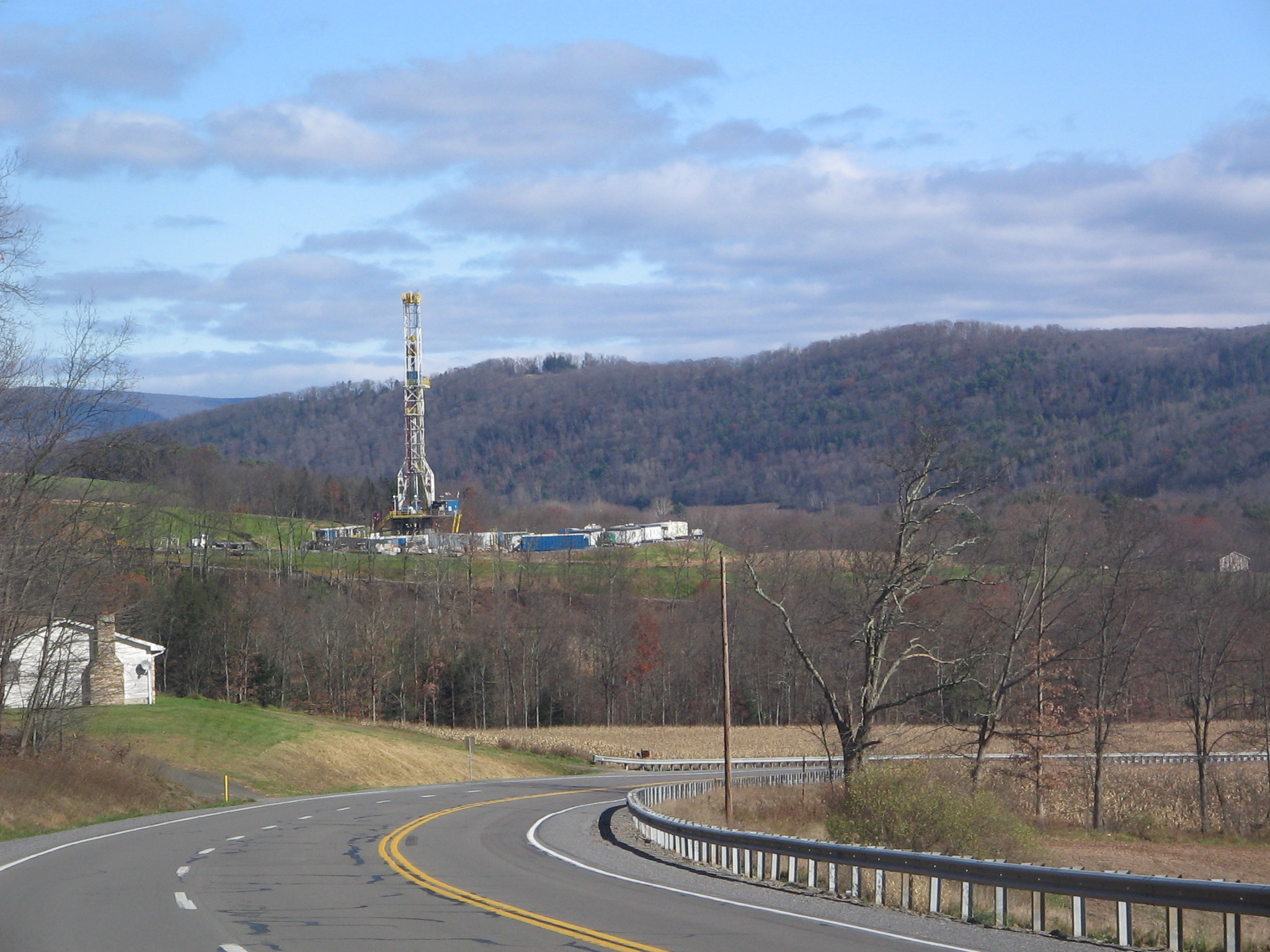
A tower drilling horizontally into the Marcellus Shale formation for natural gas, Lycoming County, Pennsylvania. The wastewater that comes back up has to go somewhere — usually trucked across the border into Ohio injection wells. In December 2011, one of those wells set off a magnitude-4 earthquake in Youngstown. Today the math behind that 4 is on the board. Image: Ruhrfisch, 2009 —
Wikimedia Commons, CC BY-SA 4.0.
A magnitude-7 earthquake is not "a little stronger" than a magnitude-6 — it is ten times stronger.
Soil that drops from pH 6 to pH 5 isn't “a little more acidic” — it is ten times more acidic.
Why does the same hidden math run both stories?
Standards: HSF-LE.A.4, HSF-IF.B.4. This is the IM optional Lesson 18 redesigned. Math objective is unchanged: students use logarithmic relationships to model acidity (pH) and earthquake magnitude (Richter), then write equations of the form \(y = -\log_{10}(x)\) and \(y = \log_{10}(x) + c\). The redesign keeps both contexts and grounds them in real PA / OH data instead of generic chemistry-textbook examples.
Trauma note. Both topics here are systemic / future-tense (no acute personal harm in the room): permaculture crop choice and induced seismicity from wastewater injection. The drill-rig image and Youngstown earthquake are political-policy stories, not personal-harm stories. No opt-out language needed up front. If a student has family in oil & gas work, treat their experience as expert testimony, not as a target.
Prep Checklist
☐ Calculators (or phones) for slides 6, 9, 11, 13. Students will need \(\log_{10}\) once.
☐ Open the Data + Intervention Packet (top of file) before class — it contains the source citations and the intervention menu used on slide 12.
☐ This lesson is marked optional in the IM scope & sequence. Skip slides 8 (Activity 2 launch) and shorten slide 11 if pacing is tight; the Lesson Synthesis (slide 12) carries the agency move regardless.
Warm-Up5 min
Do Now
No calculator. Order these five expressions from least to greatest. Be ready to explain how you decided.
\(\log_{2}(8)\)
\(\log_{3}(1)\)
\(\log_{5}(0.2)\)
\(\log_{10}(11)\)
\(\log_{4}\!\left(\tfrac{1}{16}\right)\)
Complete on your own. Then confirm your answers with a partner.
List the five expressions in order, smallest to largest.
Pick the one that took the most thought. Explain in writing how you found its value.
5 min total for warm-up (slides 2–3). Students should work ~3 min, then pair-share. Surface students who rewrite decimals or fractions as powers of the base — that is the move that unlocks the third and fifth expressions. Listen for: \(0.2 = 5^{-1}\), so \(\log_{5}(0.2) = -1\); \(\tfrac{1}{16} = 4^{-2}\), so \(\log_{4}(\tfrac{1}{16}) = -2\); \(\log_{10}(11)\) is a sliver above 1; \(\log_{3}(1) = 0\); \(\log_{2}(8) = 3\). Order: \(-2,\;-1,\;0,\;\approx 1.04,\;3\).
Warm-Up · Synthesisincluded
Scrambled Logs — Discussion
The trick across the board: rewrite the input as a power of the base. Then the exponent is the answer.
“What is the smallest? Why?”\(\log_{4}\!\left(\tfrac{1}{16}\right) = -2\). Reasoning: \(\tfrac{1}{16} = 4^{-2}\). The exponent is the answer.
“What is \(\log_{5}(0.2)\)?”\(0.2 = \tfrac{1}{5} = 5^{-1}\), so \(\log_{5}(0.2) = -1\). Rewriting decimals as powers of the base is the unlock.
“Where does \(\log_{10}(11)\) sit?”Just above 1. We know \(\log_{10}(10) = 1\), and 11 is barely larger than 10, so the answer is barely larger than 1. (Calculator: \(\approx 1.04\).)
“Final order — smallest to largest?”\(\log_{4}\!\left(\tfrac{1}{16}\right)\;<\;\log_{5}(0.2)\;<\;\log_{3}(1)\;<\;\log_{10}(11)\;<\;\log_{2}(8)\). That is \(-2 < -1 < 0 < 1.04 < 3\).
click to advance discussion ▶
Try Saying
\(\log_{b}(x) = ?\) because \(b^{?} = x\).
The skill being warmed up: convert between exponent form and log form quickly, including for inputs less than 1. Both halves of today's lesson (pH and Richter) need this fluency — soil with hydrogen-ion concentration \(10^{-5}\) gives pH 5 only if students see \(-\log_{10}(10^{-5}) = -(-5) = 5\) instantly.
Activity 1 · Launch3 min
What can you grow on this acre?
A farmer in Lancaster County tests her soil. The lab reports a hydrogen ion concentration of \(10^{-5}\) moles per liter. She is deciding what to plant. Different crops want different pH.
Chestnut (Dunstan hybrid)
pH 5.5 – 6.5
Slightly acidic; tolerates 4.5
Blueberry
pH 4.5 – 5.5
Wants more acid
Field corn
pH 6.0 – 7.0
Pretty flexible
Alfalfa (hay)
pH 6.5 – 7.5
Wants near-neutral
pH ranges: Penn State Extension & chestnut grower guides. The pH scale goes 0–14; 7 is neutral; lower is more acidic.
The lab gave a hydrogen ion concentration, not a pH. What pH is that, and which crops fit?
Launch (~3 min). Read the context aloud. Confirm: smaller pH = more acidic, larger pH = less acidic. Do not yet introduce the formula \(\text{pH} = -\log_{10}[\text{H}^{+}]\) — let students notice the pattern in the table on the next slide. Pull up the crop cards so the agency stake is visible: which crop you can grow depends on the math you do in the next 12 minutes.
Most students will guess the pH is "5 something." That is right — concentration \(10^{-5}\) gives pH = 5 exactly. Park the crop question; the class will revisit it on slide 6.
Reference · How ToActivity 1 · Work Time12 min
Reference · How To — pH from concentration
Step
What to do
Example
1
Write the H+ concentration as a power of 10.
Lab reports \(10^{-5}\) mol/L. Already a power of 10. \(\checkmark\)
2
Read off the exponent. That number is − pH.
Exponent is −5, so −pH = −5.
3
Multiply by −1 to get pH.
pH = −(−5) = 5.
★
If the concentration is not a clean power of 10 (like \(2.5 \times 10^{-11}\)), use \(\text{pH} = -\log_{10}([\text{H}^{+}])\) on a calculator.
Of pure water, coffee, root beer, and orange juice — which is most acidic? Least acidic? How do you know?
Let \(c\) be the H+ concentration and \(p\) be the pH. Write an equation linking \(c\) and \(p\). Then rewrite it.
12 min · Activity 1 Work Time. Leave this slide on screen. Walk during work. The How To handles the clean-power-of-10 cases (rows 1–3 of the table); the ★ row handles vinegar at pH 2.4 and the orange-juice / seawater conversions.
Targets. Coffee pH = 5 (matches the Lancaster farmer's soil from slide 4). Root beer pH = 4. Orange juice [H+] = \(10^{-3}\). Seawater [H+] = \(10^{-8}\). Vinegar pH = 2.4. Most acidic of the four: orange juice (pH 3, smallest). Least acidic: pure water (pH 7).
Equation forms. Either \(p = -\log_{10}(c)\) or \(c = 10^{-p}\). Both should appear — it is the same relationship.
Watch for: students writing \(p = \log_{10}(c)\) (missing the negative sign). Catch by checking against a known row: does \(\log_{10}(10^{-7}) = -7\) match pH = 7? No. Negative is doing real work.
Amplify · 4 inputs
Order: Text → Math Response (named answer1a, answer1b, answer1c, answer1d) → Note (CL in </>). One Math Response per missing cell.
Format example: Example: 5
Problem 1a: Coffee — pH given [H+] = 10^(-5).
content:
  when answer1a.submitted and answer1a.numericValue > 4.995 and answer1a.numericValue < 5.005
    "Correct! [H+] = 10^(-5), so pH = -(-5) = 5. Coffee is moderately acidic."
  when answer1a.submitted and answer1a.numericValue > -5.005 and answer1a.numericValue < -4.995
    "Almost — you found the exponent (-5), but pH is the negative of the exponent. So pH = -(-5) = 5."
  when answer1a.submitted and answer1a.numericValue > 6.995 and answer1a.numericValue < 7.005
    "Hmm — pH = 7 is the value for pure water (10^(-7)), not coffee (10^(-5)). The exponent for coffee is -5, so pH = 5."
  when answer1a.submitted and not isBlank(answer1a.latex)
    "Almost — write 10^(-5) and read the exponent. pH is -1 times that exponent."
  otherwise ""
Problem 1b: Orange juice — [H+] given pH = 3.
content:
  when answer1b.submitted and answer1b.latex = "10^{-3}"
    "Correct! pH = 3 means -log[H+] = 3, so [H+] = 10^(-3) mol/L."
  when answer1b.submitted and answer1b.latex = "10^-3"
    "Correct!"
  when answer1b.submitted and answer1b.numericValue > 0.000999 and answer1b.numericValue < 0.001001
    "Correct! 0.001 = 10^(-3) mol/L."
  when answer1b.submitted and answer1b.latex = "10^{3}"
    "Almost — that is 1,000 mol/L, way too much. The pH formula has a NEGATIVE log: pH 3 means [H+] = 10^(-3), not 10^3."
  when answer1b.submitted and answer1b.numericValue > 2.999 and answer1b.numericValue < 3.001
    "Hmm — 3 is the pH itself, not the concentration. The concentration is 10^(-pH) = 10^(-3) mol/L."
  when answer1b.submitted and not isBlank(answer1b.latex)
    "Take another look — [H+] = 10^(-pH). What is 10^(-3)?"
  otherwise ""
Problem 1c: Seawater — [H+] given pH = 8.
content:
  when answer1c.submitted and answer1c.latex = "10^{-8}"
    "Correct! [H+] = 10^(-8) mol/L. Seawater is slightly basic — less acidic than pure water."
  when answer1c.submitted and answer1c.latex = "10^-8"
    "Correct!"
  when answer1c.submitted and answer1c.numericValue > 0.0000000099 and answer1c.numericValue < 0.0000000101
    "Correct! 0.00000001 = 10^(-8) mol/L."
  when answer1c.submitted and answer1c.latex = "10^{8}"
    "Not quite — 10^8 is enormous. The exponent should be NEGATIVE: pH 8 means [H+] = 10^(-8)."
  when answer1c.submitted and not isBlank(answer1c.latex)
    "Take another look — [H+] = 10^(-pH) and pH is 8. Write the answer as a power of 10."
  otherwise ""
Problem 1d: Vinegar — pH given [H+] = 10^(-2.4).
content:
  when answer1d.submitted and answer1d.numericValue > 2.395 and answer1d.numericValue < 2.405
    "Correct! [H+] = 10^(-2.4), so pH = -(-2.4) = 2.4. Vinegar is more acidic than orange juice."
  when answer1d.submitted and answer1d.numericValue > -2.405 and answer1d.numericValue < -2.395
    "Almost — that is the exponent. pH is the negative of the exponent: pH = -(-2.4) = 2.4."
  when answer1d.submitted and answer1d.numericValue > 23.99 and answer1d.numericValue < 24.01
    "Hmm — 24 is 10 times the exponent. The pH is just -1 times the exponent: -(-2.4) = 2.4."
  when answer1d.submitted and not isBlank(answer1d.latex)
    "Almost — read the exponent of 10. pH is -1 times that exponent."
  otherwise ""
Activity 1 · Synthesis5 min
A drop in pH means…
Back to the Lancaster farmer. Her soil reads \(10^{-5}\) mol/L H+. We just confirmed that means pH 5. Now build the rate intuition the rest of the lesson rides on.
“Coffee has pH 5. Pure water has pH 7. How many times more H+ ions are in a sip of coffee?”100 times. \(\dfrac{10^{-5}}{10^{-7}} = 10^{2} = 100\). One step down on the pH scale = 10× the H+. Two steps = 100×.
“The farmer's soil is pH 5. Chestnut wants 5.5–6.5. Alfalfa wants 6.5–7.5. What can she plant today?”Chestnut, just barely — her pH is at the bottom of the chestnut tolerance band. Alfalfa is out: her soil has roughly 30× too many H+ ions for that crop. (\(10^{-5}\) vs. \(10^{-6.5} \approx 3.16 \times 10^{-7}\): ratio \(\approx 31.6\).)
“What equation links pH and H+?”\(\text{pH} = -\log_{10}([\text{H}^{+}])\), or equivalently \([\text{H}^{+}] = 10^{-\text{pH}}\). Same relationship, two readings: one starts from concentration and gets pH out; the other starts from pH and gets concentration out.
“What raises the pH of an acidic field?”Spreading agricultural lime (calcium carbonate). Lime neutralizes H+ ions, which lowers their concentration, which (because of the negative log) raises the pH. Penn State's rule of thumb: 1.5–3 tons/acre to lift pH by 1 unit on typical PA mineral soil.
click to advance discussion ▶
Try Saying
A pH change of 1 means H+ changed by a factor of ___ because ___.
Try Saying
The farmer can/can't plant ___ on this soil because ___.
The conceptual peak is question 1: pH is a log scale, so a difference of 1 pH unit is a factor of 10 in H+ concentration. Students who treat pH as linear will say "coffee has just a little more acid than water." Push back with the ratio.
Question 4 plants the agency seed used in slide 12 — lime is a real intervention with a measurable rate. Save the cost question for the synthesis ($40–$50/ton in PA, so ~$60–$150 to raise this acre 1 pH unit, or $0 if she qualifies for USDA EQIP cost-share — see packet).
Math As A Second Language
pH from hydrogen ion concentration
Math · We Say · Meaning
★ Math (given)
\(\text{pH} = -\log_{10}([\text{H}^{+}])\)
▲ We Say
“p H equals negative log base ten of the hydrogen ion concentration”or“p H is the exponent of ten in the concentration, with its sign flipped”
● Meaning
The pH of a liquid is what you get when you write its H+ concentration as a power of 10 and read off the exponent — then flip the sign. A drop of 1 in pH means the H+ concentration multiplied by 10.
Standalone MASL slide. The "We Say" reading is more important than usual here: students will encounter \(\log_{10}\) on calculators today. Saying "log base ten of x" out loud while keying in log(x) is the language ↔ symbol bridge. Negative-sign confusion is the main pitfall: highlight that the sign flip is what makes pH a positive number despite the concentration being a negative power of 10.
Activity 2 · Launch3 min
Measuring earthquakes by drum displacement
A seismograph 100 km from an earthquake's epicenter records how far the needle moves. Bigger quake → bigger displacement. The Richter scale is a way to compress that range so a magnitude 1 and a magnitude 9 fit on the same number line.
Displacement \(d\) (m, at 100 km)
Richter \(M\)
What it feels like
\(10^{-6}\) m \((1\,\mu\text{m})\)
1
Detectable only by instruments.
\(10^{-5}\) m \((10\,\mu\text{m})\)
2
Microquake. Same range as the 2016 Hilcorp PA fracking events.
USGS Earthquake Hazards. The "100 m" cell is what a classical Richter seismograph would have recorded; modern instruments use other measures, but the same logarithmic relationship holds.
Launch (~3 min). Read the table aloud. Two real PA / OH data points to flag now — you will return to them on slide 11:
2016 Lawrence County, PA: Hilcorp Energy fracked a Utica Shale well; 5 quakes M 1.8–2.3. First confirmed PA fracking-induced quakes.
2011 Youngstown, OH: 109 quakes near the Northstar 1 wastewater injection well. Strongest M 4.0. Wastewater was trucked from PA Marcellus operations.
Students will likely already see the pattern: each Richter step = 10× the displacement. Hold off on the equation; let them build it on the next slide.
Reference · How ToActivity 2 · Work Time12 min
Reference · How To — Richter from displacement
Step
What to do
Example
1
Write the displacement \(d\) as a power of 10 (in meters).
Compare a magnitude-5 quake and a magnitude-6 quake. By what factor do their displacements differ? What about a magnitude-2 and a magnitude-3?
Using \(d\) for displacement (m) and \(M\) for Richter rating, write an equation linking them. Then rewrite it.
The 2004 Indonesia earthquake produced an effective seismograph displacement of 125 m at 100 km. Estimate its Richter rating.
The Youngstown 2011 induced quake had displacement 0.001 m. Confirm \(M = 4\). The next-strongest event in the same sequence had 0.000316 m (\(\approx 10^{-3.5}\)). What is its magnitude?
Try Writing
The displacement equation is ___, which means each step on the Richter scale is ___ times the previous.
12 min · Activity 2 Work Time. Students should attempt all four problems. Give 2-min think-alone, then 5-min partner discussion, then 5-min independent work.
Targets.
Q1: M5 displacement is 10× M4; M3 is 10× M2; in general one Richter step = 10× displacement.
Watch for: students writing \(M = \log_{10}(d - 7)\) or \(\log_{10}(d/7)\) instead of \(\log_{10}(d) + 7\). Order of operations matters — the 7 is added after the log.
Amplify · 3 inputs
Order: Text → Math Response (named answer2a, answer2b, answer2c) → Note (CL in </>).
Format example: Example: 9.1
Problem 2: Equation linking d and M.
content:
  when answer2a.submitted and answer2a.latex = "M=\log_{10}(d)+7"
    "Correct! M = log10(d) + 7. Equivalently, d = 10^(M-7)."
  when answer2a.submitted and answer2a.latex = "\log_{10}(d)+7"
    "Correct!"
  when answer2a.submitted and answer2a.latex = "M=\log(d)+7"
    "Correct! (log defaults to base 10 here.)"
  when answer2a.submitted and answer2a.latex = "d=10^{M-7}"
    "Correct! That is the inverted form. Both equations describe the same relationship."
  when answer2a.submitted and answer2a.latex = "M=\log_{10}(d-7)"
    "Almost — the 7 is added AFTER taking the log. M = log(d) + 7, not log(d − 7)."
  when answer2a.submitted and answer2a.latex = "M=\log_{10}(d)-7"
    "Hmm — sign flipped. Try a known row: d = 10^(-6) gives M = 1, so log(10^(-6)) + 7 = -6 + 7 = 1. The 7 is ADDED."
  when answer2a.submitted and not isBlank(answer2a.latex)
    "Take another look — for d = 10^(-6), M = 1. What operation on -6 gives 1?"
  otherwise ""
Problem 3: Indonesia 2004, d = 125 m. Find M.
content:
  when answer2b.submitted and answer2b.numericValue > 9.05 and answer2b.numericValue < 9.15
    "Correct! M = log(125) + 7 ≈ 2.097 + 7 ≈ 9.1. One of the largest earthquakes ever recorded."
  when answer2b.submitted and answer2b.numericValue > 2.09 and answer2b.numericValue < 2.11
    "Almost — that is log(125) ≈ 2.1. Don't forget to add 7: M = log(125) + 7 ≈ 9.1."
  when answer2b.submitted and answer2b.numericValue > 124.9 and answer2b.numericValue < 125.1
    "Hmm — 125 is the displacement, not the magnitude. Use M = log(d) + 7 with d = 125."
  when answer2b.submitted and answer2b.numericValue > 7.99 and answer2b.numericValue < 8.01
    "You're close — 8 would mean log(125) ≈ 1, which it isn't (log(10) = 1, log(100) = 2). Recompute log(125) on your calculator."
  when answer2b.submitted and not isBlank(answer2b.latex)
    "Take another look — M = log(125) + 7. Use a calculator for log(125), then add 7."
  otherwise ""
Problem 4 (second part): d = 10^(-3.5). Find M.
content:
  when answer2c.submitted and answer2c.numericValue > 3.495 and answer2c.numericValue < 3.505
    "Correct! M = log(10^(-3.5)) + 7 = -3.5 + 7 = 3.5. Smaller than the M = 4 main event."
  when answer2c.submitted and answer2c.numericValue > 3.995 and answer2c.numericValue < 4.005
    "Almost — M = 4 is the Youngstown main event (d = 10^(-3)). For d = 10^(-3.5), the exponent is -3.5, so M = -3.5 + 7 = 3.5."
  when answer2c.submitted and answer2c.numericValue > -3.505 and answer2c.numericValue < -3.495
    "You found log(d) = -3.5 — good. Don't forget to add 7: M = -3.5 + 7 = 3.5."
  when answer2c.submitted and answer2c.numericValue > 10.495 and answer2c.numericValue < 10.505
    "Hmm — sign flipped. log(10^(-3.5)) is -3.5, not 3.5. So M = -3.5 + 7 = 3.5."
  when answer2c.submitted and not isBlank(answer2c.latex)
    "Take another look — log(10^(-3.5)) = -3.5. Then add 7."
  otherwise ""
Math As A Second Language
Richter rating from seismograph displacement
Math · We Say · Meaning
★ Math (given)
\(M = \log_{10}(d) + 7\)
▲ We Say
“capital M equals log base ten of d, plus seven”or“the magnitude is the exponent of ten in the displacement, plus seven”
● Meaning
For a seismograph 100 km from the epicenter, the Richter magnitude is the base-10 logarithm of the displacement (in meters), shifted up by 7 so that microquakes (\(10^{-6}\) m) read as M 1. Each whole step on M = ten times the displacement.
Notice the structural parallel with slide 7: pH and Richter are both \(\log_{10}\) of a quantity, with a constant tacked on (sign flip for pH; +7 for Richter). This is why both make a 1-unit change correspond to a 10× change in the underlying quantity. The IM Lesson 18 student summary makes this explicit at the end — preview it here if time allows.
Activity 2 · Synthesis5 min
Why Youngstown matters
Until 2011, Youngstown, OH had recorded zero earthquakes since 1776 — literally none on file. Then a wastewater injection well opened in December 2010, and 13 days later the ground started moving.
“The Northstar 1 well took fluid trucked in from PA Marcellus fracking sites. Over a year, 109 earthquakes were recorded. The biggest was M 4.0 on Dec 31, 2011. How much did the ground move at 100 km from the epicenter?”\(d = 10^{M - 7} = 10^{4 - 7} = 10^{-3}\) m, or 1 mm. Small — until you notice that a M 4 is felt indoors and is enough to crack drywall and chimneys. The ground actually moved much more near the epicenter; the Richter formula uses 100 km as the reference distance.
“Compare M 4 to a M 2 fracking microquake. How many times bigger is the displacement?”100×. \(\dfrac{10^{4-7}}{10^{2-7}} = \dfrac{10^{-3}}{10^{-5}} = 10^{2} = 100\). Two Richter steps means a hundredfold jump in shaking.
“The activity stopped about a month after injection stopped. What does that tell us about the cause?”The earthquakes track the injection — they start with it, slow when injection slows for holidays, and stop after the well closes. That timing is the smoking gun: pressurized wastewater triggered slip on an ancient fault. Researchers (Kim, JGR 2013) confirmed it as induced seismicity, not natural.
“Pennsylvania has only 9 deep injection wells. Most fracking wastewater gets trucked to Ohio. So whose problem is this?”It is a Pennsylvania output and an Ohio input. The math doesn't care where the state line is — the injection volume and the fault both do their job regardless. Policy levers exist on both sides: PA permits the wastewater, OH permits the well.
click to advance discussion ▶
Try Saying
A jump from M ___ to M ___ matters because ___.
Trauma-aware framing. Some students may have family in oil & gas work or live near a well pad. The frame is policy variance, not blame. The Youngstown well operator broke no laws when injection began — the law had not yet caught up. Ohio's response (the "stoplight rule" — halt injection if M ≥ 2 occurs within 5 km of the well) is the policy fix that came after, and the data show it cut the induced-quake rate by ~80% (Schultz et al., 2020).
Source. Kim, W.-Y. (2013), "Induced seismicity associated with fluid injection into a deep well in Youngstown, Ohio," J. Geophys. Res. Solid Earth, 118.
Lesson Synthesis~7 min
Two log scales, two rate questions
Both halves of today's lesson share the same hidden math: a log scale converts a 10× change in the world into a 1-unit change on the page. That hides nothing — it just makes the rate visible. Now use the rate to push.
Soil pH — the Lancaster farmer
Her field is pH 5. To plant alfalfa (target pH 6.5) she needs to raise pH by 1.5 — meaning cut H+ by a factor of \(10^{1.5} \approx 31.6\).
At Penn State's rule of thumb (~2 tons lime per acre per pH unit) and PA delivered prices ($40–$50/ton), that's ~$120–$150 per acre — or $0 if she gets approved for USDA EQIP cost-share.
Induced seismicity — PA wastewater → OH wells
Ohio's stoplight rule (halt injection at M ≥ 2 within 5 km) cut induced-quake rates near OH disposal wells by ~80% after 2014 (Schultz et al., 2020).
PA Act 13 + DEP traffic-light protocol now requires the same on-site monitoring at high-volume PA pads — that rule is what shut down Hilcorp's 2016 Lawrence Co. operation after 5 microquakes.
Pop-corn round. One sentence each. Pick either story. Name an intervention from the packet, then say what rate it would change.
Try Saying
For ___, I would push for ___, because that should change the rate from ___ to ___.
I Can… (SWBAT)
Convert between H+ concentration and pH using \(\text{pH} = -\log_{10}([\text{H}^{+}])\).
Convert between seismograph displacement and Richter magnitude using \(M = \log_{10}(d) + 7\).
Explain why a 1-unit change on either log scale corresponds to a 10× change in the underlying quantity.
Name a real intervention that would change the rate of a problem (lime cost-share; wastewater injection monitoring) and defend the rate change it would produce.
Agency move (~5 min popcorn). The frame on the board is: name an intervention from the packet; say what rate it would shift. Below are sample student moves — the goal is not consensus, it is fluency at the move.
Sample moves — pH side:
"County conservation district subsidizes soil tests → the rate of fields tested rises from once-a-decade to once every 3 years → lime is targeted 15–25% better → less waste, more growable acres."
"USDA EQIP CP-590 cost-share covers 50–75% of liming → a $150/acre job becomes $40–$75 → smaller farms can afford to amend → more diverse plantings (chestnut, alfalfa, not just commodity corn)."
Sample moves — quake side:
"PA Act 13 + DEP traffic-light protocol → auto-halt at M 2 in 5 km → based on the OH 2014 data, induced-quake rates drop ~80%."
"PA opens its own deep injection wells with pre-permit seismic surveys → cuts the truck-to-OH practice; lets PA regulators (not OH) own the risk and the rule."
Closing rate question on the board for tomorrow: “PA produces ~2 million barrels/year of fracking wastewater that currently leaves the state. What's the lowest rate of in-state seismic monitoring + permit review that would let PA stop exporting that risk to OH?”
Cool-Down5 min
Apple Juice and a Cleaning Solution
The expression \(-\log_{10}(c)\) gives the pH of a substance with H+ concentration \(c\) (mol/L). Pure water has \(c = 10^{-7}\) and pH 7.
On your own — show your reasoning
Apple juice has pH 4. Select all true statements about apple juice:
It has 1,000 times the H+ concentration of water.
It has 3 times the H+ concentration of water.
It has \(\tfrac{1}{1000}\) the H+ concentration of water.
It has so much H+ that it can dissolve a Toyota Camry overnight. (Don't pick this. Apple juice can't dissolve a car.)
It has an H+ concentration of \(10^{-4}\) mol/L.
A cleaning solution has \(\tfrac{1}{100{,}000}\) the H+ concentration of water. What is its pH?
Cool-Down · 5 min. No partner discussion. Submit independently.
Problem 1: Correct selections: A (apple juice [H+] = 10-4, water = 10-7; ratio = 103 = 1000) and E (10-4 mol/L). B is the linear-thinking trap. C is the inverse direction. D is a joke distractor — if anyone selects it, that's a quick "you read the choices" win without it tipping the actual answer.
Problem 2: Cleaning solution [H+] = (1/100,000) × 10-7 = 10-5 × 10-7 = 10-12 mol/L. So pH = 12.
Watch for: students who write 10-7/100,000 and forget to add the negative exponents. Have them write 1/100,000 = 10-5 first, then multiply.
Amplify · 2 inputs
Order: Problem 1: Multiple-Select component (A through E) named answer3a. Problem 2: Text → Math Response (named answer3b) → Note (CL in </>).
Format example for Problem 2: Example: 12
Problem 1: Apple juice has pH 4. Select all true statements. (Multiple Select; correct: A and E.)
content:
  when answer3a.submitted and answer3a.selected = "A,E"
    "Correct! Apple juice has [H+] = 10^(-4), 1000 times water's 10^(-7) — and that concentration is 10^(-4) mol/L."
  when answer3a.submitted and answer3a.selected = "E,A"
    "Correct!"
  when answer3a.submitted and answer3a.selected = "A"
    "You got the ratio (1000×) right, but check E: is 10^(-4) mol/L the actual concentration?"
  when answer3a.submitted and answer3a.selected = "E"
    "Right concentration, but check A: how does 10^(-4) compare to water's 10^(-7)? That's 10^3 = 1000 times."
  when answer3a.submitted and answer3a.selected = "B"
    "Almost — pH is a LOG scale, not linear. A pH difference of 3 means a factor of 10^3 = 1000, not 3."
  when answer3a.submitted and answer3a.selected = "C"
    "Direction flipped — apple juice has MORE H+ than water (lower pH = more acid). The ratio is 1000, not 1/1000."
  when answer3a.submitted and answer3a.selected = "D"
    "Funny choice. Apple juice will not dissolve a Camry. Re-read the others."
  when answer3a.submitted
    "Take another look — pH 4 is 3 units below pH 7. Each unit is a factor of 10."
  otherwise ""
Problem 2: Cleaning solution has 1/100,000 the H+ concentration of water. Find its pH.
content:
  when answer3b.submitted and answer3b.numericValue > 11.995 and answer3b.numericValue < 12.005
    "Correct! [H+] = 10^(-5) × 10^(-7) = 10^(-12) mol/L. So pH = -(-12) = 12. That's a strong cleaner — about as basic as ammonia."
  when answer3b.submitted and answer3b.numericValue > 4.995 and answer3b.numericValue < 5.005
    "Almost — 5 is the exponent on 1/100,000 alone. But the cleaning solution is 1/100,000 OF water's concentration, so multiply: 10^(-5) × 10^(-7) = 10^(-12), and pH = 12."
  when answer3b.submitted and answer3b.numericValue > 6.995 and answer3b.numericValue < 7.005
    "Hmm — 7 is the pH of water, not of the cleaning solution. The cleaner has 1/100,000 the concentration, so its pH is HIGHER (less acidic) than 7."
  when answer3b.submitted and answer3b.numericValue > 1.999 and answer3b.numericValue < 2.001
    "Sign flipped — 1/100,000 = 10^(-5), so [H+] dropped by 10^5, which RAISES pH by 5 (from 7 to 12). pH 2 would mean MORE H+, not less."
  when answer3b.submitted and answer3b.numericValue > 99999 and answer3b.numericValue < 100001
    "That is the dilution factor itself, not the pH. Convert 1/100,000 to a power of 10 first (= 10^(-5)), then add to the exponent for water."
  when answer3b.submitted and isBlank(answer3b.latex)
    "Enter the pH of the cleaning solution as a number. Example: 12"
  when answer3b.submitted
    "Take another look — water is 10^(-7); the cleaner is 10^(-5) times less, so its [H+] is 10^(-12). What is -log(10^(-12))?"
  otherwise ""
Lesson Summary
A log scale makes a 10× change look like a 1-unit change
Acidity and earthquake strength both span enormous ranges — from \(10^{-14}\) to 1 mol/L for H+, and from \(10^{-7}\) m to dozens of meters for seismograph displacement. Putting a base-10 logarithm in front of each compresses those ranges so a single number line works.
pH
\(\text{pH} = -\log_{10}([\text{H}^{+}])\) ⇔ \([\text{H}^{+}] = 10^{-\text{pH}}\)
Drop pH by 1 → H+ goes up by ×10.
Richter
\(M = \log_{10}(d) + 7\) ⇔ \(d = 10^{M-7}\)
Up M by 1 → displacement goes up by ×10.
Why it matters
These aren't “just” chemistry/geology scales. They are choices: which crops we can plant, which wells we permit, which faults we wake up.
Lesson Summary
Logarithms compress multiplicative change into additive distance. Whenever the underlying quantity moves by a factor of 10, the log of it moves by 1. That is why pH and Richter look "scale-friendly" — and also why a 1-unit difference is bigger than it sounds.
Lesson Summary slide. Read aloud or have a student read. Tomorrow's lesson can pick up either thread — if the agency move from slide 12 had energy, run a 10-minute pre-class poll: which intervention would they push for? The packet has the data to back any of the four sample moves.