Point Breeze (19146) home values up 404% over 2000–2018 — second-highest in the nation; income only rose 51% in same period. Source: PhillyVoice citing NCRC gentrification study.
Interventions With Measured Effect Sizes
1. Mandatory Inclusionary Zoning (Philadelphia, signed Jan 2022)
Requires any new residential building of 20+ units to set aside 20% as affordable.
Effect: Bigger than the failed 2018 voluntary program — that one produced fewer than 24 affordable units citywide because developers paid into the trust fund instead of building. Mandatory programs in Montgomery County, MD (40+ years) and Cambridge, MA produce 5–15% of new units as below-market.
Source: Philadelphia City Council.
2. PHLHousing+ direct cash rental assistance pilot (300 households, 2022–2026)
Median monthly cash payment: $1,000. Effect: 75% reduction in forced moves after two years vs. control; 22% reduction in serious housing-quality concerns; comparable in many outcomes to traditional Section 8 vouchers.
Source: National Low Income Housing Coalition / Penn Housing Initiative.
3. Rent stabilization (NJ-style, 2–4% annual cap)
Effect: Diamond, McQuade & Qian (2019, AER) found San Francisco's rent control suppressed in-unit rents but reduced rental supply by 15% (landlords sold or redeveloped). Net: protects existing tenants, raises rents on new units.
Source: American Economic Review.
4. Wage growth via minimum-wage indexing
Pennsylvania state minimum wage has been $7.25 since 2009 (no increase in 17 years). If income had grown at 4%/year (matching rent), the rent burden ratio would shrink, not grow. Effect on the model: doubling the income growth rate from ~1.25% to ~4% per year flips the rent-burden trajectory entirely.
Source: U.S. Dept. of Labor.
All sources accessed May 2026. The math in the deck uses calibrated round numbers anchored on the actual figures so students can guess-and-check without floating-point gore.
Unknown Exponents: When Rent Crosses 30%
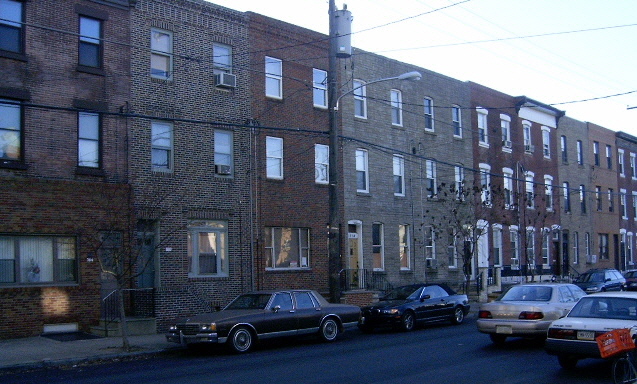
South Philadelphia rowhouses
— the housing stock that makes up most of Philly's rental market. About 52% of Philadelphia households rent (Pew, 2025); the median monthly rent rose from about $870 in 2010 to $1,500 in 2024. Photograph by Wikipedia user Moncrief, December 2004. Released to the public domain.
Rent in Philly grows at one rate.
Income grows at another.
The line where rent eats 30% of income
is what HUD calls "cost-burdened."
When did Philly cross it —
and what would it take to push it back?
Standards: HSF-LE.A.4 (introduce), HSA-CED.A.2, HSA-SSE.B.3.c. This lesson opens Unit 5 Section B's pivot from fitting exponential models to solving them for an unknown exponent. We use guess-and-check today; logs come in lessons 9-10.
The wrench: The IM lesson uses bacteria and tessellated trapezoids. We swap context — Philadelphia rent vs. income — but keep the math identical: solve \(a \cdot b^t = c\) for \(t\), first by integer guess-and-check, then by squeezing fractional intervals. The agency move at the end asks: what rate change would push the 30% crossing past 2050?
Prep Checklist
☐ Scientific calculators (or phones): one per pair
☐ Open the Data + Intervention Packet (top-right, teacher mode) before class
☐ Optional opt-out: "If your family has been priced out of a Philly neighborhood and today's content is heavy, you can sit out the discussion in Activity 2 — just do the math."
Big Question
If we know how fast rent and income are growing, can we figure out the year when rent first ate 30% of the typical Philly paycheck?
We know how to find the rent in any year. Today we flip the question: given the rent, find the year.
Read the Big Question aloud. Don't resolve it. The lesson will land on the answer (~2024). The phrasing intentionally inverts the input/output relationship students have practiced through Unit 5 so far: instead of "plug in t, get the rent," they will "plug in the target rent or ratio, find t." That inversion is the whole math objective. SWBAT lives at the end of the lesson, not here.
Warm-Up5 min
Do Now
Complete on your own. Then confirm your answers with a partner.
Solve for x: \(\;5x = 80\)
Solve for x: \(\;x^2 = 49\)
Solve for x: \(\;\sqrt{x} = 6\)
Solve for x: \(\;2^x = 32\)
Solve for x: \(\;10^x = 1{,}000{,}000\)
Solve for x: \(\;3^x = 50\)— estimate to the nearest whole number
5 min total for warm-up. Students work alone (~3 min), then pair-share. Most will breeze through 1-3. Problem 4 is comfortable for most (\(2^5 = 32\), so \(x = 5\)). Problem 5 is the bridge: \(10^6 = 1{,}000{,}000\), so \(x = 6\) — students realize "I just count zeros."
Problem 6 is the hook: \(3^3 = 27\), \(3^4 = 81\), so \(x\) is between 3 and 4. It is not a whole number. Press: "Can you pin it down further? Closer to 3 or to 4?" (Answer: closer to 4, since 50 is closer to 81 than to 27.) Don't reveal — Activity 1 launches from this confusion. The point: some unknown exponents are integers; others aren't. Both are findable.
Warm-Up · Synthesis3 min
"Undoing" the operation that hides the unknown
Each problem has the same shape: an operation is applied to x, and we have to undo it. The operation is different each time.
“Problems 1–3: what operation isolated x?”Divide by 5 (P1). Square root (P2). Square both sides (P3). For each one, we know an inverse operation that peels the x out cleanly.
“Problem 4: \(2^x = 32\). What operation are we undoing?”We are undoing exponentiation — specifically, "2 raised to a power." We could solve it because we recognized 32 as \(2^5\). So \(x = 5\). When we recognize the right power, we can solve it exactly.
“Problem 6: \(3^x = 50\). Can we recognize 50 as a power of 3?”No. \(3^3 = 27\); \(3^4 = 81\). 50 is in between, so x is between 3 and 4 — but it isn't a whole number. We need a way to estimate it. That's today's lesson.
click to advance discussion ▶
Try Saying
To find a missing exponent, I would ___ because ___.
The synthesis spotlights the kind of equation we'll work with today. The big move: in P4 students recognized a power; in P6 they couldn't. Both are valid problem types, and today they'll meet both.
Tell students: "For the rest of the unit we're going to learn how to find exponents even when we can't recognize the power. Today we start with estimation."
Activity 1 · Launch3 min
Philly Median Rent — Every 5 Years Since 2010
The median monthly rent in Philadelphia grew from about $800 in 2010 with a steady factor of 1.25 every 5 years — that is, every 5 years rent multiplied by \(\tfrac{5}{4}\). (Real ACS values rounded for clean math; same shape as the actual data.)
$800
2010 (\(t = 0\))
×1.25
$1,000
2015 (\(t = 1\))
×1.25
$1,250
2020 (\(t = 2\))
×1.25
?
2025 (\(t = 3\))
Each box is the rent. Each step is 5 years. What pattern do you see — and what would the box for 2025 say?
Launch (3 min). Display the visual. Use the question above to elicit:
• "Each step is the previous one times 1.25."
• "2025 should be \(1{,}250 \times 1.25 = \$1{,}562\)" (or, equivalently, \(800 \cdot 1.25^3\)).
The factor 1.25 is real-data adjacent: Philly rents grew about 4%/year nominal between 2010 and 2024, which is exactly \(1.04^5 \approx 1.22\) per 5 years. We're using 1.25 for clean integer guess-and-check.
Trauma-aware note: Some students will react fast — "my landlord just raised our rent." If a student volunteers a personal story, hold space briefly, then steer back to the math: "That's exactly the kind of question this lesson lets us answer numerically. Hold that for the agency move at the end."
Reference · How ToActivity 1 · Work Time10 min
Reference · How To — Find an integer exponent by guess-and-check
Step
What to do
Example: when is rent first ≥ $1,500?
1
Write the equation. Let t = the unknown step number.
\(800 \cdot 1.25^{t} = 1{,}500\)
2
Try low integer values for t. Multiply step-by-step.
\(t=1\): \(800 \cdot 1.25 = \$1{,}000\) — too low. \(t=2\): \(\$1{,}000 \cdot 1.25 = \$1{,}250\) — too low.
3
Keep going until you cross the target.
\(t=3\): \(\$1{,}250 \cdot 1.25 = \$1{,}562\) — ✓ first value over $1,500.
★
"First reaches" with discrete steps means: the answer is the smallest integert for which \(a \cdot b^{t} \geq c\).
Answer: \(t = 3\), which means year 2025 (3 five-year steps after 2010).
Activity 1 · Work Time
Problems
Write an equation for \(R(t)\), the median monthly rent t five-year steps after 2010.
Use \(R(t)\) to find the rent in 2030 (\(t = 4\)).
In what year does the rent first reach $2,000/month? Show your guess-and-check.
Explain to a partner: how would you find when rent first reaches $5,000/month? What's an efficient strategy when the target is far away?
10 min · Activity 1 Work Time. Leave this slide on screen during work time.
Problem 1: Target: \(R(t) = 800 \cdot 1.25^{t}\). Problem 2: \(R(4) = 800 \cdot 1.25^4 = \$1{,}953\) (year 2030). Problem 3: Trial: \(t=4 \Rightarrow \$1{,}953\); \(t=5 \Rightarrow \$2{,}441\). First t with rent \(\ge \$2{,}000\) is \(t = 5\), year 2035. Problem 4: Discussion. Strategies: (a) keep multiplying by 1.25 — slow; (b) make a table — moderate; (c) jump ahead in larger powers (e.g., compute \(1.25^{10}\) first to bracket); (d) graph it. Watch for: students who divide $5,000 by 1.25 once and get $4,000 — they think the inverse is "divide once." Press: "Then how many times do you divide?"
Watch for
Students who answer P3 with "$2,000 happens at \(t = 4.something\)" — affirm and ask, "is the question asking for a year, or for the first whole step?" The answer depends on the wording. Real-rent answer: \(800 \cdot 1.25^t = 2000\) gives \(t \approx 4.1\) — between 2030 and 2031. Discrete answer: \(t = 5\) (year 2035). Both interpretations are useful; today we want the discrete one. Activity 2 will ask the continuous version.
Amplify · 3 inputs
Order per problem: Text → Math Response (named answer1, answer2, answer3) → Note (CL in </>). Problem 4 is Text Response only (named answer4).
Format examples: Example: 800(1.25)^t · Example: 1953 · Example: 5
Problem 1: Equation for R(t).
content:
  when answer1.submitted and answer1.latex = "800(1.25)^{t}"
    "Correct! R(t) = 800 · 1.25^t — initial rent $800 at t = 0, factor 1.25 per 5-year step."
  when answer1.submitted and answer1.latex = "800\cdot(1.25)^{t}"
    "Correct!"
  when answer1.submitted and answer1.latex = "800\cdot1.25^{t}"
    "Correct!"
  when answer1.submitted and answer1.latex = "800(1.25)^t"
    "Correct!"
  when answer1.submitted and answer1.latex = "800 \cdot 1.25^{t}"
    "Correct!"
  when answer1.submitted and not isBlank(answer1.latex)
    "Good start — what's the rent at t = 0? (That's the initial value.) And what factor multiplies the rent per step? Combine them as a · b^t."
  otherwise ""
Problem 2: Find R(4).
content:
  when answer2.submitted and answer2.numericValue > 1950 and answer2.numericValue < 1955
    "Correct! 800 · 1.25^4 ≈ $1,953 in 2030."
  when answer2.submitted and answer2.numericValue > 1561 and answer2.numericValue < 1564
    "That's R(3) — year 2025. The question asks for t = 4 (year 2030). Multiply by 1.25 one more time."
  when answer2.submitted and answer2.numericValue > 2440 and answer2.numericValue < 2444
    "That's R(5) — one step too many. Multiply 800 by 1.25 four times, not five."
  when answer2.submitted and answer2.numericValue > 999 and answer2.numericValue < 1001
    "That's R(1) — year 2015. We want R(4). Keep multiplying by 1.25."
  when answer2.submitted and not isBlank(answer2.latex)
    "Almost — substitute t = 4 into your equation: 800 · 1.25^4. What do you get?"
  otherwise ""
Problem 3: Year rent first reaches $2,000.
content:
  when answer3.submitted and answer3.numericValue = 2035
    "Correct! At t = 5 (year 2035), R = $2,441 — first step over $2,000."
  when answer3.submitted and answer3.numericValue = 5
    "Correct! t = 5, which is the year 2035 (5 five-year steps after 2010)."
  when answer3.submitted and answer3.numericValue = 2030
    "Almost — in 2030 (t = 4) the rent is $1,953, still under $2,000. Try one more step."
  when answer3.submitted and answer3.numericValue = 4
    "Almost — at t = 4 the rent is $1,953, still under $2,000. The question asks for the first time it reaches $2,000."
  when answer3.submitted and answer3.numericValue = 2025
    "Hmm... in 2025 (t = 3) the rent is only $1,562. Keep multiplying by 1.25."
  when answer3.submitted and answer3.numericValue = 3
    "Hmm... at t = 3 the rent is only $1,562. Keep going."
  when answer3.submitted and not isBlank(answer3.latex)
    "Trial-and-check: keep multiplying by 1.25 until you cross $2,000. Which step is that?"
  otherwise ""
Problem 4: Strategy for $5,000 target — Text Response.
content:
  when answer4.submitted and not isBlank(answer4.content)
    "Thank you — share your strategy in the discussion."
  when answer4.submitted and isBlank(answer4.content)
    "Please write a short explanation before submitting."
  otherwise ""
Activity 1 · Synthesis5 min
Strategies for an Unknown Exponent
Different students used different strategies for "in what year does rent first reach $2,000?" Each one is solving the same equation: \(800 \cdot 1.25^{t} = 2{,}000\).
“Strategy 1: Multiply step by step until you cross.”$800 → $1,000 → $1,250 → $1,562 → $1,953 → $2,441. The fifth step ($t = 5$, year 2035) is the first to clear $2,000. Slow but bulletproof.
“Strategy 2: Use the equation directly.”Try \(t = 5\): \(800 \cdot 1.25^{5} = \$2{,}441\) (over). Try \(t = 4\): \(800 \cdot 1.25^{4} = \$1{,}953\) (under). So the first integer step that crosses is \(t = 5\). Faster — jump to a guess instead of climbing.
“Strategy 3: Skip ahead. \(1.25^{10}\) is a known landmark.”If we know \(1.25^{10} \approx 9.3\), then \(800 \cdot 1.25^{10} \approx \$7{,}450\) — way over. Then we know the answer is between $t = 5$ and $t = 10$. Halve and check: \(t = 7\) gives ~$3,800. Bracket and squeeze. Fastest for big targets.
“Big idea: what's the same about all three?”All three are guess-and-check. They differ in where they guess and how big the jumps are. None of them solve the equation algebraically — that's coming in a few lessons (logarithms). Today, the move is: "I don't know the exact t, but I can pin it down."
click to advance discussion ▶
Try Saying
Strategy ___ is faster when ___ because ___.
Sequence: name the slow-and-sure strategy first, then the smarter ones. Press: "What if the target was $50,000? Which strategy still works?" (Strategy 3 — bracket-and-squeeze.) The synthesis sets up Activity 2: when the target isn't a clean integer power, we bracket between integers, then start squeezing inside that interval with fractional exponents.
Note: If a student writes \(t \approx 4.1\) using a calculator's exponent function, validate: "Yes — between integer steps. Activity 2 is exactly that."
MASL · Vocabulary
Solving for an unknown exponent
Math
\(\;a \cdot b^{t} = c\;\) solve for \(t\)
We Say
"When does a times b to the t equal c?"
Meaning
An equation where a, b, and c are known but the exponent t is unknown. We're asking how many growth steps it takes to go from a to c.
If \(c\) is a clean power of \(b\) (like \(2^x = 32\)), we can read \(t\) off directly.
If \(c\) isn't (like \(800 \cdot 1.25^{t} = 1{,}600\)), we estimate by guess-and-check — bracket, then squeeze.
MASL slide. The Math card shows the general form. The Meaning card emphasizes the inverse-question framing: "how many growth steps?"
Hold this slide for ~2 minutes. Then transition to Activity 2, where the target $c$ is decidedly not a clean power.
Activity 2 · Launch5 min
Two Exponentials, One Question
Real Philly data, anchored on U.S. Census ACS estimates and Pew "State of the City" 2025. From 2010 to 2024:
Median rent rose from about $870/mo to about $1,500/mo — roughly 4%/year.
Median income rose from about $51,000 to about $60,500 — roughly 1.25%/year.
Annual Rent (let \(t\) = years since 2010)
\(R(t) = 10{,}440 \cdot (1.04)^{t}\)
($870/mo × 12 = $10,440 per year)
Annual Income
\(I(t) = 51{,}000 \cdot (1.0125)^{t}\)
Rent burden
\(\;\dfrac{R(t)}{I(t)}\;\) — fraction of income paid in rent
HUD calls a household cost-burdened when this ratio ≥ 0.30.
Launch (5 min). Walk through the data carefully. Two curves, two rates. Both grow exponentially; rent grows faster than income. Their ratio — \(R(t)/I(t)\) — is itself an exponential function with rate factor \(\frac{1.04}{1.0125} \approx 1.027\).
Show the graph. The dashed amber line is "30% of income." When the blue rent curve crosses the amber line, the typical Philly renter has hit cost-burden. Visually: it crosses near 2024.
Today's question: can we pin that crossing year down using only guess-and-check? No logs. No solver. Just the algebra we have.
Real-world anchor (from packet): Pew 2025 reports that 48.5% of Philadelphia renters spent ≥30% of income on rent in 2024. Our model predicts that the typical renter — exactly at the median — hit that threshold around 2024. The two facts agree. That's the model working.
Reference · How ToActivity 2 · Work Time12 min
Reference · How To — Bracket then squeeze a fractional exponent
Step
What to do
Example: solve \(\;1.027^{t} = 1.466\)
1
Find two integer values that bracket the answer.
\(1.027^{10} \approx 1.305\) (under). \(1.027^{15} \approx 1.494\) (over). So \(t\) is between 10 and 15.
2
Try a value halfway. Re-bracket.
\(1.027^{14} \approx 1.455\) (just under). \(t\) is between 14 and 15.
"Approximate" means: good enough for the question. Year-level decisions don't need 6 decimal places.
14.3 years after 2010 = mid-2024. (Logarithms in the next lesson give an exact answer.)
Activity 2 · Work Time
Problems — work in pairs
Show that the rent burden ratio simplifies to: \(\;\dfrac{R(t)}{I(t)} \;=\; 0.205 \cdot (1.027)^{t}.\) (Hint: divide the two equations from the launch.)
To find when rent burden first hits 30%, set the ratio equal to 0.30. What equation in t do you need to solve?
Use guess-and-check (or the How To) to find t to one decimal place. What year is this?
How does your answer compare to what Pew reported about 2024 (\(\sim\)48.5% of renters cost-burdened)?
Try Saying
I think the answer is between ___ and ___ because ___.
12 min · Activity 2 Work Time. Provide calculators. Pairs work. Roam.
Problem 1: Target reasoning: \(\frac{R(t)}{I(t)} = \frac{10440}{51000} \cdot \frac{1.04^{t}}{1.0125^{t}} = 0.2047 \cdot \left(\frac{1.04}{1.0125}\right)^{t} \approx 0.205 \cdot (1.027)^{t}\). Many students will try to substitute years one at a time — that works but is slow. Press the algebraic move: "Why is the ratio of two exponentials still exponential?"
Problem 2: Set \(0.205 \cdot 1.027^{t} = 0.30 \Rightarrow 1.027^{t} = \frac{0.30}{0.205} = 1.466\). This is the equation in the How To example.
Problem 3: \(t \approx 14.3\), so mid-2024.
Problem 4: Discussion. The model says the typical renter hit cost-burden in 2024. Pew reports 48.5% of actual renters were cost-burdened in 2024. The numbers agree because the median is, by definition, the 50th percentile — almost exactly where the burden fraction crosses 30% city-wide. The model isn't theoretical. It matches.
Watch for
Common error: dividing 0.30 by 0.205 incorrectly (getting 1.46 vs 1.46 vs 1.466 — the small differences matter at the third decimal). Encourage students to keep one extra decimal in intermediate steps.
Amplify · 4 inputs
Order: Text → Math Response (answer1, answer2, answer3) + Text Response (answer4) → Note (CL).
Problem 1: Show ratio simplifies to 0.205(1.027)^t.
content:
  when answer1.submitted and answer1.latex = "0.205(1.027)^{t}"
    "Correct! R/I = (10440/51000) · (1.04/1.0125)^t ≈ 0.205 · (1.027)^t. The ratio of two exponentials is exponential."
  when answer1.submitted and answer1.latex = "0.205\cdot(1.027)^{t}"
    "Correct!"
  when answer1.submitted and answer1.latex = "0.205\cdot1.027^{t}"
    "Correct!"
  when answer1.submitted and answer1.latex = "0.205(1.027)^t"
    "Correct!"
  when answer1.submitted and not isBlank(answer1.latex)
    "Almost — divide R(t) by I(t). The constants give 10440/51000 ≈ 0.205. The bases combine: 1.04^t / 1.0125^t = (1.04/1.0125)^t ≈ 1.027^t. Combine them."
  otherwise ""
Problem 2: Equation to solve for the 30% crossing.
content:
  when answer2.submitted and answer2.numericValue > 1.465 and answer2.numericValue < 1.467
    "Correct! 1.027^t = 1.466 — that's the equation to solve."
  when answer2.submitted and answer2.numericValue > 1.463 and answer2.numericValue < 1.469
    "Correct! 1.027^t = 1.466 (you may have rounded slightly differently)."
  when answer2.submitted and answer2.numericValue > 0.295 and answer2.numericValue < 0.305
    "That's the target ratio (0.30). The next step is to isolate the exponential: divide both sides by 0.205. What do you get?"
  when answer2.submitted and answer2.numericValue > 1.27 and answer2.numericValue < 1.28
    "Hmm — if you got something like 1.27 or 1.028, you may have mixed up the calculation. Set 0.205 · 1.027^t = 0.30 and divide both sides by 0.205."
  when answer2.submitted and not isBlank(answer2.latex)
    "Set 0.205 · 1.027^t = 0.30. Divide both sides by 0.205. What does the right side become?"
  otherwise ""
Problem 3: Approximate t to one decimal.
content:
  when answer3.submitted and answer3.numericValue > 14.25 and answer3.numericValue < 14.35
    "Correct! t ≈ 14.3, so mid-2024."
  when answer3.submitted and answer3.numericValue > 14.15 and answer3.numericValue < 14.45
    "Close — the more precise answer is around 14.3. Either way, it's mid-2024."
  when answer3.submitted and answer3.numericValue > 13.9 and answer3.numericValue < 14.2
    "Almost — try t = 14.3 next. Is 1.027^14.3 closer to 1.466 than 1.027^14 was?"
  when answer3.submitted and answer3.numericValue > 14.5 and answer3.numericValue < 15.1
    "A little high — try t = 14.3. Is 1.027^14.3 close to 1.466?"
  when answer3.submitted and answer3.numericValue > 2023.5 and answer3.numericValue < 2024.5
    "Yes — 2024 is the right year. (For the value of t, that's about 14.3 years after 2010.)"
  when answer3.submitted and not isBlank(answer3.latex)
    "Bracket between t = 14 (gives 1.455) and t = 15 (gives 1.494). Then squeeze to one decimal."
  otherwise ""
Problem 4: Compare with Pew 2025 (Text Response).
content:
  when answer4.submitted and not isBlank(answer4.content)
    "Thanks — bring this to the synthesis discussion."
  when answer4.submitted and isBlank(answer4.content)
    "Please write a short observation before submitting."
  otherwise ""
Activity 2 · Synthesis5 min
Two exponentials → their ratio is also exponential
Now that we know the model matches reality (Pew's 48.5% in 2024 ↔ our 14.3-year crossing), we can use it to ask different questions. Each one is the same kind of problem: a known equation, an unknown exponent, find t.
“When does the burden ratio reach 50% (severely cost-burdened)?”Set \(0.205 \cdot 1.027^{t} = 0.50 \;\Rightarrow\; 1.027^{t} = 2.439\). Bracket: \(1.027^{30} \approx 2.232\) (under), \(1.027^{35} \approx 2.552\) (over). Squeeze: \(t \approx 33.4\). That's year 2043 — within most of your lifetimes.
“What if rent kept growing at 4%/yr but income jumped to 4%/yr too?”Then \(\frac{R(t)}{I(t)} = 0.205 \cdot \left(\frac{1.04}{1.04}\right)^{t} = 0.205\). The ratio never grows. The 30% line is never crossed. Same starting burden forever.
“What rent rate (with income still at 1.25%) would push the 30% crossing past 2050 (40 years from 2010)?”We need: \(\dfrac{r_{rent}}{1.0125} \le \left(1.466\right)^{1/40} \approx 1.0096\). So \(r_{rent} \le 1.0096 \cdot 1.0125 \approx 1.022\) — 2.2% per year or less. Less than half the current rent growth rate.
“Big idea: the rate constants are not physics — they're policy.”Bacteria triple every hour because biology. Rent grows at 4%/year because of zoning, taxes, supply, and contracts. Income grows at 1.25%/year because PA's minimum wage hasn't moved since 2009. The math says the rates are the lever. Today we figured out where the lines cross. Tomorrow's question: which inputs would move the rates?
click to advance discussion ▶
Try Saying
The crossing happens earlier/later when ___, because ___.
Click through one at a time. The pivot from "what year does it cross?" to "what rate would change the answer?" is the core wrench move of this lesson.
Question 4 is non-negotiable: state explicitly that PA minimum wage has been $7.25 since 2009. Inflation since 2009 is roughly +50%. Income has stagnated as a result for low-end workers (the median includes everyone, hence the 1.25%/year nominal). This is not anyone's natural law — it's what the legislature chose. The exponent we just solved is downstream of that choice.
Surface the algebraic structure: changing \(b\) (the rate factor) changes how steeply the curve climbs. Changing \(a\) (the starting value) shifts the whole curve up/down. Today's interventions act on \(b\).
Agency Move7 min
If you got to set the rate — what would you push for?
The math just told us: at current rates, severely cost-burdened (50%) hits Philly's median renter around 2043. Picking a real intervention means picking a new rate. Each card below has a measured effect — these are not made up.
1. Mandatory inclusionary zoning
Philly's 2022 law: 20% set-aside in new buildings of 20+ units. Effects ripple slowly — supply takes years to shift.
Real-rate slowdown: ~0.3 to 0.8 pp/yr
Source: Phila. City Council, 2022 ordinance; comparison cities (Cambridge, MA; Montgomery County, MD).
2. Rent stabilization (NJ-style 2% cap)
Hard cap on annual rent increases for rent-stabilized units. Strong short-term protection, but Diamond et al. (2019) found 15% supply reduction in SF — landlords sold or redeveloped.
Capped rate: 2%/yr (under the line)
Source: Diamond, McQuade, Qian, AER 2019.
3. Direct cash assistance (PHLHousing+)
$1,000/mo median to 300 households. 75% reduction in forced moves. Doesn't change market rents — protects specific people from this trajectory.
Recipient burden: capped under 30%
Source: NLIHC + Penn Housing Initiative, 2025.
4. Voucher waitlist expansion
2023 PHA waitlist: 37,000 applied for 10,000 slots; only 2,000 placed immediately. Expanding HCV slots is a federal funding question; states/cities can supplement.
Recipient burden: capped at 30%
Source: WHYY / Philadelphia Housing Authority, 2023.
5. State minimum wage increase
PA min wage: $7.25 since 2009. If raised + indexed, low-end income growth could lift to 4–5%/yr. Flips the rate ratio.
New income rate: ~4%/yr
Source: U.S. Dept. of Labor wage history.
6. Land bank / community land trust expansion
WCRP and Phila. Land Bank acquire vacant parcels and develop permanently affordable housing. Slow but durable supply addition.
Real-rate slowdown: ~0.2 to 0.5 pp/yr
Source: Reinvestment Fund + Drexel Wagner reports.
Try Saying
I would pick intervention ___ because it changes the rate of ___ by ___, which would push the 30% crossing year to ___.
7 min — popcorn discussion. Not a project. Quick, sharp, defended. Read the cards out loud or have students skim. Then go around: each student picks one and defends it using the sentence frame.
Watch for the trade-offs:
Rent control protects existing tenants but reduces supply (Diamond et al). Some students will love this; press them on the supply effect.
Cash assistance and vouchers help specific people but don't change market rents — they shift who pays.
Min wage and inclusionary zoning change rates — slower acting, broader.
There's no single right answer. The point is: students choose, defend, and connect their choice to a rate change in the model. That's the agency move.
Trauma-aware: If a student says "my family was priced out of [neighborhood]," validate, then redirect: "That's exactly the rate we just modeled. Which intervention would have changed it for your family?" Keep math as the language; keep the choice with the student.
Lesson Synthesis3 min
Every problem today had the same shape: a known starting value, a known growth factor, a target value — and an unknown exponent. Sometimes we recognized the power exactly; usually we estimated by bracketing.
“What kind of equation did we solve today?”\(a \cdot b^{t} = c\), where \(t\) is unknown. The question is always: "how many growth steps does it take to go from \(a\) to \(c\)?"
“When could we solve it exactly?”When \(c/a\) is a clean integer power of \(b\) — like \(2^x = 32\), so \(x = 5\). Otherwise we estimate: bracket between integers, then squeeze to a decimal.
“What did the rent vs. income problem add?”Two exponentials in ratio are still one exponential — the bases combine: \(\frac{1.04^{t}}{1.0125^{t}} = 1.027^{t}\). So a "two-curve crossing" question is the same kind of unknown-exponent equation we already knew how to solve.
“Why does any of this matter outside the math classroom?”Because the rate constants aren't physics. PA hasn't raised the minimum wage in 17 years. Philly's 2022 inclusionary zoning ordinance set a different rate than its 2018 voluntary version. The crossing year you found (~2024 for 30%, ~2043 for 50%) is a direct output of those choices. Different choices, different exponent.
click to advance discussion ▶
Try Saying
To find an unknown exponent, I can ___ when ___, or ___ when ___.
I Can… (SWBAT)
Solve \(a \cdot b^{t} = c\) for the exponent t — exactly when the answer is a clean power, and approximately by bracket-and-squeeze when it isn't.
Explain how the ratio of two exponentials is itself exponential, and use that to find when one quantity crosses a fixed fraction of another.
Lesson Synthesis (3 min). Cold-call through the four questions. Question 4 is the wrench: students should hear out loud that the rates are political, not biological.
SWBAT closes the lesson — confirms what students just did. Tomorrow's lesson introduces logarithms as the exact tool for this same problem; today's bracket-and-squeeze is the conceptual on-ramp.
Cool-Down5 min
Point Breeze: A Faster Crossing
Some Philly neighborhoods are not "the median." In Point Breeze (19146), rent grew faster than the city average between 2010 and 2024 — by about 5.5%/year instead of 4%. Suppose income there grew at the same 1.25%/year as the city. Starting in 2010, monthly rent was about $850/mo and median income about $50,000/year.
Problems — answer briefly
Write the rent-burden ratio \(\dfrac{R_{PB}(t)}{I_{PB}(t)}\) as a single exponential function of t. (Combine the bases.)
Use guess-and-check to estimate the year when Point Breeze rent first hit 30% of income. Show your bracket and your decimal squeeze.
5 min · Cool-Down. Students work alone.
Problem 1: \(\dfrac{R_{PB}(t)}{I_{PB}(t)} = \dfrac{12 \cdot 850}{50000} \cdot \left(\dfrac{1.055}{1.0125}\right)^{t} = 0.204 \cdot (1.042)^{t}\). The combined base is ~1.042 (or 1.0420; accept anything ≥ 1.041 ≤ 1.043).
Problem 2: Set \(0.204 \cdot 1.042^{t} = 0.30 \Rightarrow 1.042^{t} \approx 1.471\). Bracket: \(1.042^{9} \approx 1.448\) (under), \(1.042^{10} \approx 1.510\) (over). Squeeze: \(1.042^{9.4} \approx 1.473\). \(t \approx 9.4\), so mid-2019.
Real-data check: Point Breeze (zip 19146) is consistently flagged in Pew/NCRC reports as one of Philly's most rapidly gentrifying neighborhoods, with home values up 404% from 2000–2018. The model's "early 2019 crossing" matches the qualitative report — Point Breeze hit cost-burden well before the city as a whole did.
Common errors: students who write \(1.055^{t}/1.0125^{t}\) but forget to combine into \(1.042^{t}\). Either form is correct mathematically, but combined is much easier to bracket.
Trauma-aware
Some students live in 19146 or know families displaced from it. If you sense the topic is heavy, offer this as a written exit ticket only — no whole-class discussion. The math is the point.
Amplify · Cool-Down Setup
Problem 1: Text → Math Response (answer1) → Note. Format example: Example: 0.204(1.042)^t
Problem 2: Text → Math Response (answer2 = year, numeric) → Note. Format example: Example: 2019
Problem 1: Combined ratio expression.
content:
  when answer1.submitted and answer1.latex = "0.204(1.042)^{t}"
    "Correct! R_PB/I_PB = (10200/50000) · (1.055/1.0125)^t ≈ 0.204 · (1.042)^t."
  when answer1.submitted and answer1.latex = "0.204\cdot(1.042)^{t}"
    "Correct!"
  when answer1.submitted and answer1.latex = "0.204(1.042)^t"
    "Correct!"
  when answer1.submitted and answer1.latex = "0.204\cdot1.042^{t}"
    "Correct!"
  when answer1.submitted and answer1.latex = "0.2(1.042)^{t}"
    "Close! 10200/50000 = 0.204 — keep the third decimal for accuracy. Otherwise correct."
  when answer1.submitted and not isBlank(answer1.latex)
    "Almost — annual rent is 12 · 850 = 10,200, so the constant is 10200/50000 = 0.204. The base is 1.055/1.0125 ≈ 1.042. Combine into 0.204 · (1.042)^t."
  otherwise ""
Problem 2: Year of 30% crossing in Point Breeze.
content:
  when answer2.submitted and answer2.numericValue > 2018.5 and answer2.numericValue < 2019.5
    "Correct! t ≈ 9.4, so mid-2019. Point Breeze hit the 30% line about 5 years before the city median did."
  when answer2.submitted and answer2.numericValue = 2019
    "Correct! t ≈ 9.4 years after 2010 = mid-2019."
  when answer2.submitted and answer2.numericValue > 9.3 and answer2.numericValue < 9.5
    "Correct! t ≈ 9.4, which is mid-2019."
  when answer2.submitted and answer2.numericValue = 9
    "Almost — at t = 9, the ratio is ~0.295 (just under 30%). Try t = 9.4."
  when answer2.submitted and answer2.numericValue = 10
    "Close — at t = 10, ratio is ~0.308 (just over). Squeeze: try t = 9.4. What year is that?"
  when answer2.submitted and answer2.numericValue > 2023.5 and answer2.numericValue < 2024.5
    "That's the city-wide answer (median rent of $1,500). Point Breeze grew faster (5.5%/yr vs 4%/yr), so it crossed 30% earlier. Try smaller t."
  when answer2.submitted and not isBlank(answer2.latex)
    "Bracket: 1.042^9 ≈ 1.45 (under 1.471), 1.042^10 ≈ 1.51 (over). Squeeze to one decimal. What year is that?"
  otherwise ""
Lesson Summary
Solving \(a \cdot b^{t} = c\) for an unknown t
Sometimes we know the value of an exponential expression but not the exponent. Today we learned two ways to handle this:
A crossing question becomes a single unknown-exponent question.
Lesson Summary
To find an unknown exponent in \(a \cdot b^{t} = c\): recognize the power if you can; bracket and squeeze if you can't. The answer might not be a whole number — that's expected, not a failure. Tomorrow: logarithms make this exact.
Read aloud or have a student read. The yellow box generalizes the rent-vs-income trick: it works for any two exponentials being compared. Solar adoption vs. fossil-fuel use, EV sales vs. gas car sales, vape rates vs. tobacco rates — same algebra.
Tomorrow: logarithms enter as the inverse operation that makes today's "bracket-and-squeeze" exact in one step.