Data + Intervention Packet — Teacher Reference (click to expand)
Headline numbers
S&P 500 CEO-to-median-worker pay ratio (2024): 285:1 — AFL-CIO Executive Paywatch 2025 (released July 2025; reports 2024 fiscal year). Average S&P 500 CEO compensation: $18.9M (+7% YoY).
EPI realized CEO-to-typical-worker ratio (2024): 281:1 — EPI 2025 update. Realized CEO pay ≈ $23M; pay grew 1,094% since 1978 vs 26% for typical workers.
Walmart (FY ending Jan 31, 2024): CEO Doug McMillon total compensation $27.4M; median worker $29,469. Ratio 930:1. (AFL-CIO; Benzinga)
Starbucks (FY 2024): CEO Brian Niccol $97.8M; median worker $14,674. Ratio 6,666:1 — highest in the S&P 500. (AFL-CIO)
BLS Employment Cost Index — wages and salaries, private industry, 12-month change: Sept 2024 = +3.9%. March 2025 = +3.4%. March 2026 = +3.4%. (BLS ECI)
Compounding math (used by students)
Catch-up rate: solve \(S \cdot b^{50} = C\) → \(b = (C/S)^{1/50}\). For Walmart: \(b = 930^{1/50} \approx 1.1465\), or about 14.6% / year, every year, for 50 years. For Starbucks: ~19.3% / year.
Years at 3% raise to catch up to Walmart CEO pay: \(t = \log_{1.03}(930) \approx 231\) years. The typical worker at the actual ECI rate never catches up in a working lifetime; the gap is multiplicative.
The logarithm is the language of "the unique exponent that closes the gap."
Interventions with measured effect sizes
SEC pay ratio disclosure (Dodd-Frank §953(b), 2018–) — Required public disclosure of CEO:median ratio. Effect: CEO pay growth slowed modestly at firms with the highest disclosed ratios in years immediately after disclosure (Crawford, Nelson & Rountree, 2021). The data this lesson uses exists because of this rule.
Portland, OR Pay Ratio Surtax (2017–) — 10% city business-tax surcharge if CEO:median > 100; 25% if > 250. First-year revenue: ~$3.5M, dedicated to homeless services. (Portland.gov) Effect on pay ratios at affected companies: small / inconclusive after 5 years (NBC News 2020 review). Effect on revenue: clear and stable.
UK binding say-on-pay (2013–) — Shareholders vote on pay, binding every 3 years. Ferri & Maber (2013), data from earlier advisory regime: no change in pay level, but pay-for-failure cases reduced; sensitivity of pay to negative performance increased. Boards reduced excess salary at firms with high dissent votes.
Switzerland 1:12 referendum (Nov 2013) — Proposed cap: highest pay in a company ≤ 12× lowest. Result: rejected 65.3% to 34.7%. Even so, it spurred related Swiss reforms (Minder Initiative, 2013, banning golden parachutes — passed). Useful as a "what if it had passed" extrapolation.
German codetermination (Mitbestimmung, 1976–) — Workers elect ~50% of supervisory board seats at firms with 2,000+ employees. Effect on CEO pay levels: limited (Jäger, Schoefer & Heining, QJE 2021 — no impact on wages or labor share). Effect on pay structure: lower CEO-to-worker spreads; less M&A-driven short-term restructuring. The lever is decision rights, not pay caps.
Profit-sharing contract (e.g., SK Hynix, KR) — Negotiated 10% of annual profits as worker bonuses, no cap. During AI/HBM boom, individual bonuses reached hundreds of thousands of dollars. Effect: directly converts firm-level exponential growth into worker pay rather than CEO equity grants. (Topic-bank reference; see Mr. Bennett's brief.)
SEC Pay Ratio Rule (17 CFR 229.402(u)) — Dodd-Frank §953(b) implementation, 2015 final rule.
What Is a Logarithm?
Algebra 2 · Unit 5 · Lesson 9 | CEO Pay Catch-Up
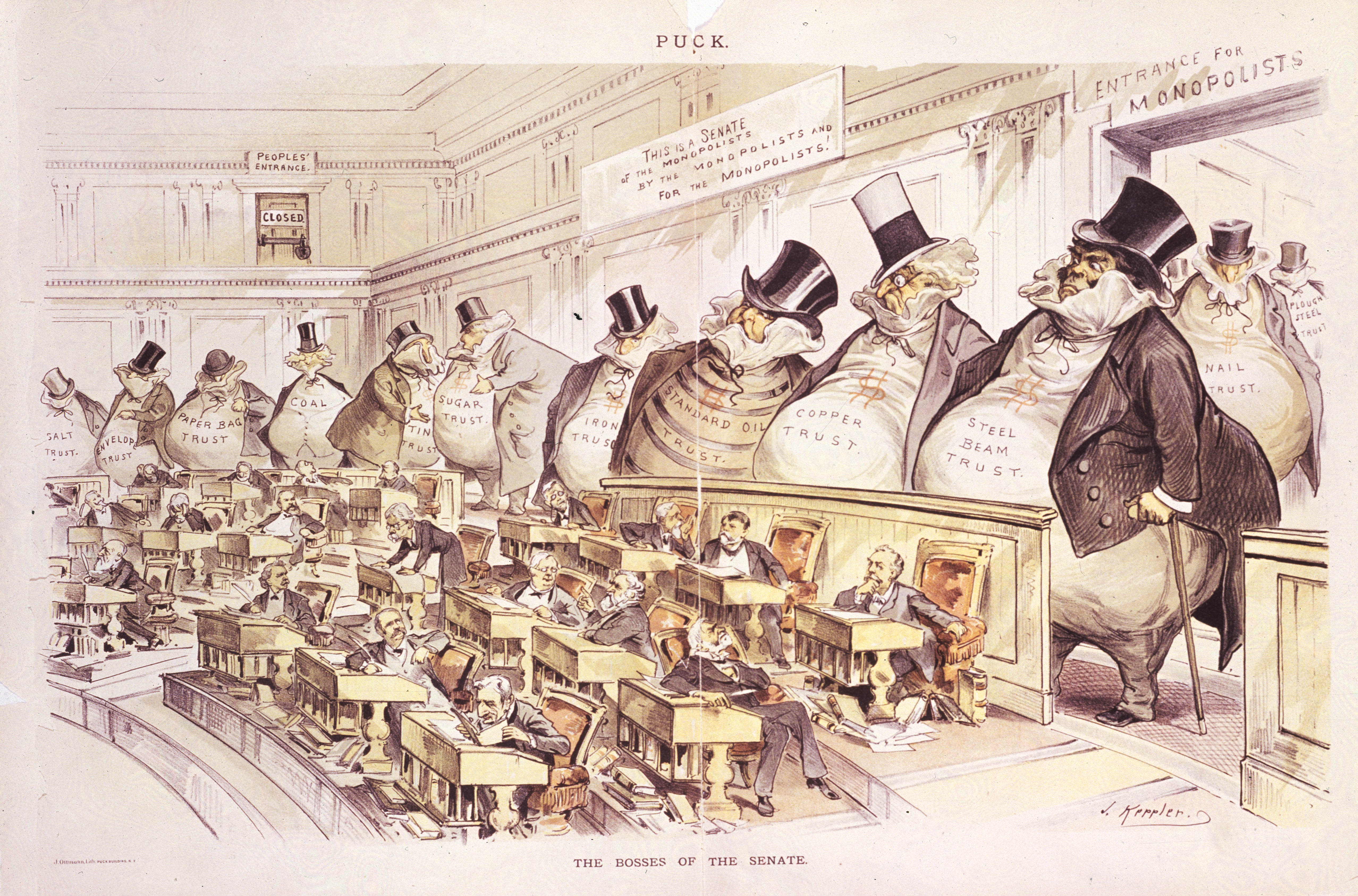
"The Bosses of the Senate"
— Joseph Keppler, Puck magazine, January 23, 1889. The trusts of the Gilded Age — sugar, oil, steel, copper, coal — dwarf the senators they bought.
The wealth gap of the 1880s gave us anti-trust law. The wealth gap today is wider on most measures, and exponentials are how we measure it. Public domain (published before 1931). Source: U.S. Senate · Library of Congress · Wikimedia Commons.
Big Question
A Walmart cashier earns about $29,000. The Walmart CEO earns about $27,000,000.
What annual raise would the cashier need — every year, for 50 years — to match the CEO's pay?
Today we name the math that answers questions like that.
Standards: HSF-LE.A.4 (logarithms), HSF-BF.B.4. This is the lesson where students name the logarithm. They've spent Lessons 5–8 on rate, interval, and compounding. Today they meet the inverse: when you can't read the exponent off the page, the log is what you write down.
Prep Checklist
☐ Open the Data + Intervention Packet (top of HTML; toggle visibility with P) before class.
☐ Calculator-light lesson — IM specifies students do not evaluate logs on calculators today; that comes Lesson 10. Today's logs are read off a base-10 table or back-figured from familiar powers.
☐ Have a base-10 log table accessible (Activity 1). PDF/printable in the packet appendix.
☐ Trauma-aware framing: pay disparity is a class-of-class topic, not a personal-blame topic. If a student names a parent's wage or working condition, redirect to "what does the math say about this rate?" — keep the lever, not the person, at the center.
Warm-Up · Math Talk5 min
Do Now
Find or estimate each value mentally. Then confirm with a partner.
Solve for x: \(2^{x} = 32\)
Solve for x: \(10^{x} = 1{,}000{,}000\)
Solve for x: \(5^{x} = 1\)
Estimate x to the nearest whole number: \(2^{x} = 1000\)
5 min total. Reveal one problem at a time; quiet think first, then share strategies. Possible answers: (1) x = 5 because \(2^{5} = 32\); (2) x = 6 because \(10^{6} = 1{,}000{,}000\); (3) x = 0 because anything to the 0 is 1; (4) x ≈ 10 because \(2^{10} = 1024\), close to 1000.
The fourth one is the wedge for today: students can't get an exact answer by inspection. There's no clean integer. That's where the logarithm enters — to name that exact exponent.
Warm-Up · Synthesis3 min
Easy exponents, hard exponent — what's different?
The first three problems have clean, integer answers. The fourth doesn't. Surface that gap before naming the new tool.
“What did problems 1–3 have in common?”Each right-hand side was a familiar power of the base — 32 = \(2^{5}\), 1,000,000 = \(10^{6}\), 1 = \(5^{0}\). The exponent was an integer we already knew. We could solve by inspection.
“Why is \(2^{x} = 1000\) different?”1000 is not a clean power of 2. \(2^{10} = 1024\) is close, so x is just under 10 — but the exact value isn't an integer or any familiar fraction. We can estimate, but we can't name it without new notation.
“Today's question: how do we write that exponent down exactly?”That's exactly what a logarithm does — gives us a way to write down "the exponent that makes \(2^{x} = 1000\) true," even when no clean number works. We meet the notation in Activity 2.
click to advance discussion ▶
Try Saying
Problem 4 is harder than problems 1–3 because ___.
Don't define "logarithm" yet — that's Activity 2. The point of this synthesis is to make students want the new notation. The gap between "I know it's about 10" and "what is it exactly?" is the gap the log fills.
Activity 1 · Launch3 min
A Table of Catch-Up Factors
A Walmart cashier earns $29,469. The Walmart CEO, Doug McMillon, earns $27,400,000 — about 930× the cashier. Suppose a cashier gets the same percent raise r every year for 50 years. Their pay is multiplied by \(b = 1+r\) each year, so after 50 years it has grown by a factor of \(b^{50}\).
The table below shows \(b^{50}\) for several annual raise rates. Mathematicians and accountants used tables like this for 350 years — before calculators — to find unknown exponents.
Annual raise r
Yearly factor b = 1 + r
After 50 years b50
0%
1.00
1.00
3%
1.03
4.38
5%
1.05
11.47
7%
1.07
29.46
10%
1.10
117.39
12%
1.12
289.00
14%
1.14
700.23
15%
1.15
1083.66
20%
1.20
9100.44
REAL-WORLD ANCHOR
Average actual U.S. raise (BLS Employment Cost Index, 2024): about 3% / year.
TARGET
To match the CEO, the cashier's pay must grow by a factor of 930 in 50 years. Find the row whose \(b^{50}\) hits 930.
Looking at the table — what value of b would give exactly 930? It's not on any row.
Launch (~3 min). Make sure students know what each column means. Walk through the 3% row aloud: “1.03 to the 50th power equals 4.38. So 50 years of 3% raises multiplies your pay by 4.38. The cashier would go from $29k to about $129k — not $27 million.”
Then frame the gap. The target factor is 930. The 14% row gives 700; the 15% row gives 1084. The answer is between. There is no clean row. That is the whole point of today's lesson. Don't resolve the question yet — the table is built to leave them stuck.
If a worker gets a steady 3% raise every year, what factor multiplies their pay over 50 years?
If \(1.10^{x} = 117.39\), what is x?
If \(1.05^{x} = 11.47\), what is x?
The catch-up factor for the Walmart cashier is 930. Use the table to estimate the value of b that satisfies \(b^{50} = 930\). Between which two rows does it fall?
Some rows give whole-number answers (Problem 1). Problem 4 doesn't — the answer falls between rows. Why doesn't the table just include the row we need?
12 min. Leave on screen during work. Students may work alone for ~6 min, then partner-share. Walk and listen for “between 14% and 15%” on Problem 4 — that's the wedge for Activity 2.
Problem 1: 4.38 (read off table). Problem 2:x = 50 (the table column header is “\(b^{50}\)”). Problem 3:x = 50. Problem 4: 14.6% — between 14% (700) and 15% (1084). Push for an estimate; closer to 14% or to 15%? (Closer to 15%, but not exactly.) Problem 5: The exact b isn't a familiar number. The table can't list every b; we'd need infinitely many rows. We need notation for “the value of b that satisfies \(b^{50} = 930\)” — even if no row matches.
Watch for: students who try \(930 / 50 = 18.6\) (linear thinking). Press: “Does 18.6% sit between any two rows?” (No — it's between 14% and 15% by trial.)
Amplify · 4 inputs
Order per problem: Text → Math Response (named answer1, answer2, answer3, answer4_low, answer4_high) → Note. Problem 5 → Text Response only.
content:
  when answer1.submitted and answer1.numericValue > 4.37 and answer1.numericValue < 4.39
    "Correct! 50 years of 3% raises multiplies pay by about 4.38. A $29,000 salary becomes about $129,000."
  when answer1.submitted and answer1.numericValue > 1.49 and answer1.numericValue < 1.51
    "Almost — 1.5 looks like 1 + 0.03 · 50 / 6 (linear). Use the exponential factor 1.03^50, which is on the table."
  when answer1.submitted and answer1.numericValue > 2.49 and answer1.numericValue < 2.51
    "Not quite — 2.5 is roughly 1 + 0.03 · 50 (linear logic). Compounding multiplies, not adds. Read the b^50 column for the 3% row."
  when answer1.submitted and not isBlank(answer1.latex)
    "Almost — read straight off the table. Find the 3% row; what is in the b^50 column?"
  otherwise ""
Problem 2: 1.10^x = 117.39, find x.
content:
  when answer2.submitted and answer2.numericValue > 49.5 and answer2.numericValue < 50.5
    "Correct! x = 50. The b^50 column is exactly that — every entry is the result of raising b to the 50th power."
  when answer2.submitted and not isBlank(answer2.latex)
    "Not quite — 117.39 is in the 1.10 row, b^50 column. So 1.10^? = 117.39. What exponent does the column header use?"
  otherwise ""
Problem 3: 1.05^x = 11.47, find x.
content:
  when answer3.submitted and answer3.numericValue > 49.5 and answer3.numericValue < 50.5
    "Correct! x = 50 again — same column."
  when answer3.submitted and not isBlank(answer3.latex)
    "Almost — same idea as Problem 2. The column header tells you the exponent: every value is b^50."
  otherwise ""
Problem 4 (lower bound): What r% gives b^50 just below 930?
content:
  when answer4_low.submitted and answer4_low.numericValue > 13.5 and answer4_low.numericValue < 14.5
    "Correct! 14% gives 700.23 — just below 930."
  when answer4_low.submitted and answer4_low.numericValue > 14.5 and answer4_low.numericValue < 15.5
    "Almost — 15% gives 1083.66 (just ABOVE 930). The lower bound is one row below: 14%."
  when answer4_low.submitted and not isBlank(answer4_low.latex)
    "Almost — find the largest r whose b^50 entry is still less than 930. Then submit that r."
  otherwise ""
Problem 4 (upper bound): What r% gives b^50 just above 930?
content:
  when answer4_high.submitted and answer4_high.numericValue > 14.5 and answer4_high.numericValue < 15.5
    "Correct! 15% gives 1083.66 — just above 930."
  when answer4_high.submitted and answer4_high.numericValue > 13.5 and answer4_high.numericValue < 14.5
    "Almost — 14% gives 700.23 (BELOW 930). The upper bound is one row up: 15%."
  when answer4_high.submitted and not isBlank(answer4_high.latex)
    "Almost — find the smallest r whose b^50 entry is greater than 930. Then submit that r."
  otherwise ""
Problem 5: Why does the exact answer fall between rows? [Text Response]
content:
  when answer5.submitted and not isBlank(answer5.content)
    "Thank you — share your reasoning during the synthesis discussion."
  when answer5.submitted and isBlank(answer5.content)
    "Please write a short explanation before submitting."
  otherwise ""
Activity 1 · Synthesis5 min
A Table of Catch-Up Factors — Discussion
Surface the structure of the table and the gap it can't close. The exact catch-up rate falls between rows. We need notation for “the unique exponent that closes \(b^{50} = 930\)” — even when it isn't a clean number.
“What does each row of the table actually tell us?”Each row pairs an annual factor b with the result of raising it to the 50th power. The number in the third column is b50. So when we write \(1.10^{x} = 117.39\), the table says x = 50, because that's the column we built.
“The catch-up rate falls between 14% and 15%. Can we narrow it more?”By trial: \(1.146^{50} \approx 925\) (just under), \(1.147^{50} \approx 970\) (just over). The exact value is about 14.65%, but it isn't a familiar number. To pin it down further we'd need infinitely many table rows — an impossible table.
“What we want is a name for that exact b. Or, equivalently, the exact exponent that solves \(b^{50} = 930\).”For 350 years, sailors and astronomers used tables like this to do exactly this kind of work. The notation that names “the exponent that makes the equation true” was invented in 1614 by John Napier and is called a logarithm. We meet it next.
click to advance discussion ▶
Try Saying
The exact catch-up rate falls between ___ and ___ because ___.
Try Saying
What I want notation for is ___.
The big move is from “the table tells us \(b^{50}\)” to “we want notation that asks for the exponent.” If a student says “I'd just type it into a calculator,” agree — and ask: “What button do you press? What's the function called?” That's log. They'll meet it formally in Activity 2.
MASL · Naming the Logarithm
Three ways to say the same thing
Logarithm — general form
Math
\(\log_{b}(x) = y \;\;\iff\;\; b^{y} = x\)
We Say
"log base b of x equals y" means "b to the y equals x"
Meaning
The logarithm is the exponent you must put on the base b to produce the value x. Two equations — same relationship, just rearranged.
Concrete example — the catch-up
Math
\(\log_{1.03}(4.38) = 50\)
We Say
"log base 1.03 of 4.38 equals 50"
Meaning
50 is the exponent that turns 1.03 into 4.38. So 50 years of 3% raises multiplies your pay by 4.38.
Pronunciation note
When the base is 10, we may drop the subscript: \(\log_{10}(x)\) is often written simply \(\log(x)\) and read "log of x."
MASL slide. Three cards across, two rows: the general form first, then a concrete example. Read each card aloud. The Meaning card is the one to land — if students leave the lesson knowing "a log is an exponent," they have the core idea. Tomorrow's lesson revisits the rewriting.
Reference · How To~3 min
How To — Rewrite an exponential as a logarithm
Step
What to do
Example
1
Identify the base, the exponent, and the value in the exponential equation.
\(10^{3} = 1000\). Base = 10, exponent = 3, value = 1000.
Read it: "log base [base] of [value] equals [exponent]."
"Log base 10 of 1000 equals 3" — or just "log of 1000 equals 3."
★
A logarithm is an exponent. The base in \(b^{y} = x\) is the same base in \(\log_{b}(x) = y\). Don't switch the base when you rewrite.
\(2^{10} = 1024 \;\;\iff\;\; \log_{2}(1024) = 10\). Base 2 stays base 2.
How To reference. Click through one row at a time. Step 2 is the move — "swap which thing is named." The exponent is what we want to know; the log is the notation that names it.
Leave this slide on screen during Activity 2 work time.
Activity 2 · Launch2 min
Hello, Logarithm
Now that we have a name for “the exponent that makes \(b^{x} = y\) true,” let's practice reading it both ways. The next activity asks you to fill in “?” and to articulate what each piece of a logarithmic equation does.
The base
The little subscript number. It tells you which exponential equation you're inverting.
The argument
The number inside the parentheses. It's the value the exponential expression must equal.
The output
What the log equals. It's the exponent you put on the base.
Reading practice: \(\log_{10}(100) = 2\). What is the base? The argument? The output?
2 min. Quick orientation. Cold-call: in \(\log_{10}(100) = 2\), base = 10, argument = 100, output = 2 (because \(10^{2} = 100\)). The IM convention is to ask “what's on either side of the equals sign,” but giving each piece a name makes the activity work faster.
Activity 2 · Work Time10 min
Find the value that replaces “?” in each equation. Use what you know about powers.
\(\log_{10}(100) = ?\)
\(\log_{10}(1) = ?\)
\(\log_{10}(?) = 7\)
\(\log_{2}(8) = ?\)
Estimate: \(\log_{10}(630) = ?\). It's between which two whole numbers, and why?
\(\log_{1.03}(4.38) = ?\) (use the table from Activity 1)
Try Saying
\(\log_{b}(x)\) asks “what exponent on ___ gives ___?”
10 min. Students alone first (~5 min), then partner-share (~5). Encourage rewriting each as an exponential equation: \(\log_{10}(100) = ?\) becomes \(10^{?} = 100\).
Problem 1: 2 (because \(10^{2} = 100\)). Problem 2: 0 (because \(10^{0} = 1\)). Problem 3: 10,000,000 (because \(10^{7} = 10{,}000{,}000\)). Problem 4: 3 (because \(2^{3} = 8\)). Problem 5: Between 2 and 3 (because \(10^{2} = 100\) and \(10^{3} = 1000\); 630 falls in between, closer to 1000, so closer to 3 — about 2.8). Problem 6: 50 (read off the Activity 1 table: 1.03 row, b50 = 4.38).
Problem 6 is the bridge — the same fact from the table, now in log notation. Tomorrow students see how to solve log equations like this. Today they only need to recognize: it's the same equation, written differently.
Amplify · 6 inputs
Order per problem: Text → Math Response (named answer1, answer2, answer3, answer4, answer5_low, answer5_high, answer6) → Note.
Format examples: Example: 2 · Example: 0 · Example: 10000000
Problem 1: log base 10 of 100.
content:
  when answer1.submitted and answer1.numericValue > 1.99 and answer1.numericValue < 2.01
    "Correct! 10^2 = 100, so log_10(100) = 2."
  when answer1.submitted and answer1.numericValue > 99.99 and answer1.numericValue < 100.01
    "Almost — 100 is the value, not the exponent. Ask: 10 to what power is 100? That power is the answer."
  when answer1.submitted and answer1.numericValue > 9.99 and answer1.numericValue < 10.01
    "Not quite — 10 is the base. The log gives the exponent. 10^? = 100."
  when answer1.submitted and not isBlank(answer1.latex)
    "Almost — log_10(100) is asking 'what exponent on 10 gives 100?'"
  otherwise ""
Problem 2: log base 10 of 1.
content:
  when answer2.submitted and answer2.numericValue > -0.001 and answer2.numericValue < 0.001
    "Correct! Anything to the 0 is 1, so log_10(1) = 0."
  when answer2.submitted and answer2.numericValue > 0.99 and answer2.numericValue < 1.01
    "Not quite — 1 is the value. What exponent on 10 gives 1? Hint: any nonzero base raised to that exponent gives 1."
  when answer2.submitted and not isBlank(answer2.latex)
    "Almost — 10^? = 1. What exponent makes any base equal 1?"
  otherwise ""
Problem 3: log base 10 of (?) equals 7.
content:
  when answer3.submitted and answer3.numericValue > 9999999 and answer3.numericValue < 10000001
    "Correct! 10^7 = 10,000,000, so log_10(10,000,000) = 7."
  when answer3.submitted and answer3.numericValue > 6.99 and answer3.numericValue < 7.01
    "Almost — 7 is the exponent (already given on the right side). The ? is the value: 10^7."
  when answer3.submitted and answer3.numericValue > 69 and answer3.numericValue < 71
    "Not quite — 70 is 10 · 7. We need 10 raised to the 7th power: 10 · 10 · 10 · 10 · 10 · 10 · 10."
  when answer3.submitted and not isBlank(answer3.latex)
    "Almost — log_10(?) = 7 means 10^7 = ?. Compute 10^7."
  otherwise ""
Problem 4: log base 2 of 8.
content:
  when answer4.submitted and answer4.numericValue > 2.99 and answer4.numericValue < 3.01
    "Correct! 2^3 = 8, so log_2(8) = 3."
  when answer4.submitted and answer4.numericValue > 7.99 and answer4.numericValue < 8.01
    "Almost — 8 is the value, not the exponent. 2^? = 8."
  when answer4.submitted and not isBlank(answer4.latex)
    "Almost — log_2(8) asks 'what exponent on 2 gives 8?'"
  otherwise ""
Problem 5 lower bound: log_10(630) is between which two integers? (lower)
content:
  when answer5_low.submitted and answer5_low.numericValue > 1.99 and answer5_low.numericValue < 2.01
    "Correct! 10^2 = 100 < 630."
  when answer5_low.submitted and not isBlank(answer5_low.latex)
    "Almost — find the largest integer n where 10^n is still less than 630. (10^2 = 100. 10^3 = 1000.)"
  otherwise ""
Problem 5 upper bound: log_10(630) is between which two integers? (upper)
content:
  when answer5_high.submitted and answer5_high.numericValue > 2.99 and answer5_high.numericValue < 3.01
    "Correct! 10^3 = 1000 > 630. So log_10(630) is between 2 and 3."
  when answer5_high.submitted and not isBlank(answer5_high.latex)
    "Almost — find the smallest integer n where 10^n is greater than 630. (10^3 = 1000.)"
  otherwise ""
Problem 6: log base 1.03 of 4.38, using the catch-up table.
content:
  when answer6.submitted and answer6.numericValue > 49.5 and answer6.numericValue < 50.5
    "Correct! The 3% row of the table shows 1.03^50 = 4.38, so log_1.03(4.38) = 50. Same fact, log notation."
  when answer6.submitted and answer6.numericValue > 4.37 and answer6.numericValue < 4.39
    "Not quite — 4.38 is the value, the argument of the log. The log gives the exponent. Find 4.38 in the table; the column header is the answer."
  when answer6.submitted and answer6.numericValue > 1.02 and answer6.numericValue < 1.04
    "Almost — 1.03 is the base. The log returns the exponent. The 3% row of the catch-up table shows 1.03^? = 4.38; the column header is the answer."
  when answer6.submitted and not isBlank(answer6.latex)
    "Almost — log_1.03(4.38) is asking 'how many times do we multiply by 1.03 to get 4.38?' Read the b^50 column for the 3% row."
  otherwise ""
Activity 2 · Synthesis5 min
Hello, Logarithm — Discussion
Bring the language together. The log is an exponent. The base names which exponential we're inverting. The argument names the value we want to hit.
“In your own words: what does \(\log_{b}(x)\) do?”It returns the exponent you'd have to put on b to make the value equal x. So \(\log_{b}(x)\) and \(b^{?} = x\) are the same question, written two ways.
“Why is \(\log_{10}(630)\) between 2 and 3?”\(10^{2} = 100\), \(10^{3} = 1000\). 630 falls between, so the exponent that produces 630 falls between 2 and 3 — closer to 3, since 630 is closer to 1000. (Actual value: about 2.80.) This is what the Activity 1 table couldn't give us.
“What does \(\log_{1.03}(4.38) = 50\) mean in plain language?”It takes 50 years of compounding by 1.03 to multiply your starting pay by 4.38. The logarithm names the catch-up time. If we change the argument to 930 (the Walmart catch-up), \(\log_{1.03}(930) \approx 231\) — meaning 231 years of 3% raises to match the CEO. Far longer than a working life.
click to advance discussion ▶
Try Saying
\(\log_{b}(x) = y\) means ___, in the same way that \(b^{y} = x\) means ___.
The third question is the on-ramp to the agency move. 231 years is not a normal number for a working life. Don't dwell on the despair — pivot it into the next slide: if 3% won't catch up, what rate would? And what would have to change to produce that rate?
Agency Move7 min
If 3% won't close the gap, what rate would? And what moves the rate?
Status quo
3% raise / year (BLS ECI 2024).
Catch-up time at 3%: \(\log_{1.03}(930) \approx \mathbf{231\;\text{years}}\). Cashier at Walmart never catches up in a working lifetime.
50-year catch-up
Solve \(b^{50} = 930\): \(b = 930^{1/50} \approx \mathbf{1.146}\) → 14.6% raise / year, every year, for 50 years. About 5× the actual rate.
Where does that 11.6 percentage-point gap come from? Policy choices. Below: real interventions, with what they did and didn't move.
SEC Pay-Ratio Disclosure (2018)Required: companies must publish CEO:median worker ratio. Effect: the data we used today exists because of this rule. Modest slowdown in pay growth at highest-ratio firms.
Portland Pay-Ratio Surtax (2017)Mechanism: +10% city tax if ratio > 100; +25% if > 250. Effect: raised ~$3.5M / year for homeless services. Limited impact on ratios so far.
UK Binding Say-on-Pay (2013)Mechanism: shareholders vote on pay every 3 years. Effect: didn't lower average pay; did reduce "rewards for failure" — pay now tracks performance more closely.
German Mitbestimmung (1976)Mechanism: workers elect ~50% of supervisory board at 2,000+ employee firms. Effect: lower CEO-to-worker spread; less M&A-driven restructuring. Decision rights, not pay caps.
Profit-Sharing Contract (SK Hynix, KR)Mechanism: union negotiated 10% of annual profit, distributed to workers, no cap. Effect: AI-boom profits flowed into worker bonuses (hundreds of thousands per worker), not just CEO equity.
Switzerland 1:12 Referendum (2013)Proposed: highest pay ≤ 12× lowest in any company. Effect: rejected 65% to 35%. A "what if" reference point: what would a 12:1 cap mean for the rate?
Popcorn discussion — pick one and defend
Walmart's status quo: ratio 930:1, raise 3%, catch-up 231 years. You can pick one intervention from the cards above. Which one do you think would move the catch-up rate the most? Defend your choice using the math: what would the new b be? What's the new \(\log_{b}(930)\)?
Try Saying
I would push for ___, because it would change b to about ___, which makes \(\log_{b}(930)\) ≈ ___ years — a ___ change from the status quo.
7 min. Popcorn discussion — not a project, not a research task. Each student picks one card, names a plausible b, computes (or estimates) the new catch-up time. Most picks are sensible; help students translate "this changes the rate by N points" into a new b and a new log value.
Sample defenses (do not show students):
Profit-sharing (SK Hynix style): if 10% of company profit goes equally to workers, in a high-profit year the cashier's effective raise jumps from 3% to ~8–10%. New catch-up time: \(\log_{1.10}(930) \approx 71\) years.
Mitbestimmung: doesn't change the rate dramatically (Jäger et al. find limited wage effect) — but it changes the structure; it slows CEO-pay growth, lowering the target. Catch-up shrinks because the gap shrinks, not because b jumps.
Pay-ratio surtax: only meaningfully changes b if it actually changes corporate behavior. Real-world data (Portland) suggests the revenue effect is bigger than the ratio effect — honest answer: small change to b, small change to catch-up.
Do not let “all of them together” off the hook. Bundle answers are fine; press for a numerical defense. Honesty about effect size is the lesson.
Lesson Synthesis3 min
What is a logarithm?
“Read \(\log_{10}(100{,}000) = 5\) aloud and explain what it means.”"Log base 10 of 100,000 equals 5." It says: the exponent you put on 10 to get 100,000 is 5. Equivalently: \(10^{5} = 100{,}000\). Same fact, two notations.
“If a friend has never heard the word ‘logarithm,’ what's the one-sentence definition?”A logarithm is the exponent hiding inside an exponential equation — the unique number that makes \(b^{?} = x\) come out true. \(\log_{b}(x)\) is the name we give that exponent.
“In today's CEO problem, what was the log?”\(\log_{1.03}(930)\) — the number of years of 3% raises required to multiply pay by 930. That number is about 231. The log is what lets us write that exact catch-up time even though 231 isn't a clean integer.
click to advance discussion ▶
Try Saying
A logarithm is ___ that ___.
I Can… (SWBAT)
Comprehend the definition of a logarithm as the solution to an exponential equation.
Identify the base, argument, and output in an expression involving a logarithm.
3 min. The middle question is the lesson takeaway: "a log is the exponent." If a student can say that out loud, today landed. SWBAT below confirms what they just did — not a preview of what they're about to learn.
Cool-Down5 min
Explaining Logarithm to a Friend
Find the value that replaces “?” in each equation.
\(\log_{10}(10) = ?\)
\(\log_{10}(10{,}000) = ?\)
\(\log_{10}(?) = 7\)
How would you explain to a friend who doesn't know about logarithms what the equation \(\log_{10}(M) = k\) says about M and k?
5 min. Standard IM cool-down structure (matches the JSON cool-down). Students work alone.
Problem 1: 1 (because \(10^{1} = 10\)). Problem 2: 4 (because \(10^{4} = 10{,}000\)). Problem 3: 10,000,000 (because \(10^{7} = 10{,}000{,}000\)). Problem 4: Sample response: k is the exponent you put on 10 to get the value M. Equivalently, \(10^{k} = M\). The log returns the exponent.
Common errors: confusing the exponent with the value (saying log_10(10) = 10); forgetting the base when re-expressing.
Amplify · Cool-Down Setup
Order: Text → Math Response (named cd1, cd2, cd3) → Note. Problem 4 → Text Response (cd4).
Format examples: Example: 1 · Example: 4 · Example: 10000000
Cool-Down Problem 1: log base 10 of 10.
content:
  when cd1.submitted and cd1.numericValue > 0.99 and cd1.numericValue < 1.01
    "Correct! 10^1 = 10, so log_10(10) = 1."
  when cd1.submitted and cd1.numericValue > 9.99 and cd1.numericValue < 10.01
    "Almost — 10 is the value, not the exponent. Ask: 10 to what power is 10? That power is 1."
  when cd1.submitted and not isBlank(cd1.latex)
    "Almost — log_10(10) = ? means 10^? = 10. What exponent makes that true?"
  otherwise ""
Cool-Down Problem 2: log base 10 of 10,000.
content:
  when cd2.submitted and cd2.numericValue > 3.99 and cd2.numericValue < 4.01
    "Correct! 10^4 = 10,000, so log_10(10,000) = 4."
  when cd2.submitted and cd2.numericValue > 9999 and cd2.numericValue < 10001
    "Not quite — 10,000 is the value. The log returns the exponent. 10^? = 10,000."
  when cd2.submitted and cd2.numericValue > 2.99 and cd2.numericValue < 3.01
    "Almost — 10^3 = 1,000, not 10,000. Try one more factor of 10."
  when cd2.submitted and not isBlank(cd2.latex)
    "Almost — count the zeros in 10,000 to find the exponent on 10."
  otherwise ""
Cool-Down Problem 3: log base 10 of (?) = 7.
content:
  when cd3.submitted and cd3.numericValue > 9999999 and cd3.numericValue < 10000001
    "Correct! 10^7 = 10,000,000, so log_10(10,000,000) = 7."
  when cd3.submitted and cd3.numericValue > 6.99 and cd3.numericValue < 7.01
    "Almost — 7 is the exponent (already on the right side). The ? is the value: 10 raised to the 7th."
  when cd3.submitted and not isBlank(cd3.latex)
    "Almost — log_10(?) = 7 means 10^7 = ?. Compute 10 multiplied by itself 7 times."
  otherwise ""
Cool-Down Problem 4: Explain log_10(M) = k. [Text Response]
content:
  when cd4.submitted and not isBlank(cd4.content)
    "Thank you — I'll read your explanation. Sample: k is the exponent you put on 10 to get the value M."
  when cd4.submitted and isBlank(cd4.content)
    "Please write at least a sentence explaining what the equation says."
  otherwise ""
Lesson Summary
A logarithm is the exponent that makes an exponential equation true.
We began the lesson stuck. The Activity 1 table told us \(b^{50}\) for clean values of b, but the catch-up factor (930) sat between rows. There was no integer or familiar fraction we could write down to name the exact b — or, equivalently, the exact exponent that solves \(1.03^{?} = 930\). The logarithm is the name for that exponent.
Definition
\(\log_{b}(x) = y \;\;\iff\;\; b^{y} = x\)
Read it as
"The exponent that, applied to base b, gives the value x."
Special case — base 10
\(\log_{10}(x)\) is often written \(\log(x)\). E.g., \(\log(1000) = 3\).
Today's wrench
The catch-up rate from a $29k cashier salary to a $27M CEO salary is \(\log_{1.03}(930) \approx 231\) years — or, if the catch-up window is 50 years, the required raise rate is about 14.6%. The actual rate (BLS) is 3%. The gap between those rates is what policy decides.
Lesson Summary. Read aloud. Tomorrow students learn to evaluate logs with a calculator and to solve simple log equations. The CEO problem returns: same data, new tools.