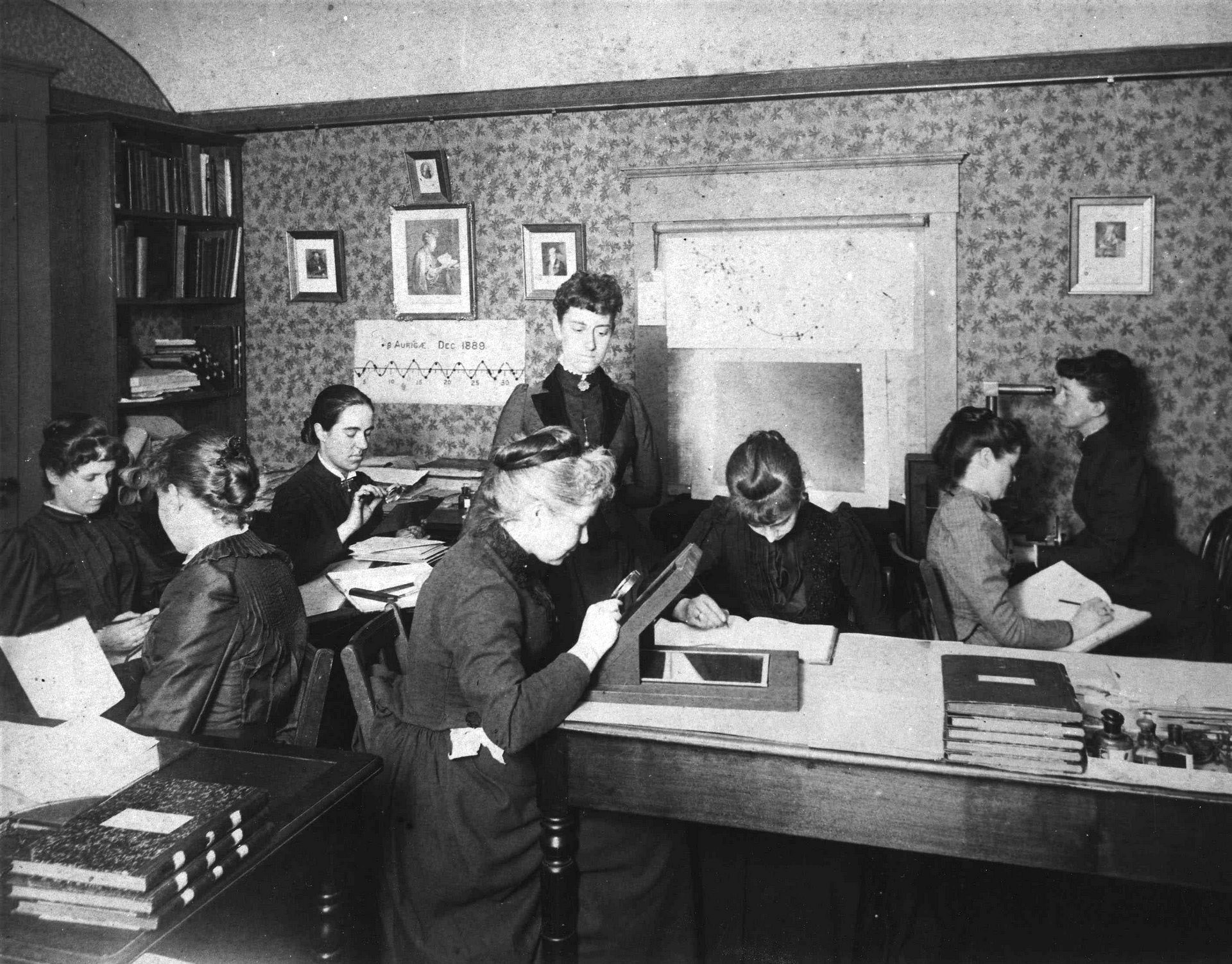
The
Harvard Computers
at work at the Harvard College Observatory, c. 1913. Among them was
Henrietta Swan Leavitt
(1868–1921), who discovered the period-luminosity relation for Cepheid variable stars — a logarithmic law that, for the first time, let astronomers measure distances across the universe. The brightness of stars is reported on a log scale because the eye perceives intensity multiplicatively, not additively. Image: Harvard College Observatory / Wikimedia Commons —
File:Astronomer Edward Charles Pickering’s Harvard computers.jpg, public domain.
If \(\log_{10}\) tells you about powers of 10,
what does \(\log_{2}\) tell you about —
and when would that ever matter?
Standards: HSF-LE.A.4, HSA-SSE.B.3, HSF-BF.B.4.a. Big Question is rhetorical here — no answer yet. The payoff lands in Activity 1 (base-2 log table, Slide 6) and the lesson synthesis (Slide 11): every base names a different family of exponents, and base-2 logs show up anywhere quantities double or halve (computer memory, half-lives, octaves of musical pitch, magnitudes of brightness). SWBAT moves to the lesson-synthesis slide — do not read objectives here. Two minutes max on this slide.
Rewrite each logarithmic equation in exponential form. Then check with your partner.
Example.\(\log_{10}(1000) = 3\) rewrites in exponential form as \(10^{3} = 1{,}000\).
Rewrite: \(\log_{10}(100{,}000{,}000) = 8\)
Rewrite: \(\log_{10}(1) = 0\)
Rewrite: \(\log_{2}(16) = 4\)
Rewrite: \(\log_{5}(25) = 2\)
Try Saying
Log reading
log base of the value equals
e.g. “log base 10 of the value 1,000 equals 3”
Exponential reading
raised to the power of equals the value
e.g. “10 raised to the power of 3 equals the value 1,000”
3 min for the Do Now (synthesis is on slide 3). Pair students — take turns rewriting each log expression in exponential form using the reference card at the top.
Listen for students who notice that base-2 and base-5 equations have the same structure as base-10. Surface those students in the synthesis.
Common stumble: students try to compute the answer rather than rewrite. Redirect: “The equation already gives you the answer — use the reference card to flip it into exponential form.”
No ACB on warm-up (discussion only). Sample interpretations live on the synthesis slide (s3).
Warm-Up · Synthesis2 min
Logs Have the Same Structure in Every Base
Every logarithm asks the same question. Only the base changes.
“What changes when the base changes — and what stays the same?”The structure stays the same: log of (number) = (exponent). Only the base of the power expression changes — that controls which factor we are repeating.
“Why does \(\log_{2}(16) = 4\)?”Because \(2^{4} = 16\). Log reading: “log base 2 of the value 16 gives us the exponent 4.” Exponential reading: “2 raised to the power of 4 equals the value 16.”
“What would \(\log_{3}(81)\) equal? How do you know?”\(4\), because \(3^{4} = 81\). Same structural question — new base. Count factors of 3: \(3^{1} = 3\) \(3^{2} = 3 \times 3 = 9\) \(3^{3} = 3 \times 3 \times 3 = 27\) \(3^{4} = 3 \times 3 \times 3 \times 3 = 81\) Mr. Bennett tip: think of \(3^{4}\) as \(9 \times 9\)… because we know \(3^{2} = 9\), and we know \(9 \times 9 = 81\). four factors of 3, so the exponent is 4.
click to advance discussion ▶
Try Saying
Log form
“log base 2 of the value 16 gives us the exponent 4.”
Exponential form
“2 raised to the power of 4 equals the value 16.”
This is the bridge to the base-2 table on Slide 6. Confirm aloud that every student can re-read a log equation as an exponent question — that is the prereq for the rest of the lesson.
Listen for: students who notice base-2 and base-5 work exactly the same as base-10 — surface their words. Common stumble: students try to compute rather than read the equation as a sentence. Redirect: “Don't compute — just read it as the exponent question.”
No ACB on this slide — synthesis is discussion-only per CL standard.
Math As A Second Language3 min
A Logarithm Names an Exponent
Math · We Say · Meaning
★ Math (given)
\(\log_{b}(x) = y \;\iff\; b^{y} = x\)
▲ We Say
“log base b of the value x gives us the exponent y, which means b raised to the power of y equals the value x”
● Meaning
Taking the log base b of the value x gives the exponent y that is applied to base b in order to produce the value x.
Read all three cards aloud, slowly. Anchor the language: a logarithm is the exponent — the one we must raise the base b to in order to produce x. The We Say card is the script students should rehearse; have the class echo it back. Do not compute logarithms numerically yet — this slide names the general form before the base-2 table on slide 6. Pair immediately with the How To on slide 5 (reading any \(\log_b(x) = y\) statement as a base / value / exponent triple). This is the general-form MASL; the equivalence MASL (\(\log_b(x) = y \Leftrightarrow b^{y} = x\)) comes later on slide 8 — general form before component / equivalence, always. No ACB — MASL slides are discussion/reference only.
Reference · How To⏱ 2 min
How To: Rewrite Logs in Exponential Form
Step
What to do
Example: \(\log_2(32) = 5\)
1
Identify the baseb — the subscript on “log”.
In \(\log_{\mathbf{2}}(32) = 5\), the base is 2.
2
Identify the exponenty — the right side of the equals sign. Write b raised to the power of y.
The exponent is 5. Write: \(2^{5}\).
3
Identify the valuex — the number inside the parentheses. Write b raised to the power of y equals the value x.
The value is 32. Write: \(2^{5} = 32\). ✓
Try Saying
“The base is ___, the value is ___, and the exponent is ___.”
🧑🏫 Leave this slide on screen during work time. This How To pairs with the general-form MASL on slide 4 (\(\log_b(x) = y\)) and supports Activity 1 (slide 6), where students read the base-2 table and write \(2^x = 50\) in logarithmic form. Each row reveals on click — action first, then example, then advance to the next row. Cold-call students to read the example aloud after each reveal using the sentence frame. Common stumble: students try to compute a logarithm before they have named the three parts. The naming move (base / value / exponent) is the prereq for every problem in the lesson. The equivalence How To (Exp ↔ Log) comes later on slide 9.
Activity 1 · Work8 min
Base-2 Logarithms
Here is a logarithm table — like the base-10 one, but the base is 2. Use it to read off exponents.
value x
\(\log_2(x)\)
1
0
2
1
4
2
8
3
15
≈ 3.9069
16
4
32
5
40
≈ 5.3219
Pre-revealed: \(\log_2(8) = 3\) because \(2^3 = 8\). \(\log_2(1) = 0\) because \(2^0 = 1\).
On your own, then compare with a partner
Evaluate: \(\log_2(2) = \;?\)
Evaluate: \(\log_2(32) = \;?\)
Solve for x: \(2^x = 15\). Write the exact solution as a logarithm and as a decimal approximation from the table.
Write \(2^x = 50\) in logarithmic form.
Try Writing
\(\log_2(\_\_\_) = \_\_\_\) because raising 2 to the exponent ___ gives ___.
8 min · Activity 1 Work Time. Leave this slide on screen during work time.
Compressed activity. IM allots 15 min for 7 problems plus a Co-Craft Questions protocol; this deck drops Co-Craft and 3 problems. Keep the focus on reading the table as an exponent question.
Listen for students who say “the exponent” out loud — that is the target language. Surface those students in the synthesis (next slide).
Common error: students try to compute \(\log_2(15)\) without the table, or they read 15 ÷ 2 = 7.5. Redirect to the table row: which row has 15 in the value column? Then to the language — “the exponent that turns 2 into 15.”
Pin slide 5 (How To: Read or Write a log equation) on a second monitor, or navigate back if students need to identify base/value/exponent again.
Amplify · 4 inputs
Order: 4 separate Text→Response→Note sequences, named answer1, answer2, answer3, answer4. Problems 1–3 are Math Responses graded on numericValue. Problem 4 is a Math Response graded on latex string match (logarithmic form).
Format examples: Example: 1 · Example: 5 · Example: 3.9069 · Example: log_2(50) = x
Problem 1: Evaluate log_2(2)
content:
  when answer1.submitted and answer1.numericValue > 0.995 and answer1.numericValue < 1.005
    "Correct! 2^1 = 2, so log_2(2) = 1. Any base raised to the power of 1 gives itself."
  when answer1.submitted and answer1.numericValue > -0.005 and answer1.numericValue < 0.005
    "Almost! 0 is log_2(1), not log_2(2). The row you want has 2 in the value column. What exponent on 2 gives 2?"
  when answer1.submitted and answer1.numericValue > 1.995 and answer1.numericValue < 2.005
    "Hmm — 2 is log_2(4), not log_2(2). Read carefully: log_2(2) asks for the exponent that turns 2 into 2."
  when answer1.submitted and not isBlank(answer1.latex)
    "Take another look — log_2(2) asks: what exponent on base 2 gives 2? Try the table row where x = 2."
  otherwise ""
Problem 2: Evaluate log_2(32)
content:
  when answer2.submitted and answer2.numericValue > 4.995 and answer2.numericValue < 5.005
    "Correct! 2^5 = 32, so log_2(32) = 5."
  when answer2.submitted and answer2.numericValue > 3.995 and answer2.numericValue < 4.005
    "You're close — 4 is log_2(16), one row up. Check the table again: what is in the log column when x = 32?"
  when answer2.submitted and answer2.numericValue > 15.995 and answer2.numericValue < 16.005
    "I see what happened — 16 is the *value* whose log is 4, not the log of 32. The log column gives the exponent."
  when answer2.submitted and answer2.numericValue > 5.995 and answer2.numericValue < 6.005
    "Almost — 6 is log_2(64), one row past 32. Read the row where the value column is exactly 32."
  when answer2.submitted and not isBlank(answer2.latex)
    "Good start — log_2(32) asks: what exponent on base 2 gives 32? Count: 2, 4, 8, 16, 32 — how many doublings?"
  otherwise ""
Problem 3: Solve 2^x = 15 (decimal approximation from the table)
content:
  when answer3.submitted and answer3.numericValue > 3.9009 and answer3.numericValue < 3.9129
    "Correct! The exact solution is x = log_2(15). From the table, that is approximately 3.9069."
  when answer3.submitted and answer3.numericValue > 7.495 and answer3.numericValue < 7.505
    "Hmm — log_2(15) is not 15 ÷ 2. It is the exponent that turns 2 into 15. Check the table: which row has 15 in the value column?"
  when answer3.submitted and answer3.numericValue > 3.995 and answer3.numericValue < 4.005
    "You're close — 4 is log_2(16), and 16 is bigger than 15. The exponent for 15 is just under 4. Read the table row for x = 15."
  when answer3.submitted and answer3.numericValue > 14.995 and answer3.numericValue < 15.005
    "Not quite — 15 is the *value* on the left side of 2^x = 15, not the exponent. The exponent is what x equals. Read the log column for the row x = 15."
  when answer3.submitted and not isBlank(answer3.latex)
    "Take another look — solving 2^x = 15 means finding the exponent that turns 2 into 15. That is log_2(15). Read the decimal from the table."
  otherwise ""
Problem 4: Write 2^x = 50 in logarithmic form
content:
  when answer4.submitted and (answer4.latex matches "log_2\(50\)\s*=\s*x" or answer4.latex matches "log_\{2\}\(50\)\s*=\s*x" or answer4.latex matches "x\s*=\s*log_2\(50\)" or answer4.latex matches "x\s*=\s*log_\{2\}\(50\)")
    "Correct! 2^x = 50 means the exponent x is the log, base 2, of 50. Logarithmic form: log_2(50) = x."
  when answer4.submitted and (answer4.latex matches "log_\{?50\}?\(2\)\s*=\s*x" or answer4.latex matches "x\s*=\s*log_\{?50\}?\(2\)")
    "Good start — you swapped the base and the value. In 2^x = 50, the base is 2 and the value is 50. The base of the log is the same as the base of the power. Try log_2(50) = x."
  when answer4.submitted and (answer4.latex matches "log_x\(50\)\s*=\s*2" or answer4.latex matches "log_\{x\}\(50\)\s*=\s*2")
    "Hmm — the base of the log is the same as the base of the power. The base is 2, not x. The exponent (the unknown x) goes on the right of the equals sign."
  when answer4.submitted and (answer4.latex matches "log_2\(x\)\s*=\s*50" or answer4.latex matches "log_\{2\}\(x\)\s*=\s*50")
    "I see what happened — x is the exponent, not the value. 50 is the value (what you get when you raise 2 to the x). Try log_2(50) = x."
  when answer4.submitted and isBlank(answer4.latex)
    "Identify base, value, and exponent in 2^x = 50. Base = 2, value = 50, exponent = x. Then write log_base(value) = exponent."
  when answer4.submitted
    "Take another look — 2^x = 50 has base 2, exponent x, and value 50. Logarithmic form is log_base(value) = exponent. What do you get?"
  otherwise ""
Activity 1 · Synthesis2 min
\(\log_2(15)\) Is Exact; 3.9069 Is Approximate
Both forms are valid solutions to \(2^x = 15\). One is exact. The other is the calculator's best estimate.
Both Exact
\(2^x = 8 \;\Rightarrow\; x = \log_2(8) = 3\)
Log Form Exact · Decimal Approximate
\(2^x = 15 \;\Rightarrow\; x = \log_2(15) \approx 3.9069\)
“Why are both \(3\) and \(\log_2(8)\) valid answers for \(2^x = 8\)?”Because they are equal. \(\log_2(8) = 3\) by definition — the exponent that takes 2 to 8 is 3. Writing it either way gives the same number.
“Why is \(\log_2(15)\) exact but 3.9069 is not?”Because \(2^{3.9069}\) is almost 15 but not exactly 15 — the decimal is a rounded calculator output. \(\log_2(15)\) is the unrounded answer; it names the exact exponent.
“When would we prefer the log form? When the decimal?”Log form for proofs and exact comparisons — whenever “exactly” matters. Decimal when we need to measure, build, or compare to a numeric scale.
click to advance discussion ▶
Try Saying
\(\log_2(15)\) is exact because ___. The decimal 3.9069 is approximate because ___.
2-min reveal. The “exact vs. approximate” distinction shows up again in the cool-down (Problem 3 — \(\log_2(1) = 0\) is exact). Listen for students who say “\(\log_2(15)\) is the answer” rather than treating it as an unfinished calculation — that is the target framing. Read the SWBAT idea later on the lesson synthesis slide; don't preview it here.
Math As A Second Language3 min
Same Relationship, Two Forms
Math · We Say · Meaning
★ Math (given)
\(b^{y} = x \;\Longleftrightarrow\; \log_{b}(x) = y\)
▲ We Say
“b to the y equals xif and only if log base b of x equals y”or“the exponential form and the logarithmic form say the same thing”
● Meaning
An exponential equation and its equivalent logarithmic equation express the same relationship between a base, an exponent, and a value. The base stays the base. The exponent and the value swap positions but never swap roles. Example: \(2^{4} = 16\) and \(\log_{2}(16) = 4\) say the same thing.
Equivalence — example
\[2^{4} = 16 \;\Longleftrightarrow\; \log_{2}(16) = 4\]
Try Saying
“\(b^{y} = x\) and \(\log_{b}(x) = y\) are equivalent because they show the same ___, ___, and ___.”
Standalone MASL slide — pairs with the How To on the next slide. This is the lesson's central equivalence: an exponential equation and its logarithmic form encode the same three values (base, exponent, value) in two different syntactic arrangements. Read aloud all three cards. As you read the Math card, annotate with arrows showing b ↔ b (base), y ↔ y (exponent), x ↔ x (value). Verbalize: “Two ways to say the same thing.” This MASL builds on Slide 4’s general form (\(\log_{b}(x) = y\)) — general form precedes the equivalence form per MASL ordering. Bonus aside (mention but don’t dwell): when no base subscript is written, \(\log(x)\) means base 10 — students will see this in upcoming lessons. The most common student error this triggers is swapping base and value when converting; the How To on Slide 9 addresses that directly.
Reference · How To2 min
How To: Switch Between Exponential and Logarithmic Form
Two directions. The base stays the base in both forms.
Step
What to do
Example
Going Exponential → Logarithmic
1
Identify the baseb, the exponenty, and the valuex in the exponential equation.
In \(5^{3} = 125\): base = 5, exponent = 3, value = 125.
Leave this slide on screen during work time and cool-down. This How To is paired with Slide 8 (MASL equivalence \(b^{y} = x \Leftrightarrow \log_{b}(x) = y\)) and doubles as the paired How To for the cool-down on Slide 12. Each row reveals on click: action first, then example, row by row. The two direction banners (Exp→Log, Log→Exp) are always visible — they orient students before clicking. Anchor the language: “The base is always the base.” The most common error in Activity 2 and the cool-down is swapping base and exponent (e.g. writing \(\log_3(125) = 5\) from \(5^3 = 125\)). When students miss a row in the work-time problems, navigate back here and re-read Step 1 or Step 3 aloud — identification before writing. No ACB on this slide — reference only.
Activity 2 · Work Time12 min
Exponential and Logarithmic Forms
Each row shows two equations that say the same thing. Fill in the missing form. Then translate the two word problems into both forms.
Complete the tableclick to reveal answers ▶
#
Exponential form
Logarithmic form
given
\(2^{4} = 16\)
\(\log_{2}(16) = 4\)
a
\(5^{3} = 125\)
?
c
?
\(\log_{4}(64) = 3\)
e
\(10^{-2} = 0.01\)
?
g
?
\(\log_{7}(49) = 2\)
i
?
\(\log_{3}\!\left(\tfrac{1}{9}\right) = -2\)
Then — translate each sentence into both an exponential and a logarithmic equation
“To what exponent do we raise 4 to get 64?”
“What is the log, base 2, of 128?”
Try Writing
In ___, the base is ___, the value is ___, and the exponent is ___.
12 min · Activity 2 Work Time — full IM treatment. Pacing: ~8 min on the 5-row table, then ~4 min on the two word-problem translations.
Pin slide 9 (How To: Switch Between Exponential and Logarithmic Form) — keep it accessible on a second monitor or navigate back as needed. The base always stays the base.
Common error: students flip base and value. In \(5^3 = 125\), 5 is the base (stays a subscript in log form), 125 is the value (stays inside the parentheses), 3 is the exponent (lives on the right-hand side of the log equation). Row e stresses negative exponents; row i stresses fraction values plus negative exponents — both intentionally chosen as the harder cases.
Word problems: force students to generate both forms from a verbal description — the assessment standard. WP1 answer: \(4^{?} = 64\) and \(\log_{4}(64) = ?\) (either form accepted as a first input; ideally students write both). WP2 answer: \(\log_{2}(128) = ?\) and \(2^{?} = 128\).
Watch for students who answer the word problems numerically (“3” for WP1, “7” for WP2). That's a separate skill — here, the target is writing the equation, not solving it. Push students to slow down and write the symbolic translation first.
Amplify · 7 inputs
Order: 7 separate Text→Math Response→Note sequences. Names: answer10a, answer10c, answer10e, answer10g, answer10i, answer10wp1, answer10wp2. All Math Response (LaTeX-tolerant equation matching). No numericValue — these are equation translations, not real-number correctness.
content:
  when answer10a.submitted and (answer10a.latex matches "log_5\(125\)\s*=\s*3" or answer10a.latex matches "log_\{5\}\(125\)\s*=\s*3")
    "Correct! 5 to the 3rd power is 125, so log base 5 of 125 is 3. Same relationship, two forms."
  when answer10a.submitted and (answer10a.latex matches "log_3\(125\)\s*=\s*5" or answer10a.latex matches "log_\{3\}\(125\)\s*=\s*5")
    "Hmm — you swapped the base and the exponent. The **base** stays the base in both forms. In 5^3 = 125, 5 is the base. The 3 is the exponent. Try log_base(value) = exponent."
  when answer10a.submitted and (answer10a.latex matches "log_5\(3\)\s*=\s*125" or answer10a.latex matches "log_\{5\}\(3\)\s*=\s*125")
    "Not quite — 125 is the VALUE (what you get when 5 is raised to 3), not the exponent. Try log_base(value) = exponent."
  when answer10a.submitted and isBlank(answer10a.latex)
    "Identify the base (5), the value (125), and the exponent (3), then write log_base(value) = exponent. Example: log_5(125) = 3"
  when answer10a.submitted
    "Take another look — base is 5, value is 125, exponent is 3. Write log_base(value) = exponent. What do you get?"
  otherwise ""
Problem 10c: Write log_4(64) = 3 in exponential form.
content:
  when answer10c.submitted and (answer10c.latex matches "4\^3\s*=\s*64" or answer10c.latex matches "4\^\{3\}\s*=\s*64")
    "Correct! log_4(64) = 3 says the exponent that takes 4 to 64 is 3. Exponential form: 4^3 = 64."
  when answer10c.submitted and (answer10c.latex matches "3\^4\s*=\s*81" or answer10c.latex matches "3\^\{4\}\s*=\s*81")
    "Almost — you swapped base and exponent. The base stays the base. In log_4(64) = 3, 4 is the base; 3 is the exponent. Try base^exponent = value."
  when answer10c.submitted and (answer10c.latex matches "64\^3" or answer10c.latex matches "64\^\{3\}")
    "Not quite — 64 is the VALUE (what you get when you raise the base to the exponent), not the base. The base is the subscript. Try base^exponent = value."
  when answer10c.submitted and isBlank(answer10c.latex)
    "Identify the base (4), exponent (3), and value (64), then write base^exponent = value. Example: 4^3 = 64"
  when answer10c.submitted
    "You're close — base is 4, exponent is 3, value is 64. Write base^exponent = value. What do you get?"
  otherwise ""
Problem 10e: Write 10^(-2) = 0.01 in logarithmic form.
content:
  when answer10e.submitted and (answer10e.latex matches "log_\{?10\}?\(0?\.01\)\s*=\s*-?2" or answer10e.latex matches "log_\{10\}\(0\.01\)\s*=\s*-2" or answer10e.latex matches "log_10\(0\.01\)\s*=\s*-2")
    "Correct! log_10(0.01) = -2. Negative exponents on base 10 produce values between 0 and 1 — exactly what 0.01 is."
  when answer10e.submitted and (answer10e.latex matches "log_\{?10\}?\(0?\.01\)\s*=\s*2" or answer10e.latex matches "log_10\(0\.01\)\s*=\s*2")
    "Almost — the exponent in 10^(-2) is *negative* 2, not positive 2. Don't drop the minus sign when you move it to the right-hand side."
  when answer10e.submitted and (answer10e.latex matches "log_\{?-?2\}?\(0?\.01\)\s*=\s*10" or answer10e.latex matches "log_-2\(0\.01\)\s*=\s*10")
    "Hmm — you swapped the base and the exponent. The base is 10 (it stays the base). The exponent -2 becomes the right-hand side of the log equation."
  when answer10e.submitted and isBlank(answer10e.latex)
    "Identify the base (10), value (0.01), and exponent (-2), then write log_base(value) = exponent. Example: log_10(0.01) = -2"
  when answer10e.submitted
    "I see what happened — base is 10, value is 0.01, exponent is -2. Write log_base(value) = exponent. Keep the minus sign on the 2."
  otherwise ""
Problem 10g: Write log_7(49) = 2 in exponential form.
content:
  when answer10g.submitted and (answer10g.latex matches "7\^2\s*=\s*49" or answer10g.latex matches "7\^\{2\}\s*=\s*49")
    "Correct! log_7(49) = 2 means the exponent that turns 7 into 49 is 2. Exponential form: 7^2 = 49."
  when answer10g.submitted and (answer10g.latex matches "2\^7\s*=\s*128" or answer10g.latex matches "2\^\{7\}\s*=\s*128")
    "Hmm — you swapped base and exponent. In log_7(49) = 2, 7 is the BASE (the subscript) and 2 is the exponent. Try base^exponent = value."
  when answer10g.submitted and (answer10g.latex matches "49\^2" or answer10g.latex matches "49\^\{2\}")
    "Not quite — 49 is the VALUE (the inside of the parentheses), not the base. The base is the subscript: 7. Try base^exponent = value."
  when answer10g.submitted and isBlank(answer10g.latex)
    "Identify the base (7), exponent (2), and value (49), then write base^exponent = value. Example: 7^2 = 49"
  when answer10g.submitted
    "Good start — base is 7, exponent is 2, value is 49. Write base^exponent = value. What do you get?"
  otherwise ""
Problem 10i: Write log_3(1/9) = -2 in exponential form.
content:
  when answer10i.submitted and (answer10i.latex matches "3\^\{?-?2\}?\s*=\s*\\?frac\{?1\}?\{?9\}?" or answer10i.latex matches "3\^\{-2\}\s*=\s*1/9" or answer10i.latex matches "3\^\(-2\)\s*=\s*1/9" or answer10i.latex matches "3\^-2\s*=\s*1/9")
    "Correct! 3^(-2) = 1/9. The negative exponent flips the base: 3^(-2) = 1 / 3^2 = 1/9. Same relationship, written exponentially."
  when answer10i.submitted and (answer10i.latex matches "3\^2\s*=\s*\\?frac\{?1\}?\{?9\}?" or answer10i.latex matches "3\^2\s*=\s*1/9")
    "Almost — you dropped the minus sign. The exponent in log_3(1/9) = -2 is *negative* 2. Without the negative, 3^2 = 9, not 1/9."
  when answer10i.submitted and (answer10i.latex matches "3\^\{?-?2\}?\s*=\s*9" or answer10i.latex matches "3\^-2\s*=\s*9")
    "Hmm — 3^(-2) is not 9. A negative exponent gives the reciprocal: 3^(-2) = 1 / 3^2 = 1/9. Check the value column."
  when answer10i.submitted and (answer10i.latex matches "\\?frac\{?1\}?\{?9\}?\^\{?-?2\}?\^?" or answer10i.latex matches "1/9\^-2")
    "Not quite — 1/9 is the VALUE, not the base. The base in log_3(1/9) = -2 is 3 (the subscript). Try base^exponent = value."
  when answer10i.submitted and isBlank(answer10i.latex)
    "Identify the base (3), exponent (-2), and value (1/9), then write base^exponent = value. Example: 3^(-2) = 1/9"
  when answer10i.submitted
    "You're close — base is 3, exponent is -2, value is 1/9. Write base^exponent = value. Keep the minus sign on the exponent."
  otherwise ""
Problem 10wp1: Translate "To what exponent do we raise 4 to get 64?" into both forms.
content:
  when answer10wp1.submitted and (answer10wp1.latex matches "4\^.*=\s*64.*log_\{?4\}?\(64\)" or answer10wp1.latex matches "log_\{?4\}?\(64\).*4\^.*=\s*64")
    "Correct! Both forms ask the same question. Exponential: 4^x = 64 (where x is the unknown exponent). Logarithmic: log_4(64) = x. The answer to either is 3."
  when answer10wp1.submitted and (answer10wp1.latex matches "4\^.*=\s*64" or answer10wp1.latex matches "4\^x")
    "Good — you have the exponential form. Now write the same question in logarithmic form: log_base(value) = exponent. The base is 4 and the value is 64."
  when answer10wp1.submitted and (answer10wp1.latex matches "log_\{?4\}?\(64\)" or answer10wp1.latex matches "log_4\(64\)")
    "Good — you have the logarithmic form. Now write the same question in exponential form: base^exponent = value. The base is 4 and the value is 64."
  when answer10wp1.submitted and answer10wp1.latex matches "^\s*3\s*$"
    "Take another look — the question asks you to *write* the equation, not solve it. (3 is the right value of the exponent, though.) Write the question in both exponential form (4^? = 64) and logarithmic form (log_4(64) = ?)."
  when answer10wp1.submitted and isBlank(answer10wp1.latex)
    "Identify the base (4) and the value (64). The exponent is unknown. Exponential form: 4^? = 64. Logarithmic form: log_4(64) = ?"
  when answer10wp1.submitted
    "Almost! Write the question two ways: as 4^(something) = 64, and as log_4(64) = (something). Both forms ask the same thing."
  otherwise ""
Problem 10wp2: Translate "What is the log, base 2, of 128?" into both forms.
content:
  when answer10wp2.submitted and (answer10wp2.latex matches "log_\{?2\}?\(128\).*2\^.*=\s*128" or answer10wp2.latex matches "2\^.*=\s*128.*log_\{?2\}?\(128\)")
    "Correct! Both forms ask the same question. Logarithmic: log_2(128) = x. Exponential: 2^x = 128. The answer to either is 7."
  when answer10wp2.submitted and (answer10wp2.latex matches "log_\{?2\}?\(128\)" or answer10wp2.latex matches "log_2\(128\)")
    "Good — you have the logarithmic form. Now write the same question in exponential form: base^exponent = value. The base is 2 and the value is 128."
  when answer10wp2.submitted and (answer10wp2.latex matches "2\^.*=\s*128" or answer10wp2.latex matches "2\^x")
    "Good — you have the exponential form. Now write the same question in logarithmic form: log_base(value) = exponent. The base is 2 and the value is 128."
  when answer10wp2.submitted and answer10wp2.latex matches "^\s*7\s*$"
    "Hmm — the question asks you to *write* the equation, not solve it. (7 is the right value of the exponent, though.) Write the question in both logarithmic form (log_2(128) = ?) and exponential form (2^? = 128)."
  when answer10wp2.submitted and isBlank(answer10wp2.latex)
    "Identify the base (2) and the value (128). The exponent is unknown. Logarithmic form: log_2(128) = ?. Exponential form: 2^? = 128."
  when answer10wp2.submitted
    "Not quite — write the question two ways: as log_2(128) = (something), and as 2^(something) = 128. Both forms ask the same thing."
  otherwise ""
Lesson Synthesis~3 min
Equivalent Forms, Equivalent Information
Today we wrote the same relationship in two equivalent forms. The skill is not memorizing a conversion — it is choosing the form that answers the question being asked.
Exponential form
\(7^{2} = 49\)
Logarithmic form
\(\log_{7}(49) = 2\)
“How are \(\log_2(60)\), \(\log_5(60)\), and \(\log_{10}(60)\) alike? How are they different?”All three are logarithms — each names the exponent that produces 60. They differ only in the base, so the exponents differ: \(\log_{10}(60) \approx 1.78\); \(\log_5(60) \approx 2.54\); \(\log_2(60) \approx 5.91\). Same value (60), three different bases, three different exponents.
“Is \(\log_{100}(10) = \tfrac{1}{2}\) true? How do you know?”Yes. \(100^{1/2} = \sqrt{100} = 10\), so \(\log_{100}(10) = \tfrac{1}{2}\). The exponent that takes base 100 to value 10 is one-half.
“How would we write the solution to \(10^x = 60\)?”\(x = \log_{10}(60)\) is the exact answer. \(x \approx 1.7782\) is the approximate decimal. Both are valid — choose based on the question.
“Why call these two equations equivalent — they look so different.”They describe the same base, exponent, and value. \(b^{y} = x\) asks the multiplication question; \(\log_b(x) = y\) asks the exponent question. One relationship, two ways to write it.
click to advance discussion ▶
Try Saying
\(b^{y} = x\) and \(\log_b(x) = y\) are equivalent because they describe the same ___, ___, and ___.
Try Saying
I would write the answer as a logarithm when ___. I would write it as a decimal when ___.
I Can… (SWBAT)
Read a logarithmic equation as an exponent question.
Write the same relationship in both exponential and logarithmic form.
Lesson Synthesis (~3 min). Cold-call through the four discussion prompts — do not let a single student answer all of them. The first prompt surfaces the “same structure, different base” idea from the warm-up; the second extends to fractional exponents; the third anchors the exact-vs.-approximate distinction from Activity 1; the fourth is the lesson’s thesis. Read the SWBAT statements aloud at the end — students should self-assess against both “I can” lines before starting the cool-down.
SWBAT belongs here, not on the title slide. Standards: HSF-LE.A.4, HSF-BF.B.4.a.
Cool-Down5 min
Writing in Different Forms
A logarithmic equation and its exponential equation say the same thing about a base, an exponent, and a value.
Use the relationship \(b^{y} = x \iff \log_{b}(x) = y\) on each problem below.
On your own — show your reasoning
Write \(\log_{5}(25) = 2\) in exponential form.
Write \(3^{4} = 81\) in logarithmic form.
Explain why \(\log_{2}(1) = 0\).
Try Writing
\(\log_{2}(1) = 0\) because ____ raised to ____ is ____, so ____.
Leave this slide on screen during the exit ticket. Standard: HSF-LE.A.4. Paired How To: Slide 9 — “How To: Switch Between Exponential and Logarithmic Form” — keep slide 9 available (second monitor or quick back-nav) for students who freeze on problems 1–2.
Exit ticket — independent work, 5 min. No partner talk. No calculator.
Problem 1 sample response: \(5^{2} = 25\). The base 5 stays the base; the exponent 2 stays the exponent; the value 25 stays the value.
Problem 2 sample response: \(\log_{3}(81) = 4\). Base 3 → subscript; value 81 → inside parentheses; exponent 4 → right side.
Problem 3 sample response (IM): “\(2^{0} = 1\), which means 0 is the power to which 2 is raised to give 1, so \(\log_{2}(1) = 0\).”
Watch for the swap error — students place the exponent where the base belongs (problem 1) or place the value where the exponent belongs (problem 2). If more than a third of the class misses problems 1 or 2, reteach with slide 9 the next day. Problem 3 is the hardest — it asks students to reason from the equivalence, not just rewrite it.
Amplify · 3 inputs
Order per problem: Text component (problem text + format example) → Math Response (Problems 1–2, named answer1, answer2) or Text Response (Problem 3, named answer3) → Note with CL.
Problems 1–2: answer.latex string matching (exact-form equations, not numeric values). Problem 3: answer3.content phrase matching for the “\(2^{0} = 1\)” reasoning.
Problem 1: Write log_5(25) = 2 in exponential form. (Example: 5^2 = 25)
content:
  when answer1.submitted and (answer1.latex matches "5\^2\s*=\s*25" or answer1.latex matches "5\^\{2\}\s*=\s*25")
    "Correct! In log_5(25) = 2, the base 5 is raised to exponent 2 to give value 25. Exponential form: 5^2 = 25."
  when answer1.submitted and answer1.latex matches "2\^5\s*=\s*32"
    "Hmm — you swapped the base and the exponent. In log_5(25) = 2, 5 is the BASE (the subscript), and 2 is the exponent. Try again: base^exponent = value."
  when answer1.submitted and answer1.latex matches "25\^2\s*=\s*625"
    "Not quite — 25 is the VALUE in log_5(25) = 2, not the base. The base is the subscript. Try base^exponent = value."
  when answer1.submitted and answer1.latex matches "2\^25"
    "Hmm — 2 is the exponent in log_5(25) = 2, not the base. The base is the subscript (5). Try base^exponent = value."
  when answer1.submitted and isBlank(answer1.latex)
    "Identify the base (subscript), exponent (right side), and value (inside parentheses), then write base^exponent = value. Example: 5^2 = 25"
  when answer1.submitted
    "Take another look — base is 5, exponent is 2, value is 25. Write base^exponent = value. What do you get?"
  otherwise ""
Problem 2: Write 3^4 = 81 in logarithmic form. (Example: log_3(81) = 4)
content:
  when answer2.submitted and (answer2.latex matches "log_3\(81\)\s*=\s*4" or answer2.latex matches "log_\{3\}\(81\)\s*=\s*4")
    "Correct! In 3^4 = 81, the base 3 raised to exponent 4 gives 81. Log form: log_3(81) = 4."
  when answer2.submitted and answer2.latex matches "log_4\(81\)\s*=\s*3"
    "Hmm — you swapped the base and the exponent. The base stays the base in both forms. In 3^4 = 81, 3 is the base. Try again: log_base(value) = exponent."
  when answer2.submitted and answer2.latex matches "log_3\(4\)\s*=\s*81"
    "Not quite — 81 is the VALUE (what you get when you raise 3 to the 4th power), and 4 is the EXPONENT. Try log_3(value) = exponent."
  when answer2.submitted and answer2.latex matches "log_\{?81\}?\(3\)"
    "Take another look — 81 is the value (it goes inside the parentheses), not the base. The base is the subscript. Write log_base(value) = exponent."
  when answer2.submitted and isBlank(answer2.latex)
    "Identify the base (3), exponent (4), and value (81), then write log_base(value) = exponent. Example: log_3(81) = 4"
  when answer2.submitted
    "Take another look — base is 3, exponent is 4, value is 81. Write log_base(value) = exponent. What do you get?"
  otherwise ""
Problem 3: Explain why log_2(1) = 0. (Text Response)
content:
  when answer3.submitted and answer3.content matches "2\^0|2 to the 0|two to the zero|2 raised to 0|2 to the zero"
    "Strong explanation — log_2(1) = 0 because 2^0 = 1. Any nonzero base raised to the power of 0 is 1, so the exponent that takes 2 to 1 is 0."
  when answer3.submitted and answer3.content matches "zero power|0 power|exponent.*0|0.*exponent"
    "Good — you named the key idea: the exponent is 0. To make this airtight, show 2^0 = 1, so log_2(1) = 0."
  when answer3.submitted and answer3.content matches "anything.*0|any.*zero|nonzero.*0"
    "You named the right rule (any nonzero base to the 0 power is 1). Now connect it: 2^0 = 1, so log_2(1) = 0."
  when answer3.submitted and isBlank(answer3.content)
    "Use the relationship log_b(x) = y means b^y = x. What value of y makes 2^y = 1? Example: 2^0 = 1, so..."
  when answer3.submitted
    "Take another look — log_2(1) asks: what exponent on base 2 gives 1? Any nonzero number raised to 0 is 1. So what is log_2(1)?"
  otherwise ""