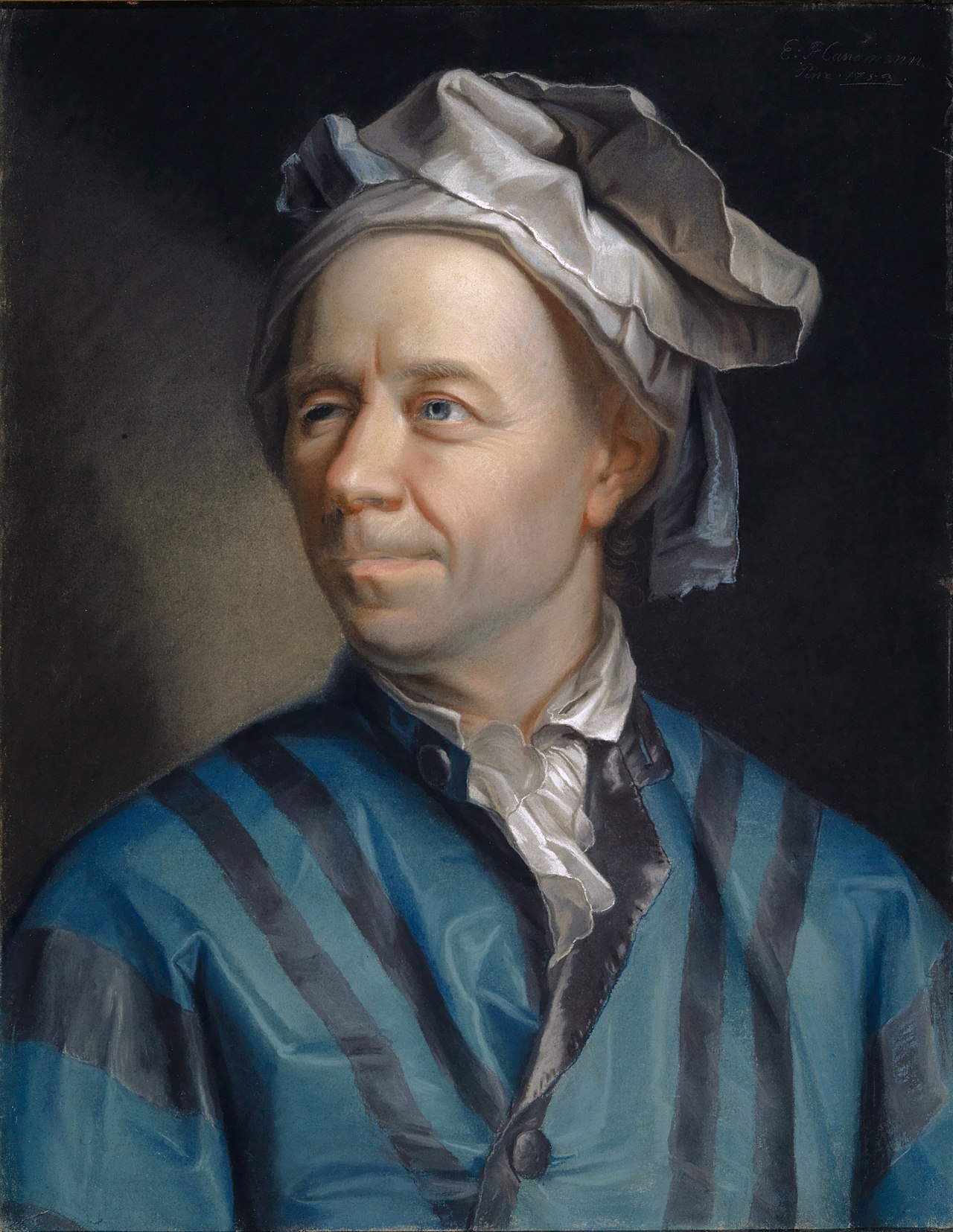
The Swiss mathematician
Leonhard Euler
(1707–1783), painted in pastel by Jakob Emanuel Handmann in 1753. Euler is the namesake of
Euler’s number,
the irrational constant e ≈ 2.718. Like π, it shows up everywhere — in compound interest, in population growth, in radioactive decay — whenever a quantity changes at a rate proportional to itself. Image: Jakob Emanuel Handmann / Wikimedia Commons —
File:Leonhard Euler.jpg, public domain.
What happens when you compound interest
not annually, not monthly, not daily,
but continuously — at every instant?
Is there a limit to how fast money can grow?
Standards: HSF-LE.A.2, HSF-LE.A.4, HSF-LE.B.5, HSF-IF.A.2. Section C opener — this lesson is students’ first encounter with e. Goal: students leave knowing e ≈ 2.718 is an irrational constant like π, that it shows up in exponential growth, and that the expression \((1 + \tfrac{1}{n})^n\) approaches e as n grows large. The standards explicitly say a deep understanding of e is beyond the scope of this course — don’t overformalize. SWBAT moves to the lesson-synthesis slide — do not read objectives here. Two minutes max on this slide.
Prep Checklist
☐ Graphing technology and spreadsheet access required for Activity 2 (the pattern behind e).
☐ No printed materials — everything is on these slides.
☐ Calculator note for Activity 2: students must wrap the reciprocal in parentheses — (1 + 1/1000)^1000 — or the calculator returns 1.
Warm-Up5 min
Do Now
Complete on your own. Then confirm your answers with a partner.
Match each equation to the situation it models. Be prepared to explain how you know. One equation will not match any situation.
Equations
A.\(f(t) = 400 \cdot 2^{\,t/10}\)
B.\(f(t) = 400 \cdot 1.25^{\,t/10}\)
C.\(f(t) = 400 \cdot 0.75^{\,t/10}\)
D.\(f(t) = 400 \cdot 0.5^{\,t/10}\)
Situations
a.A colony starts with 400 bacteria and doubles every 10 hours.
b.A pile of 400 kg of sand decreases by 25% every 10 days as it washes away.
c.A pond of 400 fish grows by 25% every 10 years (one decade).
5 min total for warm-up (slides 2–3). Students work for ~3 min, then pair-share. The point is to surface the role of the base — all four equations share the same initial value (400) and exponent structure (\(t/10\)); only the base changes. This sets the stage for introducing a new base — \(e\) — later in the lesson.
One equation has no match. That's intentional — students must reason about which base belongs to which behavior, not just sort by “has a 400 in it.” The unmatched base will be picked up in the synthesis (slide 3) as a half-life setup.
Common error to watch for: students matching by initial value alone (all four share 400) instead of by base. Ask: “Which equation grows? Which shrinks? How fast?” Push them to read the base.
Warm-Up · Synthesis2 min
What the base tells us
Same initial value, same exponent — only the base changes. The base alone tells you whether something grows or shrinks, and how fast.
If \(b > 1\)
growth
If \(b = 1\)
constant
If \(0 < b < 1\)
decay
“Which situation matches \(f(t) = 400 \cdot 2^{t/10}\)?”The bacteria — 400 organisms that double every 10 hours. Base 2 means the quantity doubles over one full interval of the exponent.
“Which matches \(1.25^{t/10}\), and which matches \(0.75^{t/10}\)?”1.25 → the fish (25% growth per decade): each decade, the population is multiplied by 1.25. 0.75 → the sand (25% loss per decade): each decade, the mass is multiplied by 0.75. Growth bases are > 1; decay bases are between 0 and 1.
“Which equation had no match — and what situation fits it?”\(0.5^{t/10}\) is the unmatched one. Base \(\tfrac{1}{2}\) is the signature of a half-life: a 10-year half-life problem with 400 g of a radioactive sample would be modeled by \(f(t) = 400 \cdot (\tfrac{1}{2})^{t/10}\).
“All four bases are familiar — 2, 1.25, 0.75, 0.5. What if a base showed up that wasn't a clean number you'd recognize?”In today's lesson, we will meet a different base — one that scientists use everywhere to model continuous growth and decay. It is not a tidy decimal. Keep your eyes open for it.
click to advance discussion ▶
Try Saying
The equation ___ matches the situation about ___ because the base ___ means ___.
Cold-call through the queue. The payoff of this warm-up is the base–behavior link: \(b > 1\) → growth, \(0 < b < 1\) → decay. Make that rule explicit on the board before moving on — students will lean on it for the rest of Section C.
Watch for students who matched by initial value alone (all four equations share 400). Redirect them to the base: it is the only thing that changes across the four.
Do not reveal \(e\) yet. End with Q4's transition line — the “different base” teaser sets up slide 4 (Notice & Wonder on the mold function \(f(t) = 10 \cdot e^{t}\)), where students will encounter \(e\) for the first time and ask “what is that?” on their own. The new-base reveal lives on slide 5, not here.
No ACB on synthesis (discussion only).
Activity 1 · Launch3 min
Moldy Growth — What Do You Notice?
A spot of mold is found on a basement wall. Its area is about 10 square centimeters. Here are three representations of a function that models how the mold grows.
Equation
\(f(t) = 10 \cdot e^{\,t}\)
t in weeks · f(t) in cm²
Table
t (weeks)
area (cm²)
0
10
1
27
2
74
3
201
values rounded
Graph
What do you notice? What do you wonder?
Try Saying
I notice ___ in the equation/table/graph because ___.
Try Saying
I wonder ___ because ___.
Launch (~3 min) · 1 min quiet think → 1 min partner discussion → 1 min whole-class share. Record student noticings without editing.
Key noticing to surface: “There’s an e in the equation — what is that?” If no one says it, prompt: “Does anything in the equation look unfamiliar?”
Table check: growth factor each week is roughly 27/10 ≈ 2.7, 74/27 ≈ 2.74, 201/74 ≈ 2.72 — the factor is about 2.7 per week. Mention the table values are rounded. Do not name e here — that reveal is on slide 5. No ACB — Notice & Wonder is discussion only.
Activity 1 · Synthesis7 min
Meet e — Euler's number
The new symbol e is just a number — like π. Its value is about 2.718, and it shows up wherever growth or decay is continuous.
Constant
\(e \approx 2.71828\,1828\ldots\) — irrational, never repeats or terminates. Named for Leonhard Euler (1707–1783).
“What kinds of numbers is e like?”e is an irrational constant, like \(\pi\) and \(\sqrt{2}\). It can't be written as a fraction, and its decimal never repeats or terminates.
“Why use a new symbol if it's just a number?”Because writing 2.71828182845904523… everywhere would be ridiculous. e is shorthand for that value, the same way \(\pi\) is shorthand for 3.14159… . And e has special properties in calculus that you'll meet in future courses.
“Looking at the mold table, what is the growth factor each week?”About 2.7 per week — very close to e. So \(e^{1} \approx 2.718\) means the mold grows by a factor of about 2.7 each week. The function \(f(t) = 10 \cdot e^{t}\) describes that exact growth.
“Type e^1 into your calculator — what does it return?”About 2.71828… on any scientific calculator. Most have a dedicated e^x button (often shift + ln). Try e^2 next — you'll get about 7.389.
click to advance discussion ▶
Try Saying
The constant e is approximately ___, and it is like ___ because ___.
Tell students they will see much more of e in future courses (precalculus, calculus). For now: it is a number, about 2.718, and it shows up as a base in exponential functions. Don't derive e here — just name it. Draw the analogy to other irrationals students already know: \(\pi\) and \(\sqrt{2}\). Have every student type e^1 into their calculator and confirm 2.71828 — this previews the calculator-input format they'll need for Activity 2 (parenthesized exponents). Standards: HSF-LE.A.4.
Math As A Second Language4 min
MASL — The Constant e
Math · We Say · Meaning
★ Math (given)
\(e \approx 2.71828\ldots\)
▲ We Say
“e”
or
“Euler’s number”
● Meaning
The constant e is an irrational number with value approximately 2.718. Like π, it cannot be written as a terminating or repeating decimal. It appears as the base of exponential functions that model continuous growth and decay.
Try Saying
I placed ___ here because ___.
Try Saying
Does ___ belong with ___?
Try Saying
I don't think ___ belongs here because ___.
First MASL of Section C — the constant itself. Per the MASL general-before-components ordering: students meet the symbole here, on its own, before they see it as the base of an exponential function on slide 7 (\(f(x) = a \cdot e^{kx}\)). Component-level trios (e.g., "k > 0 means growth") are deferred to Lesson 13. The Math card is pre-placed (given); students sort the We Say and Meaning cards onto it. The Meaning sentence anchors e to π — a familiar irrational — so students hear "constant like π" before "base of an exponential." After sorting, project the locked-in trio for the rest of Section C. No ACB — MASL card-sort slides are discussion only.
Math As A Second Language4 min
MASL — Exponential Functions With Base e
Math · We Say · Meaning
★ Math (given)
\(f(x) = a \cdot e^{kx}\)
▲ We Say
“f of x equals a times e to the kx”
● Meaning
An exponential function with base e. The starting value is a, and k sets how fast the quantity grows (k > 0) or decays (k < 0). When k = 1 and a = 10, this is the mold function \(f(t) = 10 \cdot e^{t}\).
Try Saying
I placed ___ here because ___.
Try Saying
Does ___ belong with ___?
Try Saying
I don't think ___ belongs here because ___.
Second MASL of Section C — the general form. This slide comes immediately after slide 6 (the constant e) per the MASL general-before-components ordering: the symbole is introduced first, then the general exponential \(f(x) = a \cdot e^{kx}\) here, and only later (Lesson 13) will component-level MASL trios appear (e.g., "k > 0 means growth," "k < 0 means decay"). Stress to students: this is structurally identical to \(f(x) = a \cdot b^{x}\) from earlier sections, with b replaced by \(e^{k}\). The Math card is pre-placed (given); students sort the We Say and Meaning cards onto it. After sorting, project the locked-in trio — students will use this form on slide 8 (How To pairing) and again in Lesson 13. Per MASL standard: no ACB on card-sort slides.
Reference · How To2 min
How To — Evaluating \(f(x) = a \cdot e^{kx}\)
Worked example: for \(f(t) = 10 \cdot e^{t}\), find \(f(2)\).
Step
What to do
Example
1
Identify a (starting value) and k (rate).
\(a = 10\), \(k = 1\)
2
Substitute the input t into the formula.
\(f(2) = 10 \cdot e^{(1 \cdot 2)}\)
3
Enter into the calculator using parentheses around the exponent.
10*e^(1*2)
4
Read the calculator output.
\(\approx 73.89\)
5
Interpret in context.
After 2 weeks, the mold covers about \(73.89\;\text{cm}^{2}\). (Table shows 74 — rounded.)
Leave this slide on screen during Activity 2 work time. Pure reference — no paired problem. Click each row to advance: action reveals, then example, then next row.
Calculator-input format is critical for e. Students must wrap the exponent in parentheses or the calculator will exponentiate only the first character. Demonstrate explicitly: 10*e^(1*2) — not 10*e^1*2. Most graphing calculators have a dedicated ex button (often 2nd/shift + ln). On TI-84, it auto-inserts an open parenthesis — students just need to close it after the exponent.
Step 1 anchors students back in the MASL trio from slide 7: every base-e function has the same two parameters — a (starting value) and k (rate). Step 3 is the procedural payoff — the rest is reading and interpreting. Per the How To standard: teacher-only reference, no ACB.
Activity 2 · Launch2 min
Where does e come from?
We will investigate two expressions that secretly hide e. Compute one for tiny positive values of x, and the other for very large values of x. What pattern emerges?
What numbers should you try — tiny? huge? negative? Pick a few and predict what will happen before you compute.
Try Saying
I predict that for ___ values of x, the function will ___ because ___.
Quick launch (~2 min). Arrange students in pairs. One partner uses a spreadsheet (numerical/table view); the other uses graphing technology (visual view). Suggest concrete values to seed the work:
• Tiny for g: \(x = 0.1,\; 0.01,\; 0.001\)
• Huge for h: \(x = 100,\; 1000,\; 100000\)
Use Collect and Display: capture student language like "asymptote," "approaches," "stays close to," or "levels off." Do not reveal that both expressions approach e — students discover that on slide 10. This slide is 2 minutes of setup only; computation begins on the next slide.
Activity 2 · Work Time15 min
The Pattern Behind e
In pairs — one student on spreadsheet, one on graphing tool
For very small positive values of x (try x = 0.1, 0.01, 0.001), what happens to
(1 + x)^(1/x)? What number does it approach?
For very large values of x (try x = 100, 1000, 100000), what happens to
(1 + 1/x)^x? What number does it approach?
Both expressions approach the same number. What number is it? Why does this make sense? Hint: in the first, the tiny x is the reciprocal of a huge number; in the second, the huge x is the reciprocal of a tiny one.
Example calculator entry: (1 + 1/1000)^1000 → 2.7169…
Try Saying
When x is ___ , the value of (1 + 1/x)^x is approximately ___ , which is close to ___ .
15 min · Activity 2 Work Time. Leave this slide on screen during work time.
Pairs: one student drives the spreadsheet (numerical/table view), the other drives the graphing tool. Suggested values: tiny = 0.1, 0.01, 0.001; huge = 100, 1000, 100000. Leave the How To from slide 8 visible if students need calculator input help.
Common error to watch for: typing (1 + 1/1000)^1000without parentheses around 1/1000. The calculator interprets 1 + 1/1000^1000 and returns 1. Show the parenthesized form on slide 8 if a pair gets stuck.
Targets: Problem 1 → \(g(0.001) \approx 2.7169\). Problem 2 → \(h(1000) \approx 2.7169\). Problem 3 → both approach e ≈ 2.71828. The two expressions describe the same limit from opposite directions.
Collect and Display: update the shared list with student language (“approaches,” “levels off,” “stays close to”). The standards explicitly say a deep understanding of e is beyond the scope of this course — don't overformalize.
Amplify · 3 inputs
Order per problem: Text component (problem text) → Math Response named answer1 / answer2 / Text Response named answer3 → Note with CL.
Problems 1 and 2 are numeric limits — use answer.numericValue with a generous range centered on 2.718. Problem 3 is a short written response — use answer.content keyword match.
Math Response input hint: Example: 2.718
Problem 1: For tiny positive x (try 0.1, 0.01, 0.001), what does (1 + x)^(1/x) approach?
content:
  when answer1.submitted and answer1.numericValue > 2.70 and answer1.numericValue < 2.75
    "Correct! As x shrinks toward 0, (1 + x)^(1/x) gets closer and closer to e ≈ 2.718. You can see it by plugging in x = 0.001: (1.001)^1000 ≈ 2.7169."
  when answer1.submitted and answer1.numericValue > 1.0005 and answer1.numericValue < 1.002
    "Almost! 1.001 is the base, not the whole expression. You still need to raise 1.001 to the 1000th power. Try the full calculator entry."
  when answer1.submitted and answer1.numericValue > 0.99 and answer1.numericValue < 1.01
    "Hmm — (1 + 0)^∞ would be 1, but x is positive, not zero. Try a tiny positive x like 0.001 and raise (1 + x) to the (1/x)."
  when answer1.submitted and isBlank(answer1.latex)
    "Start with x = 0.001. Calculator entry: (1 + 0.001)^(1/0.001). What number comes out?"
  when answer1.submitted
    "Take another look — the value should be a little less than 3. Try x = 0.001 and enter (1 + 0.001)^(1/0.001). What do you get?"
  otherwise ""
Problem 2: For huge x (try 100, 1000, 100000), what does (1 + 1/x)^x approach?
content:
  when answer2.submitted and answer2.numericValue > 2.70 and answer2.numericValue < 2.73
    "Correct! As x grows large, (1 + 1/x)^x approaches e ≈ 2.718. At x = 1000, the value is about 2.7169 — very close to e."
  when answer2.submitted and answer2.numericValue > 1000
    "You're close — take another look. The expression doesn't blow up. (1 + 1/x) is barely more than 1 for huge x, and that tiny edge raised to the x lands at about 2.718, not infinity."
  when answer2.submitted and answer2.numericValue > 0.99 and answer2.numericValue < 1.01
    "Not quite — yes, (1 + 1/x) → 1 as x grows, but you're raising it to the x. That tension between "base shrinks toward 1" and "exponent grows" is exactly what produces e ≈ 2.718."
  when answer2.submitted and isBlank(answer2.latex)
    "Start with x = 1000. Calculator entry: (1 + 1/1000)^1000. Watch the parentheses around 1/1000."
  when answer2.submitted
    "Good start — try x = 1000 and enter (1 + 1/1000)^1000. The answer should be a little less than 3. What do you get?"
  otherwise ""
Problem 3: Both expressions approach the same number. What number is it? Why does this make sense?
content:
  when answer3.submitted and answer3.content matches "2\.718|2\.71|\be\b|euler"
    "Correct — both expressions approach e ≈ 2.718. In the first, x is the reciprocal of a huge number; in the second, 1/x is the reciprocal of a small number. The two expressions describe the same limit from opposite directions."
  when answer3.submitted and answer3.content matches "reciprocal|flip|swap|inverse"
    "Good start — you've spotted the reciprocal relationship. Now name the number both expressions approach. (It's an irrational constant, about 2.718.)"
  when answer3.submitted and answer3.content matches "3|infinity|infinite"
    "Hmm — take another look. The number isn't 3 and it isn't infinity. It's a specific irrational constant that sits between 2.7 and 2.8. What did your calculator show?"
  when answer3.submitted and isBlank(answer3.content)
    "Look at your answers to Problems 1 and 2 — both came out to about 2.7169. What number is that close to? Why would the two expressions land in the same place?"
  when answer3.submitted
    "I see what happened — name the specific number (about 2.718) and explain why a tiny x in one expression is the reciprocal of a huge x in the other. Same limit, two directions."
  otherwise ""
Activity 2 · Synthesis5 min
Two expressions, one number
Both expressions sneak up on e — one from the small side, one from the large side. Different inputs, same destination.
“What did \((1 + x)^{1/x}\) give you for \(x = 0.001\)?”About 2.7169 — very close to e. Calculator: (1 + 0.001)^(1/0.001)
“What did \(\left(1 + \tfrac{1}{x}\right)^{x}\) give you for \(x = 1000\)?”Also about 2.7169 — very close to e. Calculator: (1 + 1/1000)^1000
“Why is that the same number?”In one expression, the small x is the reciprocal of \(1/x\). In the other, the huge x is the reciprocal of \(1/x\). When you flip a tiny number, you get a huge one — so the two expressions are the same expression written two ways. Both define e in the limit.
“So what is \(e\)?”e is the number that \(\left(1 + \tfrac{1}{n}\right)^{n}\) approaches as \(n\) grows without bound. That is one way to definee. About 2.71828.
click to advance discussion ▶
Try Saying
As n gets larger, \(\left(1 + \tfrac{1}{n}\right)^{n}\) gets closer to ___ because ___.
Try Saying
The two expressions give the same value because ___.
Quick discussion (~5 min). Tell students that \(\left(1 + \tfrac{1}{n}\right)^{n}\) is the original historical definition of e — Jacob Bernoulli stumbled on it in 1683 while studying compound interest. Tie back to the Big Question: continuously compounded interest is the calculation that inventede. Don't dwell — just plant the seed. Lesson 13 returns to compound interest formally. The two expressions are reciprocals-of-reciprocals: let \(n = 1/x\) in \((1+x)^{1/x}\) and you get \(\left(1 + \tfrac{1}{n}\right)^{n}\) exactly — same limit, two parameterizations.
Lesson Synthesis~3 min
What we learned about e
e joins \(\pi\) in your mathematical toolkit. Different domain, same idea: a constant with a special role.
\(\pi\) — geometry
\(\pi \approx 3.14159\). Irrational. Ratio of a circle's circumference to its diameter.
e — growth & decay
\(e \approx 2.71828\). Irrational. Base of continuous exponential growth and decay.
“How is e like \(\pi\)?”Both are irrational constants. Their decimals never repeat or terminate, and neither can be written as a fraction. Both have special roles in math — we give them their own symbols because writing the decimal out every time would be ridiculous.
“How is e different from \(\pi\)?”\(\pi \approx 3.14159\) is the ratio of a circle's circumference to its diameter — it lives in geometry. \(e \approx 2.71828\) shows up in exponential growth and decay — it lives in continuous compounding, radioactive decay, and (later) calculus.
“In the moldy wall problem, \(f(t) = 10 \cdot e^{t}\). How fast was the mold growing — described to someone who has never heard of e?”Each week, the area grew by a factor of about 2.7 — more than doubling, but not quite tripling. After 1 week: \(\approx 27\) cm². After 2 weeks: \(\approx 74\) cm². The base \(e\) sets the growth factor.
click to advance discussion ▶
Try Saying
The constant e is similar to \(\pi\) because ___, but different because ___.
I Can… (SWBAT)
Recognize that \(e\) is an irrational constant, like \(\pi\), with a value of about 2.718.
Identify when \(e\) appears as the base of an exponential function and interpret what the function is doing.
Lesson Synthesis (~3 min). Cold-call through the three syn-queue questions. The first two anchor \(e\) to \(\pi\) as a familiar irrational; the third grounds \(e\) back in the mold context so students leave with a concrete sense of what an "e-based" growth rate feels like. Students often want a deeper explanation of e — resist. Tell them: more in precalculus, much more in calculus. For now, knowing \(e \approx 2.718\) and that it shows up as an exponential base is enough.
SWBAT belongs here, not on the title slide. Read aloud after the discussion concludes.
Cool-Down5 min
What Did You Learn About e?
Independently — record something you learned about e today.
In 2–3 sentences, describe e to someone who has never heard of it. Include its approximate value, what kind of number it is, and one place it shows up.
(If you finish early) Compute \(e^{2}\) on your calculator and write down what you get. Calculator format: e^(2) → about 7.389.
Cool-Down · 5 min. Exit ticket. Students must work independently. Leave this slide on screen during exit ticket.
Sample response:“e is kind of like π. It is a constant and an irrational number. e is something scientists use to model exponential change. When we use larger and larger values for n in (1 + 1/n)n, the value of the expression gets closer and closer to e.”
Calibration: Don't grade fluency — grade conceptual completeness. A full-credit answer touches three pieces: (1) approximate value near 2.718, (2) it is an irrational constant (like π), and (3) one context (exponential growth/decay, continuous compounding, mold population, Euler, etc.). Any one of those three on its own is partial.
Watch for students who only write “2.718” with no context, or only write “exponential growth” with no value — both are partial. The CL feedback nudges toward the missing piece.
Standard met: HSF-LE.A.4.
Amplify · 1 input
Order: Text component (problem text) → Text Response named answer1 → Note with CL in </>.
No auto-grade — this is a written reflection. CL uses answer1.content matches with keyword patterns to acknowledge various correct interpretations and nudge incomplete answers.
Prompt: In 2–3 sentences, describe e to someone who has never heard of it. Include its approximate value, what kind of number it is, and one place it shows up.
content:
  when answer1.submitted and answer1.content matches "2\.7|2\.71|2\.718|approximately|irrational|euler|euler's|leonhard"
    "Strong answer — you named the value (about 2.718), the type (irrational, like π), and tied it to something concrete. That's the full picture of e for now."
  when answer1.submitted and answer1.content matches "exponential|growth|decay|compound|mold|continuous"
    "Good — you connected e to where it shows up. Also make sure your answer includes its approximate value (2.718) and what kind of number it is (irrational, like π)."
  when answer1.submitted and isBlank(answer1.content)
    "Start with: 'e is approximately ___ .' Then add what kind of number it is and one place you saw it today."
  when answer1.submitted
    "Take another look — your description should mention three things: e is about 2.718, it is irrational (like π), and it shows up in exponential growth."
  otherwise ""