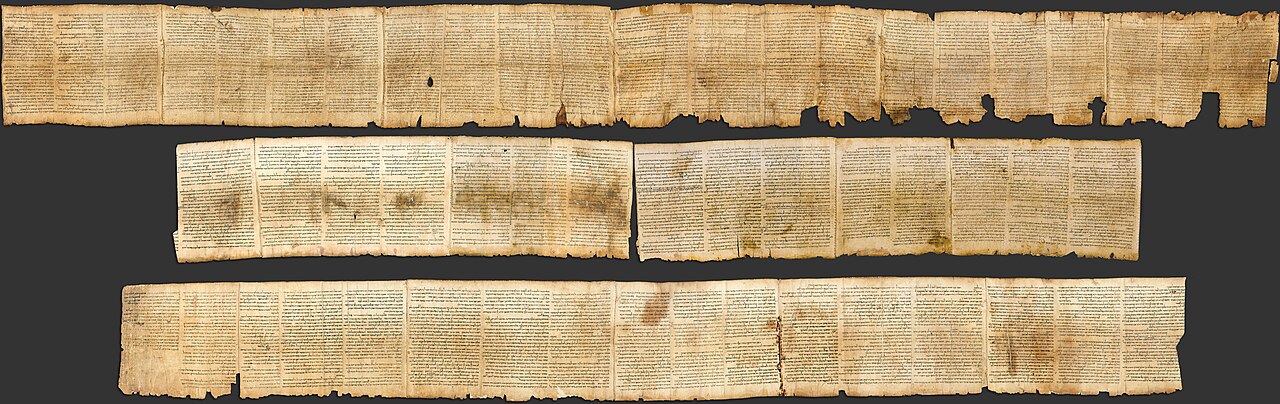
The
Great Isaiah Scroll,
one of the
Dead Sea Scrolls,
dated by radiocarbon to ~150 BCE — about 2,170 years ago, or roughly 0.38 of a carbon-14 half-life. To find the exact age from the C-14 fraction, scientists need to solve an equation like \(\bigl(\tfrac{1}{2}\bigr)^t = 0.77\) — which is exactly the move this lesson is about. Image: Wikimedia Commons —
File:Great Isaiah Scroll.jpg, public domain.
\(2x = 18\)
vs.
\(2^{x} = 18\)
You can solve \(2x = 18\) in one step.
Why can’t you solve \(2^{x} = 18\) the same way
— and what do you do instead?
Standards: HSF-LE.A.4. Last SDP lesson in Unit 5 — Lessons 15–18 are skipped; the End-of-Unit Assessment follows. Today consolidates the full unit toolkit (count half-lives · table · write expression · reason backward · NEW: solve with logs). SWBAT moves to the lesson-synthesis slide (s8) — do not read objectives here. Two minutes max on this slide.
Prep Checklist
☐ Materials: scientific calculators (with ln and log buttons).
☐ Ensure the calculator class set is charged before the period.
☐ No printed materials — everything is on these slides.
Warm-Up5 min
Do Now
Complete on your own. Then confirm your answers with a partner.
Here is a solution to the equation \(5 \cdot 3^{x} = 90\).
Explain what happened in each step.
Step
Equation
Reasoning
1
\(5 \cdot 3^{x} = 90\)
given equation
2
\(3^{x} = 18\)
divide each side by 5
3
\(x = \log_{3}(18)\)
rewrite in logarithmic form — the exponent that makes 3 give 18
4
\(x = \log_{3}(18)\) (exact)
this is the exact value; a decimal would be an approximation
Try Saying
In Step ___, the writer did ___ because ___.
5 min total — students work ~3 min, then pair-share. The transition \(3^{x} = 18 \to x = \log_{3}(18)\) is the line that will give students pause; the exponent is a single quantity (the unknown), so the definition of logarithm applies directly.
If students think the answer isn't "done" because the log isn't evaluated, remind them: log notation IS the exact solution; a decimal is an approximation.
This synthesizes the IM warm-up + warm-up synthesis into one slide. Click each reasoning cell to reveal row by row; pair-share substitutes for a separate synthesis discussion. No ACB — warm-up = discussion only.
Activity 1 · Work Time7 min
Meet the Natural Logarithm
A logarithm with base e has its own name and its own button on your calculator: the natural logarithm, written \(\ln(x)\). The expression \(\ln(x)\) means the same thing as \(\log_e(x)\) — the exponent that takes e to x. Find the e and ln keys on your calculator. Check: \(\ln(e) = 1\) and \(\ln(10) \approx 2.302585\).
Complete the table. Each row shows the same statement in two forms.
Exponential form
Logarithmic form
\(e^4 = M\) (given)
\(\ln(M) = 4\) (given)
a. \(e^x = 11\)
?
b. \(e^3 = w\)
?
c. ?
\(\ln(z) = 5\)
d. \(e^y = 2\)
? (then approximate y)
click to reveal sample response ▶
Exponential form
Logarithmic form
\(e^4 = M\)
\(\ln(M) = 4\)
a. \(e^x = 11\)
\(x = \ln(11)\)
b. \(e^3 = w\)
\(w = \ln(e^3) = 3\) (also \(e^3 \approx 20.09\))
c. \(e^5 = z\)
\(\ln(z) = 5\)
d. \(e^y = 2\)
\(y = \ln(2) \approx 0.693\) · Calculator: ln(2)
7 min · compressed: IM launch + work + synthesis for Activity 1.
Walk row 1 aloud once (“\(e^4 = M\) means \(\ln(M) = 4\) — the exponent we raise e to in order to get M is 4”), then release for ~5 min independent work.
Watch for: students who think e requires special handling — it does not. e is just a number (~2.718) that has its own special log. The mechanics of moving between exponential and log form are identical to base 10.
Synthesis is handled by the MASL slide immediately following — do not stop to debrief here; the symbolic form goes on slide 4.
Activity 1 · Synthesis3 min
Natural Logarithm
Math · We Say · Meaning
★ Math (given)
\(\ln(x)\)
▲ We Say
“the natural log of x”
or
“ell-en of x”
● Meaning
The natural logarithm is the logarithm with base e. It answers the question: “e to what power gives x?”
★ Math (given)
\(\ln(x) = y \iff e^y = x\)
▲ We Say
“the natural log of x equals y if and only if e to the y equals x”
● Meaning
A natural-log equation and an exponential equation with base e are two ways of writing the same statement. Example: \(\ln(18) = y\) means \(e^{y} = 18\).
Try Sayingln(x) answers the question ___, so it is the same as \(\log_{e}(x)\) because ___.
Try Saying
Does ___ belong with ___?
Try Saying
I don't think ___ belongs here because ___.
MASL → How-To pairing — leave on screen ~1 min before advancing to slide 5. The point: ln is not a different mathematical operation — it is a log with a special name because the base is so common. The single mathematical idea (exponent ↔ log) carries over verbatim from base 10 to base e. Students should be able to read \(\ln(18)\) aloud as either “natural log of 18” or “ell-en of 18.” Trio 1 establishes the notation (what the symbol says and means); Trio 2 establishes the relationship (how it connects to exponential form). After both are read aloud, advance to the How To on slide 5 which uses this iff move as Step 2. No ACB — MASL slides are discussion only.
Reference · How To2 min
How To — Solve \(a \cdot b^{x} = c\) with Logarithms
Worked example: solve \(5 \cdot 3^{x} = 90\).
Step
What to do
Example
★1
Isolate the exponential term on one side. Divide or subtract until you have \(b^{x} = (\text{number})\).
\(5 \cdot 3^{x} = 90\) → divide each side by 5 → \(3^{x} = 18\)
If base is 10 or e, use the log or ln key directly. Otherwise use change-of-base: \(\log_{b}(c) = \dfrac{\log(c)}{\log(b)}\).
base 3 → \(x = \dfrac{\log(18)}{\log(3)}\)
4
Evaluate on a calculator. Type the full change-of-base expression.
Calculator: log(18)/log(3) ≈ \(2.631\)
Leave this slide on screen during Activity 2 work time (slide 6). Step 3 is the one to call out aloud: when the base is not 10 or e, use change-of-base. When the base is 10 or e, the calculator key does the work.
The log(18)/log(3) block shows the literal calculator entry — students must include parentheses around the numerator and denominator, or the calculator will compute it wrong as log(18/log(3)).
Per the How To standard: teacher-only reference, no ACB. Click each row to advance: action reveals, then example, then next row.
Activity 2 · Work Time12 min
Solve Without a Calculator
Without using a calculator, solve each equation. Some answers will use log notation. Be ready to explain your reasoning.
\(10^x = 10{,}000\)
\(10^x = 315\)
\(2^x = 32\)
\(e^x = 20\)
\(3 \cdot 10^x = 6{,}000\)
click to reveal sample responses ▶
Equation
Solution
Strategy used
\(10^x = 10{,}000\)
\(x = 4\)
Exponential reasoning — \(10{,}000 = 10^4\).
\(10^x = 315\)
\(x = \log(315) \approx 2.498\)
Definition of log — 315 is not a whole-number power of 10.
\(2^x = 32\)
\(x = 5\)
Exponential reasoning — \(32 = 2^5\).
\(e^x = 20\)
\(x = \ln(20) \approx 2.996\)
Natural log — base is \(e\), so use \(\ln\).
\(3 \cdot 10^x = 6{,}000\)
\(x = \log(2000) \approx 3.301\)
Isolate first (divide by 3), then log.
12 min · Activity 2 Work Time. Leave this slide on screen during work time.
The How To from slide 5 is the reference — point students back to it. Compressed from the IM 10-equation set; the 5 chosen here cover all three strategies (exponential reasoning · definition of log · isolate-then-log).
Watch for: students who try to “evaluate” \(\log(315)\) mentally without a calculator — remind them the log expression is the exact answer; the decimal is the approximation. On Problem 4, watch for the log vs. ln slip (base 10 vs. base \(e\)). On Problem 5, watch for students forgetting to divide by 3 before applying the log.
Strategy mix: Problems 1, 3 = exponential reasoning. Problems 2, 4 = direct log/ln. Problem 5 = isolate-then-log (the hardest move).
Amplify · 5 inputs
Order per problem: Text component (problem text) → Math Response named answer1 … answer5 → Note with CL.
All five are Math Response components. Use answer.numericValue with ranges centered on the exact value. Accept decimals for log/ln answers (Problems 2, 4, 5).
Math Response input hint: Example: 2.498 (or the integer for Problems 1, 3).
Problem 1: 10^x = 10,000
content:
  when answer1.submitted and answer1.numericValue > 3.995 and answer1.numericValue < 4.005
    "Correct! 10,000 is 10^4, so x = 4. No log needed — this one yields to exponential reasoning."
  when answer1.submitted and answer1.numericValue > 2.999 and answer1.numericValue < 3.001
    "Almost! 10^3 is 1,000, not 10,000. Count the zeros in 10,000."
  when answer1.submitted and answer1.numericValue > 4.999 and answer1.numericValue < 5.001
    "Not quite — 10^5 is 100,000, one too many zeros. 10,000 is 10 to what power?"
  when answer1.submitted and not isBlank(answer1.latex)
    "Take another look — count the zeros in 10,000. How many factors of 10?"
  otherwise ""
Problem 2: 10^x = 315
content:
  when answer2.submitted and answer2.numericValue > 2.493 and answer2.numericValue < 2.503
    "Correct! In log form, x = log(315). The decimal is about 2.498."
  when answer2.submitted and answer2.numericValue > 31.4 and answer2.numericValue < 31.6
    "Hmm — 31.5 looks like dividing 315 by 10. Solving 10^x = 315 means finding the *exponent*, not dividing. Rewrite as a log: x = log(315)."
  when answer2.submitted and not isBlank(answer2.latex)
    "Good start — neither the table nor exponential reasoning gives an exact value. Rewrite as a logarithm: x = log(315). Then evaluate."
  otherwise ""
Problem 3: 2^x = 32
content:
  when answer3.submitted and answer3.numericValue = 5
    "Correct! 32 is 2^5, so x = 5."
  when answer3.submitted and answer3.numericValue > 3.999 and answer3.numericValue < 4.001
    "Almost — 2^4 is 16, not 32. Double it once more."
  when answer3.submitted and answer3.numericValue > 5.999 and answer3.numericValue < 6.001
    "Not quite — 2^6 is 64, one doubling too many. 32 is 2 to what power?"
  when answer3.submitted and not isBlank(answer3.latex)
    "Take another look — list the powers of 2: 2, 4, 8, 16, 32, 64. Which one is 32?"
  otherwise ""
Problem 4: e^x = 20
content:
  when answer4.submitted and answer4.numericValue > 2.990 and answer4.numericValue < 3.001
    "Correct! In log form, x = ln(20). The decimal is about 2.996."
  when answer4.submitted and answer4.numericValue > 19.99 and answer4.numericValue < 20.01
    "Hmm — 20 is the *right side* of the equation, not the solution. Rewrite e^x = 20 in log form: x = ln(20)."
  when answer4.submitted and answer4.numericValue > 1.30 and answer4.numericValue < 1.31
    "Close — log(20) ≈ 1.301 is the base-10 logarithm, but this equation has base e. Use ln, not log."
  when answer4.submitted and not isBlank(answer4.latex)
    "You're close — the base is e, so use the natural log. Rewrite as x = ln(20). What does your calculator say?"
  otherwise ""
Problem 5: 3 · 10^x = 6,000
content:
  when answer5.submitted and answer5.numericValue > 3.296 and answer5.numericValue < 3.306
    "Correct! Isolate first: divide each side by 3 to get 10^x = 2000. Then x = log(2000) ≈ 3.301."
  when answer5.submitted and answer5.numericValue > 7.776 and answer5.numericValue < 7.786
    "Hmm — 7.78 looks like log(6000). Divide first to isolate 10^x: 6000/3 = 2000, then x = log(2000)."
  when answer5.submitted and answer5.numericValue > 2.999 and answer5.numericValue < 3.001
    "Almost — 3 is close, but 10^3 = 1,000, not 2,000. Check: 10^x = 2,000 means x is *slightly more* than 3. Use a log: x = log(2000)."
  when answer5.submitted and not isBlank(answer5.latex)
    "Good start — the 3 in front needs to come off first. Divide each side by 3, then rewrite as a logarithm."
  otherwise ""
Activity 2 · Synthesis4 min
Solving Exponential Equations — Discussion
Today you used three different strategies. The skill is choosing the one that fits the equation in front of you.
“Which strategy did you use on \(10^x = 10{,}000\)? Why?”Exponential reasoning. \(10{,}000 = 10^4\), so \(x = 4\). No log needed because \(10{,}000\) is a whole-number power of 10.
“Which strategy on \(10^x = 315\)? Why?”Definition of log. 315 is not a whole-number power of 10 — it's between \(10^2 = 100\) and \(10^3 = 1{,}000\). So the exact solution is \(x = \log(315)\). The decimal (\(\approx 2.498\)) is the approximation.
“Which on \(3 \cdot 10^x = 6{,}000\)? What was the extra step?”Isolate first. Divide each side by 3 to get \(10^x = 2{,}000\). Then \(x = \log(2{,}000)\). The log only works once the exponential term is alone.
“What's the difference between \(\log(315)\) and \(\log_{10}(315)\)?”No difference. \(\log\) with no subscript is shorthand for \(\log_{10}\). Same idea: “the exponent that takes 10 to 315.”
“Could every equation today be solved with a log? Should they all be?”Yes, every one could be — but for problems like \(10^x = 10{,}000\), exponential reasoning is faster and gives an exact integer. Use logs when the answer isn't a whole-number power or when you need an exact form.
click to advance discussion ▶
Try Saying
For equation ___, I used ___ because ___.
Try Saying
A log expression like \(\log(315)\) is/isn't the same as a decimal answer because ___.
Sequence the strategies in the order they appeared: exponential reasoning → definition of log → isolate-then-log. Highlight: \(\log(315)\) is the exact answer — evaluating it on a calculator gives an approximation. Tie back to the warm-up: leaving the answer in log form is the rigorous move when the input isn't a nice power. No ACB — synthesis is discussion only.
Lesson Synthesis~4 min
The Full Toolkit — Solving Exponential Equations
Across this unit, you have built five ways to solve exponential equations. Today's lesson added the fifth — and the most powerful when the answer isn't a whole-number power.
1 · Count half-lives
Divide elapsed time by the half-life. Example: 17,190 yr ÷ 5,730 yr = 3 half-lives.
2 · Use a table
Multiply by the factor row by row. Example: 32 → 16 → 8 → 4.
3 · Write an expression
Substitute into \(f(t) = a \cdot b^{t/h}\) and evaluate. Example: \(6 \cdot (1/2)^{4000/5730} \approx 3.7\).
4 · Reason backward
Start from the target output and undo. Example: \((1/2)^n = 0.25 \Rightarrow n = 2\).
Try Saying
For this problem, I would use ___ because the question gives me ___ and asks me to find ___.
“Which strategy: how much C-14 remains in a 4,000-year-old fossil that started with 6 picograms?”Write an expression. Input is specific. \(6 \cdot (1/2)^{4000/5730} \approx 3.7\) pg. Calculator: 6*(1/2)^(4000/5730)
“Which: how many years to drop from 8 picograms to 1?”Count half-lives or reason backward. 8 → 4 → 2 → 1 is three halvings → 3 × 5,730 = 17,190 yr.
“Which: solve \(5 \cdot e^x = 80\) for \(x\) exactly?”Rewrite as a log (the new move). Divide by 5: \(e^x = 16\). Then \(x = \ln(16)\). Calculator: ln(16) ≈ 2.773.
click to advance discussion ▶
I Can… (SWBAT)
I can use the natural logarithm to express the exact solution to an equation with base \(e\).
I can solve simple exponential equations using base-10 and natural logarithms.
Lesson Synthesis (~4 min). Cold-call each scenario. The point is strategy selection, not computation. After the third scenario, read the SWBAT aloud. This is the consolidation slide for the entire unit's solving toolkit — Lessons 15–18 are skipped in SDP, so today's wrap-up is the last classroom moment before the End-of-Unit Assessment.
SWBAT belongs here, not on the title slide. Read aloud after the discussion concludes.
Cool-Down5 min
Solve Some Equations
On your own. Calculator allowed for Problem 3 only.
Solve for x:
\(10^x = 1{,}000\)
Solve for x:
\(4 \cdot 10^x = 88\)
Solve for x: \(e^x = 12\). Then find the approximate value using a calculator.
\(e^x = 12\)
5 min · Cool-Down. Independent — no partner work.
Calculator allowed for Problem 3 only (the IM cool-down specifies “find the approximate value using a calculator”). Problems 1 and 2 are pencil-and-paper: Problem 1 yields to exponential reasoning, Problem 2 requires isolating first then expressing the exact log answer.
Common error to watch for: students typing log(12) instead of ln(12) on Problem 3. This is the most common natural-log slip — the calculator log key is base 10, not base e.
Tomorrow:End-of-Unit Assessment.
Amplify · 3 inputs
Order per problem: Text component (problem text) → Math Response named answer1 / answer2 / answer3 → Note with CL.
Problem 1 uses an exact integer check on numericValue. Problems 2 and 3 accept the decimal value of the log expression with a generous band centered on the exact value.
Math Response input hint: Example: 2.485
Problem 1: Solve for x: 10^x = 1,000
content:
  when answer1.submitted and answer1.numericValue = 3
    "Correct! 1,000 = 10^3, so x = 3. Exponential reasoning — no log needed."
  when answer1.submitted and answer1.numericValue > 1.99 and answer1.numericValue < 2.01
    "Almost — 10^2 is 100, not 1,000. Count the zeros in 1,000."
  when answer1.submitted and answer1.numericValue > 3.99 and answer1.numericValue < 4.01
    "Not quite — 10^4 is 10,000, one zero too many. How many zeros in 1,000?"
  when answer1.submitted and not isBlank(answer1.latex)
    "Take another look — count the zeros in 1,000. That is the exponent."
  otherwise ""
Problem 2: Solve for x: 4 · 10^x = 88
content:
  when answer2.submitted and answer2.numericValue > 1.337 and answer2.numericValue < 1.347
    "Correct! Divide each side by 4 to isolate 10^x = 22. Then x = log(22) ≈ 1.342."
  when answer2.submitted and answer2.numericValue > 1.943 and answer2.numericValue < 1.953
    "Hmm — 1.945 is log(88), not log(22). The 4 in front needs to come off first. Divide each side by 4."
  when answer2.submitted and answer2.numericValue > 21.99 and answer2.numericValue < 22.01
    "You're close — 22 is what you get after dividing by 4. But x is the exponent, not 22. Rewrite 10^x = 22 as x = log(22)."
  when answer2.submitted and not isBlank(answer2.latex)
    "Good start — divide each side by 4 first, then rewrite as a logarithm. What is x?"
  otherwise ""
Problem 3: Solve for x: e^x = 12. Then find the approximate value using a calculator.
content:
  when answer3.submitted and answer3.numericValue > 2.480 and answer3.numericValue < 2.490
    "Correct! e^x = 12 rewrites as x = ln(12) ≈ 2.485. Calculator: ln(12)."
  when answer3.submitted and answer3.numericValue > 1.075 and answer3.numericValue < 1.085
    "Not quite — 1.079 is log(12), the base-10 log. This equation has base e — use ln, not log."
  when answer3.submitted and answer3.numericValue > 11.99 and answer3.numericValue < 12.01
    "Hmm — 12 is the right side, not the solution. Rewrite e^x = 12 in log form: x = ln(12)."
  when answer3.submitted and not isBlank(answer3.latex)
    "I see what happened — the base is e. Rewrite as x = ln(12). What does your calculator show?"
  otherwise ""
Lesson Summary
Logarithms — How to Pin Down an Exact Exponent
When the unknown value is an exponent, sometimes we can read it off by reasoning (\(10^{x} = 1{,}000 \to x = 3\)). When we can't, logarithms give us the exact answer.
The move
\(b^{x} = c\) becomes \(x = \log_{b}(c)\). The log notation is the exact answer; the decimal is the approximation.
Natural log
Base \(e\) is so common it has its own button: \(\ln\). \(e^{x} = c\) becomes \(x = \ln(c)\). Example: \(e^{x} = 5 \to x = \ln(5) \approx 1.609\). Calculator: ln(5).
Isolate first
If there is a coefficient or constant, undo those first. \(5 \cdot 3^{x} = 90 \to 3^{x} = 18 \to x = \log_{3}(18) = \log(18)/\log(3) \approx 2.631\). Calculator: log(18)/log(3).
Lesson Summary
Every exponential equation \(a \cdot b^{x} = c\) can be solved exactly: isolate the exponential, then rewrite as a logarithm. The base of the log matches the base of the exponent. When the base is 10 or \(e\), the calculator has a key for it. Otherwise, use change-of-base: \(\log_{b}(c) = \log(c)/\log(b)\).
Lesson Summary slide. Read aloud or have a student read. Cue tomorrow's End-of-Unit Assessment: “Lessons 15–18 are review and extensions you'll see on the assessment, but the core solving toolkit is on this slide and slide 8. If you can do those two slides cold, you're ready.”