Ammonites
— fossil cephalopods whose shells grow as logarithmic spirals. Each chamber is the same constant factor larger than the one before, no matter how big the shell has grown.
The curve looks steeper as it spirals outward — but the per-chamber growth ratio never changes. Plate from Ernst Haeckel's Kunstformen der Natur (1904), public domain.
An exponential curve looks steeper and steeper as it rises —
so does it grow faster in some places than others?
— or —
Does the math hide a kind of consistency the picture cannot show?
Standards: HSA-SSE.A, HSF-LE.A.1.a, HSF-LE.A.1.c. Lesson 5 follows directly from Lesson 4 — students should arrive comfortable rewriting an exponential expression so that the time unit changes (e.g. \(b^{t/30}\)). Today's pivot is conceptual: the per-interval factor stays the same for every equal interval, even fractional ones, and even though the slope of the curve grows.
Prep Checklist
☐ No materials required for this lesson.
☐ Activity 3 is optional — goes beyond the standards. Skip if pacing is tight.
Warm-Up5 min
Do Now
Consider the exponential function \(f(x) = 5 \cdot 2^{x}\). For each question, be ready to explain your reasoning to the class.
Complete on your own. Then confirm your answers with a partner.
By what factor does \(f(x)\) increase when the exponent x increases by 1?
By what factor does \(f(x)\) increase when the exponent x increases by 2?
By what factor does \(f(x)\) increase when the exponent x increases by 0.5?
5 min total for warm-up (slides 2–3). Students work independently for ~3 min, then pair-share. Listen for students who answer Problem 1 with a specific example (e.g. \(f(0)=5\), \(f(1)=10\)) and Problem 2 with a specific example (e.g. \(f(1)=10\), \(f(3)=40\)). Press the question: "How do you know the factor is 4 for any 2-step interval, not just from 1 to 3?"
For Problem 3, allow productive struggle. Students may guess 1 (half of 2), or √2, or be unsure. Do not resolve here — it sets up Activity 1.
Warm-Up · Synthesis5 min
Changes Over Intervals — Discussion
Students translate verbal reasoning into algebraic statements that hold for any interval of the named length, not just one specific example.
“Increase x by 1: factor = ?”Factor = 2, because \(\dfrac{f(x+1)}{f(x)} = \dfrac{5\cdot 2^{x+1}}{5\cdot 2^{x}} = 2^{(x+1)-x} = 2^{1} = 2\). The x in the numerator and denominator cancel — the factor does not depend on where you start.
“Increase x by 2: factor = ?”Factor = 4, because \(\dfrac{f(x+2)}{f(x)} = \dfrac{5\cdot 2^{x+2}}{5\cdot 2^{x}} = 2^{2} = 4\). True for any starting x — that is the meaning of "equal factor over equal intervals."
“Increase x by 0.5: factor = ?”Factor = \(\sqrt{2}\) ≈ 1.414, because \(\dfrac{f(x+0.5)}{f(x)} = 2^{0.5} = \sqrt{2}\). And the check works: \(\sqrt{2}\cdot\sqrt{2} = 2\) — two half-steps compound to one whole step, just as expected.
click to advance discussion ▶
Try Saying
The factor for an interval of length ___ is ___ because ___.
Try Saying
This factor does/does not depend on where the interval begins because ___.
The conceptual move is from "works in this example" to "works for any starting point." If a student offers only a numerical check (e.g. \(f(2)/f(0) = 20/5 = 4\)), affirm and then ask: "Would the factor still be 4 between \(x=7\) and \(x=9\)? How do you know without computing?" Steer toward the algebraic identity \(\frac{f(x+n)}{f(x)} = b^{n}\). This generalization is the engine for the rest of the lesson.
Activity 1 · Launch3 min
Machine Depreciation
After purchase, the value of a machine depreciates exponentially. The table shows its value as a function of years since purchase.
A student rewrote \(0.85^{0.5}\) as \(\bigl(0.85^{1/2}\bigr)^{1}\). What is another way to write \(0.85^{0.5}\)?
Launch (~3 min). Project the table and let students notice the pattern from year 0 to year 1 (16000 → 13600). Ask: "What is the decay factor for one year?" (0.85, since 13600/16000 = 0.85).
Then prompt the recall question — the goal is to surface that \(0.85^{0.5} = \sqrt{0.85} \approx 0.922\) before students start work. Display the exponent rule \(b^{mn} = (b^{m})^{n}\) and confirm \(b^{1/2}\) is another name for \(\sqrt{b}\).
Do not tell them the table values for \(t = 0.5\) and \(t = 1.5\). Those are the work-time payoff.
Reference · How ToActivity 1 · Work Time15 min
Reference · How To — Factor over a half-step
Step
What to do
Example
1
Identify the factor b for one whole interval.
From the table: \(\dfrac{13{,}600}{16{,}000} = 0.85\). One-year factor: \(b = 0.85\).
2
For an interval of length \(\tfrac{1}{2}\), raise b to the \(\tfrac{1}{2}\) power.
Multiply the starting value by that factor to step forward by half a year.
From \(t = 1\): \(13{,}600 \cdot 0.922 \approx \$12{,}539\) at \(t = 1.5\).
★
The half-year factor is the same for every half-year interval — not just from \(t = 0\) to \(t = 0.5\).
\(\dfrac{V(t + 0.5)}{V(t)} = \dfrac{16000 \cdot 0.85^{t+0.5}}{16000 \cdot 0.85^{t}} = 0.85^{0.5}\) — the t cancels.
Activity 1 · Work Time
Problems
Find an equation for \(V(t)\), the value in dollars after t years.
Find \(V(0.5)\) and \(V(1.5)\). Record them in the table.
By what factor does the value change every 1 year (e.g. 1 → 2, or 0.5 → 1.5)?
By what factor does the value change every half year (e.g. 0 → 0.5, or 1.5 → 2)?
Suppose we know \(V(t)\). Explain how to use it to find \(V(t + 0.5)\), the value half a year later.
15 min · Activity 1 Work Time. Leave this slide on screen during work time.
Problem 1: Target \(V(t) = 16000 \cdot (0.85)^{t}\). Initial value 16000; one-year factor 0.85. Problem 2: \(V(0.5) = 16000 \cdot 0.85^{0.5} \approx \$14{,}752\). \(V(1.5) = 16000 \cdot 0.85^{1.5} \approx \$12{,}539\). Problem 3: Factor = 0.85 (any 1-year interval). Problem 4: Factor ≈ 0.922 (any half-year interval) = \(0.85^{1/2} = \sqrt{0.85}\). Problem 5: Multiply by \(0.85^{1/2}\) — text-only, no numeric answer.
Watch for
Students who use a calculator on Problem 4 may get slightly different decimal values from different intervals (rounding in the table). Use this to motivate writing the factor as \(0.85^{1/2}\) — exact form makes the equality visible.
Amplify · 5 inputs
Order per problem: Text → Math Response (named answer1, answer2a, answer2b, answer3, answer4) → Note (CL in </>). Problem 5 → Text Response only.
Format examples (in Text component above each Math Response): Example: 16000(0.85)^t · Example: 14752 · Example: 0.85 · Example: 0.922
Problem 1: Find an equation for V(t).
content:
  when answer1.submitted and answer1.latex = "16000(0.85)^{t}"
    "Correct! V(t) = 16000 · (0.85)^t — initial value 16,000 and one-year decay factor 0.85."
  when answer1.submitted and answer1.latex = "16000\cdot(0.85)^{t}"
    "Correct!"
  when answer1.submitted and answer1.latex = "16000 \cdot (0.85)^{t}"
    "Correct!"
  when answer1.submitted and answer1.latex = "16000\cdot0.85^{t}"
    "Correct!"
  when answer1.submitted and answer1.latex = "16000 \cdot 0.85^{t}"
    "Correct!"
  when answer1.submitted and answer1.latex = "16000(0.85)^t"
    "Correct!"
  when answer1.submitted and not isBlank(answer1.latex)
    "Good start — check the initial value (year 0) and the one-year factor (year 1 ÷ year 0 = 13600 ÷ 16000). What should V(t) look like?"
  otherwise ""
Problem 2a: Find V(0.5).
content:
  when answer2a.submitted and answer2a.numericValue > 14745 and answer2a.numericValue < 14760
    "Correct! V(0.5) = 16000 · 0.85^0.5 ≈ $14,752."
  when answer2a.submitted and answer2a.numericValue > 14799 and answer2a.numericValue < 14801
    "Almost — $14,800 is the linear estimate (halfway between 16,000 and 13,600). Use the exponential model: 16000 · 0.85^0.5."
  when answer2a.submitted and answer2a.numericValue > 13599 and answer2a.numericValue < 13601
    "That is V(1), not V(0.5). Substitute t = 0.5 into your equation: 16000 · 0.85^0.5."
  when answer2a.submitted and not isBlank(answer2a.latex)
    "Not quite — substitute t = 0.5 into V(t) = 16000(0.85)^t. What do you get?"
  otherwise ""
Problem 2b: Find V(1.5).
content:
  when answer2b.submitted and answer2b.numericValue > 12530 and answer2b.numericValue < 12545
    "Correct! V(1.5) = 16000 · 0.85^1.5 ≈ $12,539."
  when answer2b.submitted and answer2b.numericValue > 12579 and answer2b.numericValue < 12581
    "Almost — $12,580 is the linear midpoint between V(1) and V(2). The exponential value is 16000 · 0.85^1.5 ≈ $12,539."
  when answer2b.submitted and answer2b.numericValue > 11559 and answer2b.numericValue < 11561
    "That is V(2), not V(1.5). Substitute t = 1.5 into V(t)."
  when answer2b.submitted and not isBlank(answer2b.latex)
    "Almost — V(1.5) = 16000 · 0.85^1.5. Try evaluating that on a calculator."
  otherwise ""
Problem 3: Factor for any 1-year interval.
content:
  when answer3.submitted and answer3.numericValue > 0.849 and answer3.numericValue < 0.851
    "Correct! The 1-year decay factor is 0.85 — same for every 1-year interval."
  when answer3.submitted and answer3.numericValue > 0.149 and answer3.numericValue < 0.151
    "Almost — 0.15 is the decay rate (15% lost per year). The factor is the multiplier applied each year: 1 − 0.15 = 0.85."
  when answer3.submitted and not isBlank(answer3.latex)
    "Not quite. Divide consecutive table values: 13600 ÷ 16000 = ? That is the one-year factor."
  otherwise ""
Problem 4: Factor for any half-year interval.
content:
  when answer4.submitted and answer4.numericValue > 0.9215 and answer4.numericValue < 0.9225
    "Correct! The half-year factor is 0.85^(1/2) = √0.85 ≈ 0.922 — same for every half-year interval."
  when answer4.submitted and answer4.numericValue > 0.424 and answer4.numericValue < 0.426
    "I see what happened — 0.425 is 0.85 ÷ 2. That uses linear logic. For exponential decay, the half-year factor is √0.85 ≈ 0.922."
  when answer4.submitted and answer4.numericValue > 0.849 and answer4.numericValue < 0.851
    "That is the 1-year factor, not the half-year factor. What value, when squared, gives 0.85? That value is the half-year factor."
  when answer4.submitted and not isBlank(answer4.latex)
    "Almost — what value, raised to the 2nd power, equals 0.85? That is the half-year factor: 0.85^(1/2) = √0.85."
  otherwise ""
Problem 5: Explain how to use V(t) to find V(t+0.5). [Text Response only]
content:
  when answer5.submitted and not isBlank(answer5.content)
    "Thank you — share your reasoning during the synthesis discussion."
  when answer5.submitted and isBlank(answer5.content)
    "Please write a short explanation before submitting."
  otherwise ""
Activity 1 · Synthesis5 min
Machine Depreciation — Discussion
Years since purchase
0
0.5
1
1.5
2
Value (dollars)
$16,000
$14,752
$13,600
$12,539
$11,560
Value lost each half-year cycle
−$1,248
−$1,152
−$1,061
−$979
Different students likely used different methods to find the half-year factor. Surface the strategies, then connect them to a single algebraic statement.
“How did you find the factor for the half-year intervals?”Three strategies (in order of generality): (1) Calculator divide. \(V(0.5) / V(0) \approx 14{,}752 / 16{,}000 \approx 0.922\). (2) Square root of the year factor. One-year factor is 0.85, so the half-year factor is \(\sqrt{0.85} \approx 0.922\). (3) Algebraic ratio. \(\dfrac{V(t+0.5)}{V(t)} = \dfrac{16000 \cdot 0.85^{t+0.5}}{16000 \cdot 0.85^{t}} = 0.85^{0.5}\) — true for every half-year interval.
“If we divide table values to find the half-year factor, the answers are very close but slightly different. Why?”The dollar values in the table are rounded. Different ratios from rounded values give slightly different decimals. Strategy (3) avoids the rounding — \(0.85^{0.5}\) is the same expression no matter which half-year interval we examine.
“How would you adjust to find the factor for any 3-year interval?”Use the same logic with exponent 3: \(\dfrac{V(t+3)}{V(t)} = 0.85^{3} \approx 0.614\). Equal intervals — equal factor — every time.
click to advance discussion ▶
Try Saying
The half-year factor is ___ because ___.
Try Saying
Strategy ___ works for any half-year interval because ___.
Sequence the discussion in the order listed (specific → general). The big move: from "this works for 0 to 0.5" to "this works for any half-year." Strategy 3 is the algebraic backbone — make sure it lands. The key insight: writing the factor as \(0.85^{0.5}\) (rather than evaluating to a decimal) shows the cancellation directly.
Pre-Activity 2 · Launch8 min
Radioactive Dating Lab
Before we model decay on paper, see it in action. You will use the Radioactive Dating Lab to date 3 real artifacts — choosing the right probe each time and using the same fractional-interval reasoning we just learned.
Pick an artifact from the gallery. Read the flavor text — this gives you a clue about whether it is organic (recent) or geological (old).
Choose the right probe. Carbon-14 for organic material under ~60,000 years; Uranium-238 for fossils and rocks older than ~1 million years. Wrong probe? The lab will tell you why.
Record the reading — the % of the isotope still remaining. This is your "measurement."
Estimate the age. Use the slider or number input. The graph shows a target line at the measured % — drag your guess to where that line meets the curve.
Submit and compare. The lab shows the true age and the inverse formula \(t = h \cdot \log_{2}\!\left(1/r\right)\). Repeat for 2 more artifacts.
Pre-Activity 2 (~8 min). Distribute laptops/Chromebooks and the printed recording sheet (or share the link).
Sequence: Walk through steps 1–3 with the class — emphasize that the artifact's flavor text contains the probe-choice clue. Pause for students to pick artifact + probe. Only after they've experienced a wrong-probe rejection (or correctly chosen and seen a reading), click “Show steps 4–6” to reveal the estimation challenge.
The lab over PhET: the slider snaps to meaningful increments (100 yrs for C-14; 1 million yrs for U-238), the input field lets students type a precise value, and the graph shows where their guess meets the target reading. Submit feedback shows the inverse-log computation explicitly.
Recording sheet (separate link) gives students a 3-row table to capture artifact name, probe, half-life, % reading, computed age, and true age. Print B&W version available via browser print.
If pacing is tight, do 1 artifact together as a class then move on. The IM activity (Tracing the Radioactivity) on the next slide reuses the same exponent reasoning in a non-isotope context.
Activity 2 · Launch
Activity 2 · Work Time
Activity 2 · Work Time
Activity 2 · Revise & Refine
Activity 2 · Synthesis
Activity 2 · Synthesis
Activity 2 · Launch3 min
Tracing the Radioactivity
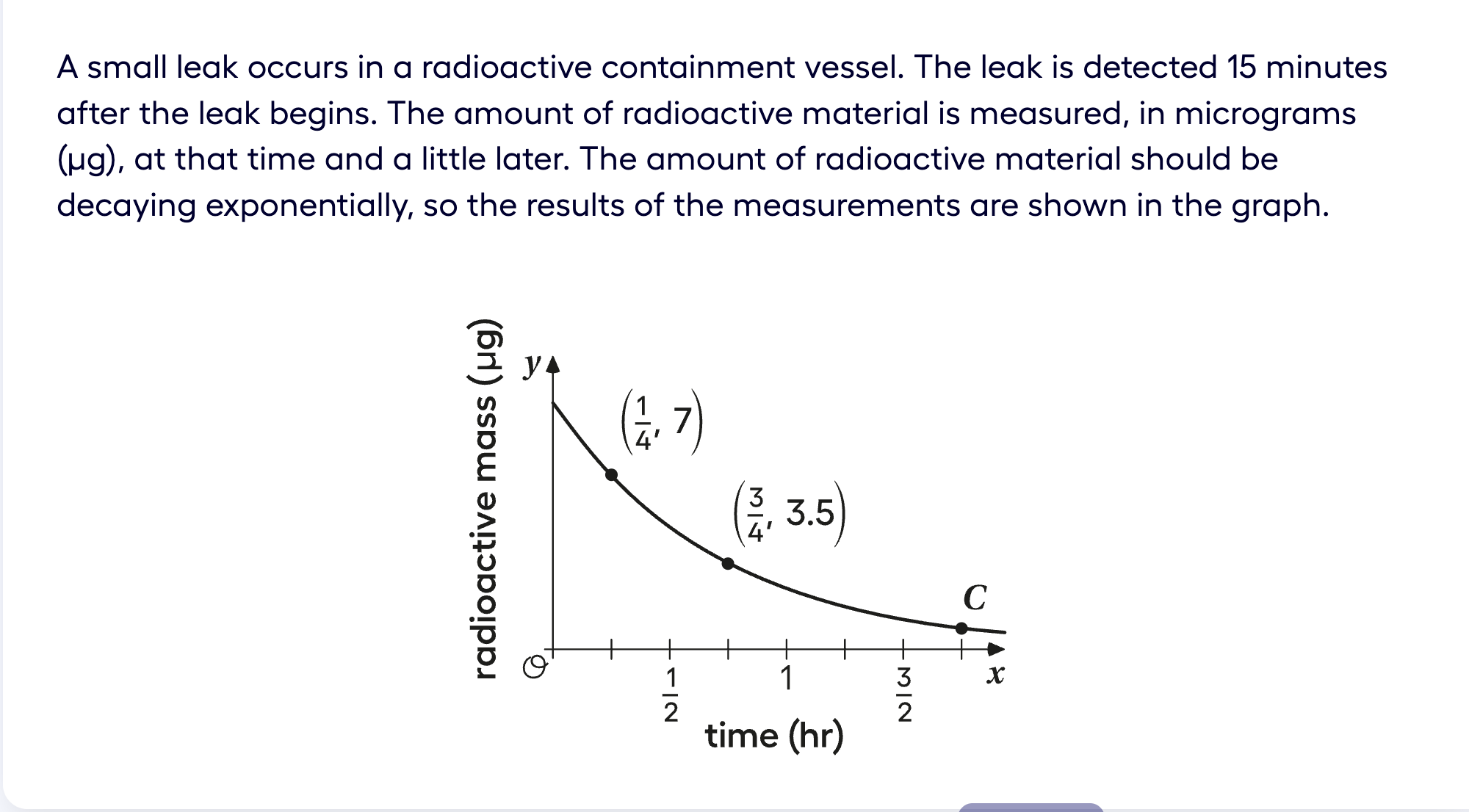
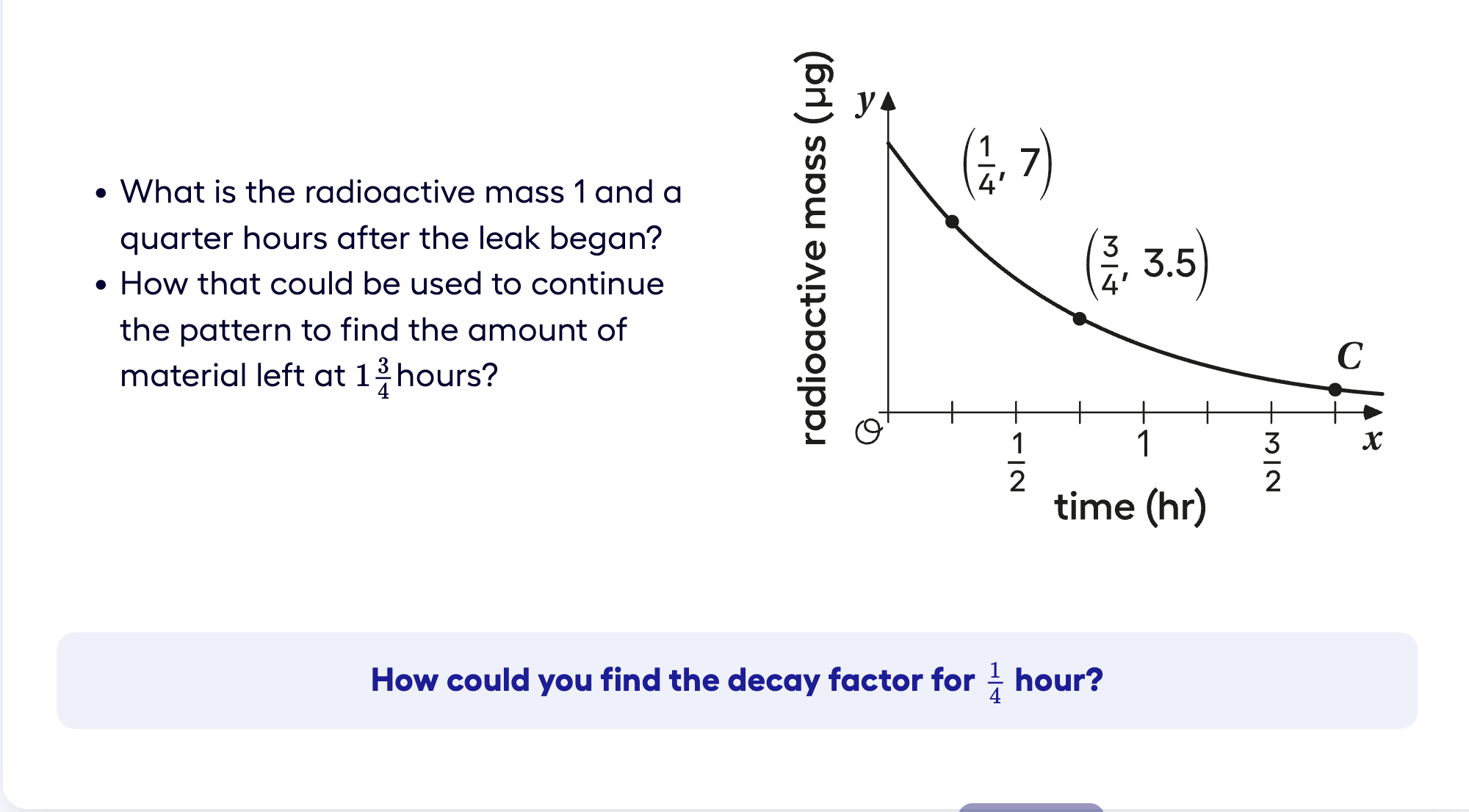
A small leak occurs in a radioactive containment vessel. The leak is detected 15 minutes after it begins. Scientists measure the amount of radioactive material at that time and a little later. The amount should be decaying exponentially.
What do you notice? What do you wonder?
Launch (~3 min). Display the graph. Ask: "What do you notice? What do you wonder?" Possible noticings: the curve decreases; from \(t=\tfrac{1}{2}\) to \(t=1\) the amount is cut in half (7 → 3.5); we don't know point C yet. Possible wonderings: how much is at C? Is the half-life half an hour? What happens after 2 hours?
Do not resolve. Students will use the equal-factors-over-equal-intervals idea to predict point C in the work time.
Activity 2 · Work Time7 min
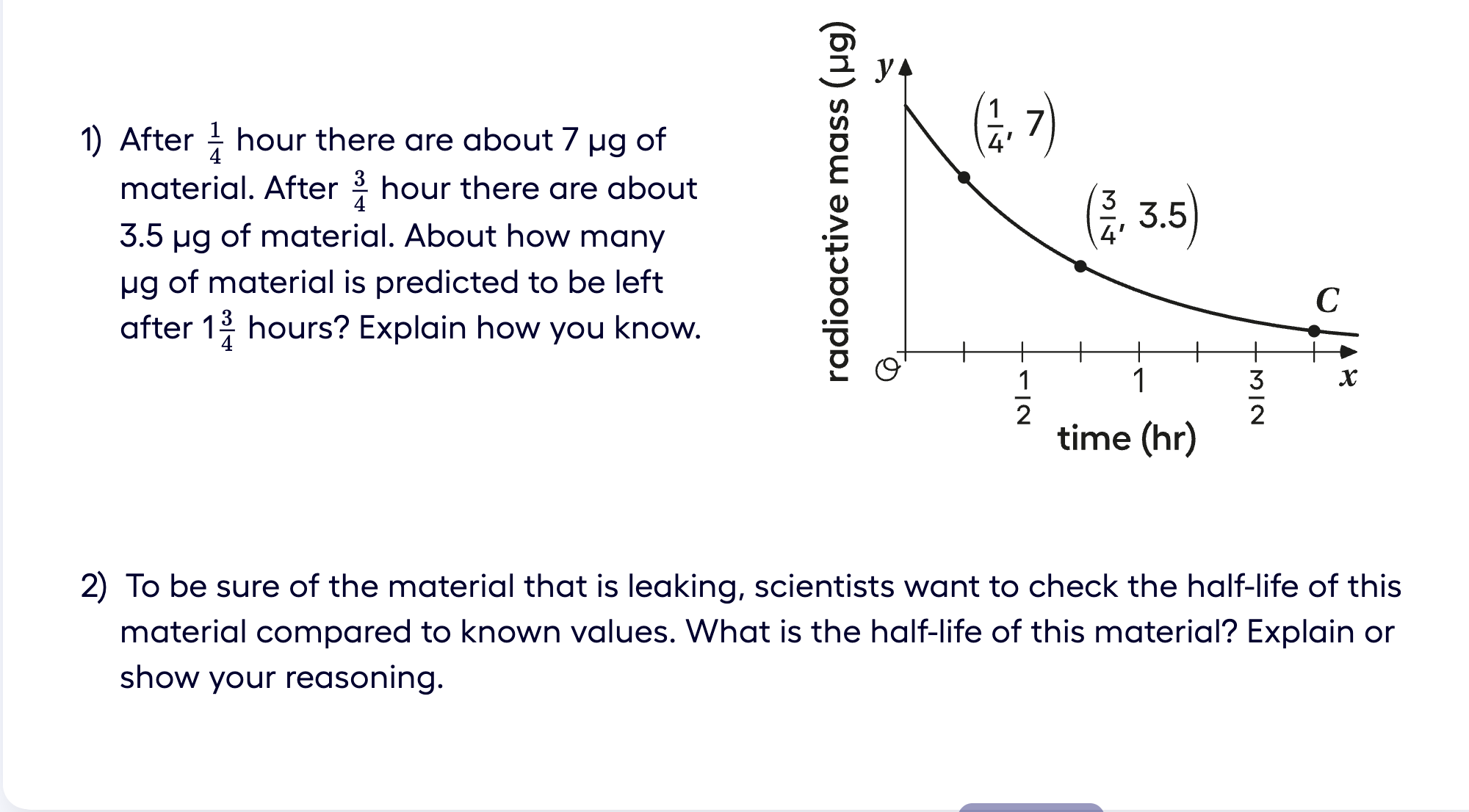
After \(\tfrac{1}{2}\) hour: about 7 µg.
After 1 hour: about 3.5 µg.
After \(1\tfrac{1}{2}\) hours: predict.
Problems
About how many µg of material is predicted to be left after \(1\tfrac{1}{2}\) hours? Explain how you know.
What is the half-life of this material? Explain or show your reasoning.
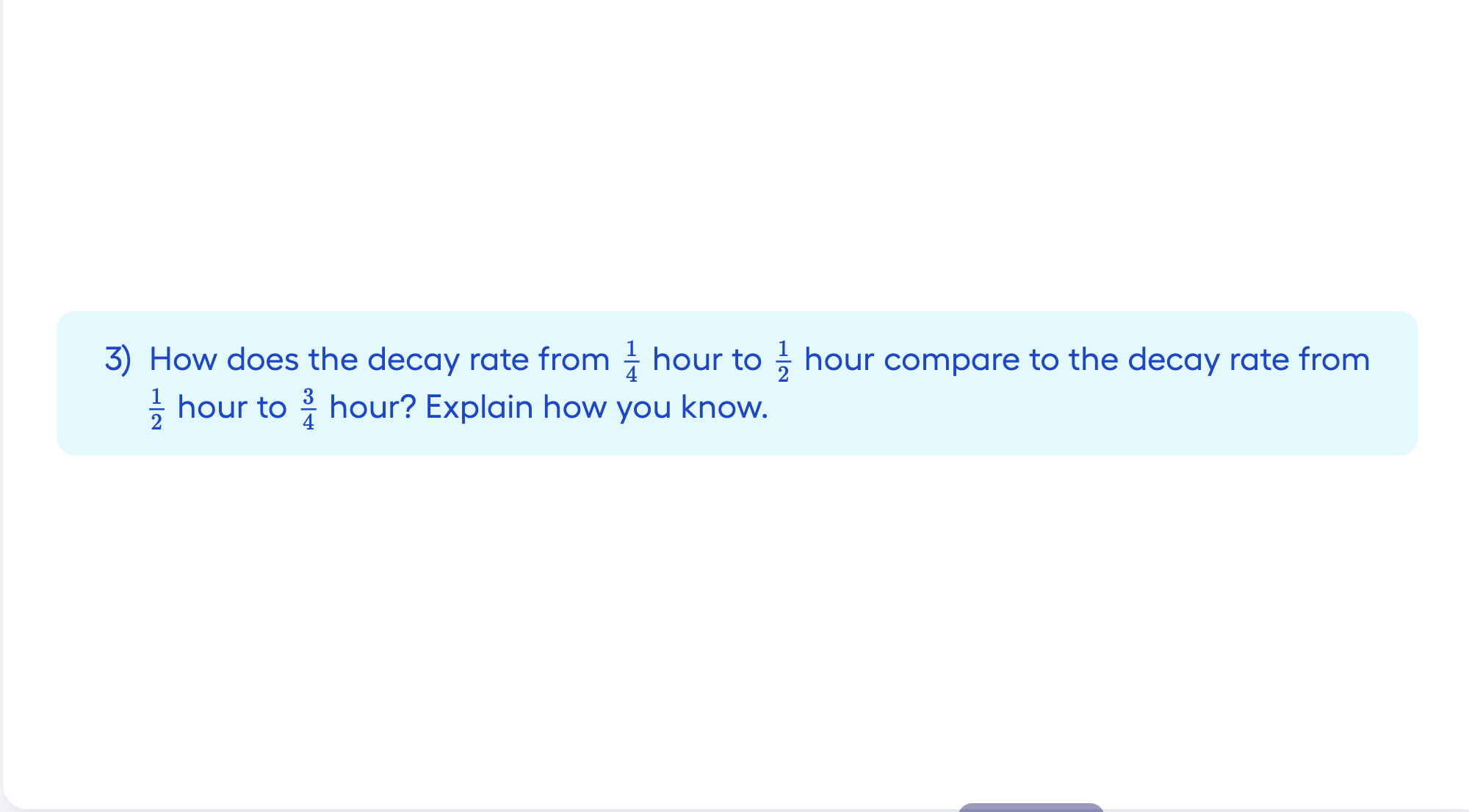
How does the decay rate from \(t = \tfrac{1}{2}\) to \(t = 1\) compare to the decay rate from \(t = 1\) to \(t = 1\tfrac{1}{2}\)? Explain how you know.
Try Writing
The amount at \(1\tfrac{1}{2}\) hours is ___ because ___.
7 min · Activity 2 Work Time. Students work alone (~4 min), then revise with a partner (~3 min) using the Stronger and Clearer Each Time protocol on Problem 1. After the first draft, partners read each other's work and ask: "What do you mean when you say ___?" and "How do you know?"
Problem 1: Target ≈ 1.75 µg. Reasoning: ½ hr → 1 hr halved (7 → 3.5), so 1 hr → 1½ hr should also halve. (Equal half-hour intervals → equal factor.) Some students may answer 1.75 directly; others may compute the quarter-hour factor (\(\sqrt{0.5}\)) and apply it twice — both are correct.
Problem 2: Half-life = ½ hour, since the amount halves between \(t = \tfrac{1}{2}\) and \(t = 1\), and that holds for every half-hour.
Problem 3: Both decay rates (in µg per half-hour) are different (3.5 µg lost vs 1.75 µg lost), but both decay factors are the same (×½). Students often confuse "rate" and "factor" — surface this in synthesis.
Amplify · 3 inputs
Order per problem: Text → Math Response (named answer1, answer2) → Note. Problem 3 → Text Response only.
Format examples: Example: 1.75 · Example: 0.5
Problem 1: How many µg after 1½ hours?
content:
  when answer1.submitted and answer1.numericValue > 1.74 and answer1.numericValue < 1.76
    "Correct! From 1 hr to 1½ hr is the same length interval (½ hr) as from ½ hr to 1 hr — so the factor is the same: ×½. So 3.5 · ½ = 1.75 µg."
  when answer1.submitted and answer1.numericValue > 0.85 and answer1.numericValue < 0.92
    "Almost — 0.875 µg is what you would get after 2 full hours (3.5 → 1.75 → 0.875). The question asks for 1½ hours, which is one more half-hour after the 1-hour mark."
  when answer1.submitted and answer1.numericValue > 1.99 and answer1.numericValue < 2.51
    "I see what happened — 2 µg or 2.5 µg suggests a linear estimate. The factor (not the difference) is what stays the same. Try ½ × 3.5."
  when answer1.submitted and answer1.numericValue > 3.49 and answer1.numericValue < 3.51
    "That is the amount at 1 hour. After another ½ hour the amount halves again."
  when answer1.submitted and not isBlank(answer1.latex)
    "Almost — equal half-hour intervals give equal factors. From ½ hr to 1 hr, the amount went from 7 to 3.5 (halved). What does ½ × 3.5 give?"
  otherwise ""
Problem 2: Half-life of this material (in hours).
content:
  when answer2.submitted and answer2.numericValue > 0.499 and answer2.numericValue < 0.501
    "Correct! The half-life is ½ hour. The amount halved over the half-hour from t = ½ to t = 1, and exponential decay halves over every half-hour."
  when answer2.submitted and answer2.numericValue > 0.999 and answer2.numericValue < 1.001
    "Not quite — the amount halved between t = ½ hr and t = 1 hr, which is a span of ½ hour. The half-life is the length of that interval."
  when answer2.submitted and answer2.numericValue > 0.249 and answer2.numericValue < 0.251
    "Almost — ¼ hour would mean the amount halved every quarter-hour. Check: from t = ½ to t = 1 (a half-hour span), the amount halved exactly once."
  when answer2.submitted and not isBlank(answer2.latex)
    "Almost — find an interval over which the amount is exactly halved. From t = ½ to t = 1, 7 µg becomes 3.5 µg — that is halving. How long is that interval?"
  otherwise ""
Problem 3: Compare the two decay rates. [Text Response only]
content:
  when answer3.submitted and not isBlank(answer3.content)
    "Thank you — share your reasoning during the synthesis discussion."
  when answer3.submitted and isBlank(answer3.content)
    "Please write your comparison before submitting."
  otherwise ""
Activity 2 · Synthesis5 min
Tracing the Radioactivity — Discussion
Connect the half-hour pattern (factor × ½) to a quarter-hour pattern (factor √(½)) to drive home: any equal interval gives an equal factor.
“How did you find the amount at 1½ hours?”From \(t = \tfrac{1}{2}\) to \(t = 1\) the amount halved (7 → 3.5). The interval from \(t = 1\) to \(t = 1\tfrac{1}{2}\) is the same length, so the same factor applies: \(3.5 \cdot \tfrac{1}{2} = 1.75\) µg.
“What is the decay factor for a quarter-hour?”Two quarter-hours = one half-hour. So if \(q\) is the quarter-hour factor, \(q^{2} = \tfrac{1}{2}\), giving \(q = \sqrt{\tfrac{1}{2}} \approx 0.707\). This works for every quarter-hour: \(t = \tfrac{1}{2}\) to \(t = \tfrac{3}{4}\), \(t = 1\) to \(t = 1\tfrac{1}{4}\), and so on.
“Decay rate vs. decay factor — what is the difference?”From \(\tfrac{1}{2}\) to 1 hr: rate = 3.5 µg lost over a half hour (= 7 µg/hr lost). From 1 to \(1\tfrac{1}{2}\) hr: rate = 1.75 µg lost (= 3.5 µg/hr lost). Different rates, same factor. The factor tells you what fraction remains; the rate (slope) tells you how many µg disappear per unit of time. Only the factor stays constant over equal intervals.
click to advance discussion ▶
Try Saying
The factor over a quarter-hour is ___ because ___.
Try Saying
The decay rate is/is not the same over equal intervals because ___.
The rate-vs-factor distinction (third question) is the bridge to Activity 3 (optional) and the central misconception of the whole lesson. Linger here. If a student says, "the decay is slowing down," ask: "In what sense? Slower in µg per hour, or slower in fraction-remaining per hour?" The factor (the second of these) is constant.
Concept · Visual~3 min
Decay Factor vs Decay Rate — same curve, different question
Both panels below show the same radioactive sample (14 µg, half-life 30 min). The annotations are the only thing that differs.
Decay Factor
The ratio between consecutive equal-interval outputs. Constant for every 30-min interval.
The amount lost each equal-interval (the slope). Diminishes as the curve flattens.
Rate = drop ÷ interval shrinks each step.
Decay factor answers: "What fraction remains?"
→ constant (½ per 30 min) → it is the b in a·bx.
Decay rate answers: "How fast is it changing?"
→ not constant (slope flattens) → average rate over an interval = Δy ÷ Δt.
Try Saying
The decay factor stays the same because ___, but the decay rate shrinks because ___.
Visual reference. Use this slide to settle the rate-vs-factor confusion before moving on. Point at one panel, then the other: "Same curve. Same data points. Different question being asked."
The blue panel asks "what fraction remains?" — that is the multiplicative factor, constant across equal intervals. The amber panel asks "how many µg disappeared?" — that is the additive rate, which shrinks because there is less material left to lose each step.
Common student confusion to surface: "the decay is slowing down." Press: slowing in what sense? Slower in µg/hr (yes — that is the rate), but not slower in fraction-per-hour (factor stays put). Both statements are true; they answer different questions.
Activity 3 · Work TimeOptional · beyond standards15 min
Average Rate of Exponentials
Here is a graph of the mass of a radioactive material, in µg, as a function of time in hours. Use the labeled points on the graph below.
Problems
By what factor does the mass change every hour?
For each pair of points, find the average rate of change, in µg per hour:
\((0, 16)\) and \((1, 8)\)
\((1, 8)\) and \((2, 4)\)
\((0, 16)\) and \((2, 4)\)
Between hours 19 and 20, by what factor do you expect the mass to change? Explain.
Between hours 19 and 20, what do you expect the average rate of change to be? Explain.
15 min · Optional. This activity goes beyond the lesson standards (HSF-LE.A.1.c). Skip if pacing is tight; the factor-vs-rate insight from Activity 2 covers the standards.
Problem 1: Factor ½ (8/16 = 4/8 = ½). Problem 2a: \(\dfrac{8 - 16}{1 - 0} = -8\) µg/hr. Problem 2b: \(\dfrac{4 - 8}{2 - 1} = -4\) µg/hr. Problem 2c: \(\dfrac{4 - 16}{2 - 0} = -6\) µg/hr. Problem 3: Same factor: ½ — equal intervals give equal factors. Problem 4: A negative value close to 0 — far out on the curve, very little is left, so the curve has nearly leveled off. The slope (rate) gets shallower; the factor stays exactly ½.
The big idea: the factor is invariant, the rate is not. That is what the title slide's question is really asking.
Amplify · 6 inputs
Order per problem: Text → Math Response (named answer1, answer2a, answer2b, answer2c, answer3) → Note. Problem 4 → Text Response only.
content:
  when answer1.submitted and answer1.numericValue > 0.499 and answer1.numericValue < 0.501
    "Correct! Hourly factor = ½ (the mass halves each hour: 16 → 8 → 4)."
  when answer1.submitted and answer1.numericValue > 1.999 and answer1.numericValue < 2.001
    "That is the inverse — 2 doubles the mass. The mass halves each hour, so the factor is ½."
  when answer1.submitted and not isBlank(answer1.latex)
    "Almost — divide consecutive y-values: 8 ÷ 16 = ? That is the hourly factor."
  otherwise ""
Problem 2a: Average rate from (0,16) to (1,8).
content:
  when answer2a.submitted and answer2a.numericValue > -8.005 and answer2a.numericValue < -7.995
    "Correct! Average rate = (8 − 16)/(1 − 0) = −8 µg/hr."
  when answer2a.submitted and answer2a.numericValue > 7.995 and answer2a.numericValue < 8.005
    "Almost — the mass is decreasing, so the average rate of change is negative. Check the sign of (8 − 16)."
  when answer2a.submitted and not isBlank(answer2a.latex)
    "Not quite — the average rate of change is (Δy)/(Δx) = (8 − 16)/(1 − 0). What do you get?"
  otherwise ""
Problem 2b: Average rate from (1,8) to (2,4).
content:
  when answer2b.submitted and answer2b.numericValue > -4.005 and answer2b.numericValue < -3.995
    "Correct! Average rate = (4 − 8)/(2 − 1) = −4 µg/hr. Notice it is half of the previous interval's rate, even though the factor is the same."
  when answer2b.submitted and answer2b.numericValue > 3.995 and answer2b.numericValue < 4.005
    "Almost — the mass is decreasing, so the average rate is negative. Try (4 − 8)/(2 − 1)."
  when answer2b.submitted and not isBlank(answer2b.latex)
    "Not quite — average rate = (4 − 8)/(2 − 1). What do you get?"
  otherwise ""
Problem 2c: Average rate from (0,16) to (2,4).
content:
  when answer2c.submitted and answer2c.numericValue > -6.005 and answer2c.numericValue < -5.995
    "Correct! Average rate = (4 − 16)/(2 − 0) = −6 µg/hr — the average of the two one-hour rates (−8 and −4)."
  when answer2c.submitted and answer2c.numericValue > 5.995 and answer2c.numericValue < 6.005
    "Almost — the mass decreases, so the rate is negative. Compute (4 − 16)/(2 − 0)."
  when answer2c.submitted and not isBlank(answer2c.latex)
    "Almost — average rate = (4 − 16)/(2 − 0). What do you get?"
  otherwise ""
Problem 3: Factor between hour 19 and hour 20.
content:
  when answer3.submitted and answer3.numericValue > 0.499 and answer3.numericValue < 0.501
    "Correct! Same factor as every other 1-hour interval: ½."
  when answer3.submitted and answer3.numericValue > -0.001 and answer3.numericValue < 0.001
    "Almost — the curve looks nearly flat at hour 19, so the rate is nearly 0, but the factor is what stays constant. Each hour the remaining mass is multiplied by ½."
  when answer3.submitted and not isBlank(answer3.latex)
    "Almost — equal-length intervals give equal factors for an exponential function. The factor between any consecutive hours is the same as between (0,16) and (1,8). What is that factor?"
  otherwise ""
Problem 4: Average rate between hour 19 and 20. [Text Response]
content:
  when answer4.submitted and not isBlank(answer4.content)
    "Thank you — share your reasoning. Hint: the curve is nearly flat there, so the slope (rate) is a small negative number, even though the factor is still exactly ½."
  when answer4.submitted and isBlank(answer4.content)
    "Please write your prediction before submitting."
  otherwise ""
Synthesis · Big Idea~4 min
If the curve looks steeper, how can the factor be the same?
“What does steeper mean visually? What does it measure?”A steeper slope measures the change in y per unit of x — that is the rate of change (how many µg lost per hour, or how many people added per year). The slope does grow as x grows.
“What does the factor measure? Is it the same thing as slope?”No. The factor is a ratio — it measures \(f(x+1) \div f(x)\), the fraction remaining over a unit interval. For \(y = 16 \cdot (\tfrac{1}{2})^{x}\), this ratio is always ½, no matter how big or small y is.
“Both can be true at once?”Yes. See the table below: the slopes (rates) get smaller as the curve flattens, but the factor (ratio) stays exactly ½. The picture shows the rate. The math shows the factor. They are different measurements of the same curve.
click to advance discussion ▶
For \(y = 16 \cdot (\tfrac{1}{2})^{x}\) — equal factors over equal intervals, even as the slope shrinks
Interval
y-values
Average rate (slope)
Factor (ratio)
\(x: 0 \to 1\)
16 → 8
−8 µg/hr
×½
\(x: 1 \to 2\)
8 → 4
−4 µg/hr
×½
\(x: 2 \to 3\)
4 → 2
−2 µg/hr
×½
\(x: \tfrac{1}{2} \to 1\)
≈ 11.3 → 8
≈ −6.6 µg/hr
×\(\tfrac{1}{\sqrt{2}}\) ≈ 0.707
\(x: 1 \to 1\tfrac{1}{2}\)
8 → ≈ 5.66
≈ −4.7 µg/hr
×\(\tfrac{1}{\sqrt{2}}\) ≈ 0.707
Same length interval → same factor, every time. The slope tells a different story than the factor.
Try Saying
The slope changes because ___, but the factor stays the same because ___.
Big-idea slide. Click through the three reveal points, then use the table to show the same curve from two angles. The Big Question on the title slide ("does it grow faster in some places than others?") finds its answer here: the slope grows; the factor does not. Both statements are true — they measure different things.
If a student protests, "but I can see it getting steeper!" — confirm: yes, you can. The picture is honest. The factor is a different kind of consistency, one the eye does not see directly.
Lesson Synthesis
The function \(R(t) = 200 \cdot \!\left(\tfrac{1}{2}\right)^{t}\) describes the amount of radioactive material \(R\), in mg, in a sample \(t\) hours after measuring 200 mg.
“How is the amount changing every hour?”It decays by a factor of \(\tfrac{1}{2}\) each hour. After one hour, \(\tfrac{1}{2}\) of the previous amount remains.
“By what factor does the material decay in the first 15 minutes?”15 minutes = \(\tfrac{1}{4}\) hour, so the factor is \(\left(\tfrac{1}{2}\right)^{1/4} \approx 0.841\). Check: \(\bigl(\!\left(\tfrac{1}{2}\right)^{1/4}\!\bigr)^{4} = \tfrac{1}{2}\) — four quarter-hours compound to one hour. ✓
“By what factor does the material decay between minute 30 and minute 45?”Same factor: \(\left(\tfrac{1}{2}\right)^{1/4} \approx 0.841\). The interval is also \(\tfrac{1}{4}\) hour — equal intervals give equal factors, regardless of starting point.
“Suppose at some point we measure 32 mg. How much is left 45 minutes later?”45 minutes = three quarter-hours. Each quarter-hour multiplies by \(\left(\tfrac{1}{2}\right)^{1/4}\), so 45 minutes multiplies by \(\left[\left(\tfrac{1}{2}\right)^{1/4}\right]^{3} = \left(\tfrac{1}{2}\right)^{3/4}\). Then \(32 \cdot \left(\tfrac{1}{2}\right)^{3/4} \approx 32 \cdot 0.595 \approx 19.0\) mg.
Or, more cleanly: 45 minutes = \(\tfrac{3}{4}\) hour, so 32 mg \(\cdot\, \left(\tfrac{1}{2}\right)^{3/4} \approx 19.0\) mg.
click to advance discussion ▶
Try Saying
The factor over a fractional interval of length \(n\) is ___ because ___.
I Can… (SWBAT)
Explain why an exponential function changes by the same factor over equal intervals — even when those intervals are not whole numbers.
Lesson Synthesis (~5 min). Cold-call through the four questions. The conceptual peak is question 3 — the factor over "minute 30 to minute 45" is the same as the factor over "hour 0 to minute 15." If students answer 4 by working in minutes (45 min in 60 min = ¾), great. If they answer in 15-minute chunks (3 chunks of ¼ hour each), also great — and shows the multiplicative compounding directly. SWBAT closes the lesson; do not put it on the title slide.
Cool-Down5 min
Cost of a Haircut
Between 1998 and 2018, the price of a haircut at one salon increased exponentially so that the same haircut in 2018 cost 51% more than it did in 1998. Suppose the salon charged $18 for a basic haircut in 1998, raising prices by a steady percentage each year.
Problems
What is the price of a basic haircut at the salon in 2008? Round to the nearest cent.
In 2003, the salon charged $19.95 for a basic haircut. Find the cost of the basic haircut in 2013. Round to the nearest cent.
Cool-Down · 5 min. Students apply the lesson's core skill: the equal-factor-over-equal-interval property holds for any interval, including a 10-year half of a 20-year window.
Problem 1: 20 years → factor 1.51. 10 years → factor \(1.51^{1/2} \approx 1.2288\). Price in 2008: \(18 \cdot 1.51^{1/2} \approx \$22.12\).
Problem 2: 2003 to 2013 is 10 years. Decade factor is \(1.51^{1/2}\). Price in 2013: \(19.95 \cdot 1.51^{1/2} \approx \$24.51\). (Rounding may give $24.52 — accept either.)
Common errors: dividing 51% by 2 to get 25.5% per decade (linear thinking — this is the lesson's central misconception); using 1.51 as the decade factor (forgetting the time conversion); compounding too many times.
Amplify · Cool-Down Setup
Problem 1: Text component (full problem text + Example: 22.12) → Math Response named answer1 → Note with CL.
Problem 2: Text component (full problem text + Example: 24.51) → Math Response named answer2 → Note with CL.
Use numericValue ranges for real-number checks.
Problem 1: Find the price of a basic haircut at the salon in 2008.
content:
  when answer1.submitted and answer1.numericValue > 22.10 and answer1.numericValue < 22.14
    "Correct! 10 years is half of the 20-year window, so the decade factor is 1.51^(1/2) ≈ 1.2288. Price: 18 · 1.51^(1/2) ≈ $22.12."
  when answer1.submitted and answer1.numericValue > 22.58 and answer1.numericValue < 22.60
    "Almost — $22.59 looks like 18 · (1 + 0.51/2) = 18 · 1.255. That uses linear logic. For exponential growth, take the square root of 1.51 (not divide by 2). Try 18 · 1.51^(1/2)."
  when answer1.submitted and answer1.numericValue > 27.17 and answer1.numericValue < 27.19
    "That is the price in 2018 (18 · 1.51 = $27.18). The question asks for 2008, halfway through the window. Use the decade factor 1.51^(1/2)."
  when answer1.submitted and answer1.numericValue > 18.08 and answer1.numericValue < 18.10
    "Almost — $18.09 looks like 18 · (1 + 0.51/100). Check whether you used the full 51% or accidentally divided it by 100. The decade factor is 1.51^(1/2) ≈ 1.229."
  when answer1.submitted and answer1.numericValue > 13.76 and answer1.numericValue < 13.78
    "I see what happened — you divided 18 by 1.31 (or similar). For exponential growth across half the window, multiply 18 by 1.51^(1/2), not divide."
  when answer1.submitted and answer1.numericValue > 18.91 and answer1.numericValue < 18.93
    "Hmm... take another look — $18.92 looks like 18 · (0.51/10 + 1) = 18 · 1.051 (using 5.1% per year). The problem says 51% over 20 years (not 51% per year and not 5.1% per year). Use 1.51^(1/2) for the 10-year factor."
  when answer1.submitted and isBlank(answer1.latex)
    "Enter a dollar amount rounded to the nearest cent. Example: 22.12"
  when answer1.submitted
    "Not quite. The 20-year factor is 1 + 0.51 = 1.51. What is the 10-year factor? (Hint: equal factors over equal intervals — 10 years is half the window, so the factor is 1.51^(1/2).) Multiply 18 by that."
  otherwise ""
Problem 2: In 2003, the salon charged $19.95 for a basic haircut. Find the cost of the basic haircut in 2013.
content:
  when answer2.submitted and answer2.numericValue > 24.49 and answer2.numericValue < 24.53
    "Correct! 2003 → 2013 is one decade, so the factor is 1.51^(1/2) ≈ 1.2288. Price: 19.95 · 1.51^(1/2) ≈ $24.51."
  when answer2.submitted and answer2.numericValue > 30.11 and answer2.numericValue < 30.13
    "That is 19.95 · 1.51 — the full 20-year factor. Between 2003 and 2013 is only 10 years, so use 1.51^(1/2) (the decade factor)."
  when answer2.submitted and answer2.numericValue > 25.04 and answer2.numericValue < 25.06
    "You're close — $25.05 looks like 19.95 · 1.255 (linear: 1 + 0.51/2). For exponential growth, the decade factor is 1.51^(1/2) ≈ 1.229, not 1.255."
  when answer2.submitted and answer2.numericValue > 39.59 and answer2.numericValue < 39.61
    "Hmm — that doubles the cost. Maybe you used 19.95 · 1.51 · 1.51 / something? Between 2003 and 2013 is only 10 years: 19.95 · 1.51^(1/2)."
  when answer2.submitted and answer2.numericValue > 21.93 and answer2.numericValue < 21.95
    "Not quite — $21.94 looks like 19.95 · 1.10 (10% over a decade). Check the decade factor: 1.51^(1/2) ≈ 1.229, which is closer to 23% per decade."
  when answer2.submitted and isBlank(answer2.latex)
    "Enter a dollar amount rounded to the nearest cent. Example: 24.51"
  when answer2.submitted
    "Not quite. The decade factor is 1.51^(1/2) (because two decades give the 20-year factor 1.51). Multiply 19.95 by 1.51^(1/2). Round to the nearest cent."
  otherwise ""
Lesson Summary
Equal factors over equal intervals — even fractional ones
For an exponential function, every time the input increases by a certain amount, the output changes by a certain factor. The country population (in millions) can be modeled by \(P(t) = 5 \cdot 16^{t}\), where t is centuries since 1900. By this model, the factor for any one century is 16. What about one decade?
Lesson Summary
Exponential functions increase or decrease by equal factors over equal intervals — even when the intervals are fractional.
Lesson Summary slide. Read aloud or have a student read. The yellow box generalizes — the factor is \(b^{n}\) for an interval of length n, no matter where the interval begins. Tomorrow students will use this property to compare exponential functions and link them back to their graphs.
Definition
Depreciates exponentially
Loses the most value the first cycle, then loses less and less value each cycle as the value approaches zero. Useful for business planning and taxes, as this loss in value can be subtracted from a business's income.