← cedarwater.net ·  Cedar Water · West Philadelphia

Tree‑Crops & Heritage Seedlings

A small, rotating selection of improved, heritage-lineage nut and fruit seedlings — pawpaw, honey locust, shellbark hickory, hican, persimmon, and black locust — grown in living, fungal soil on the side of a West Philadelphia apartment. Each tree below is profiled for siting, soil, wildlife, and the guild it wants to grow in.

Pawpaw  ·  Honey Locust  ·  Shellbark Hickory  ·  Hican  ·  Persimmon  ·  Black Locust

These seedlings carry good genetics — improved, heritage cultivar lineages selected over decades for sweeter pods, better fruit, and thinner-shelled, easier-cracking nuts (more on where they come from just below). We grow them out as seedlings, so expect the honest variability of seed-grown stock: most will be excellent, a few will be ordinary, and the best can be grafted forward.

The profiles below give you what you actually need to put a tree in the right place: spacing and mature size, time to first harvest, soil and sun, what each does for the wider ecosystem, its quirks, where it sits in a guild, what it feeds, and whether the deer will leave it alone. Read the siting flags — they save years.

The north-side rule. Tall nut trees — hickory, hican, mature honey locust — eventually throw a 60–100 ft shadow. Site them on the north edge of your planting or property so their shade falls away from the buildings and the sun-hungry crops to their south. Pawpaw, the true understory tree here, is happy in the filtered light on the south side of that canopy. Persimmon is taller (30–50 ft) but stays narrow-crowned, so it casts little lateral shade — give it a sunny edge or gap where it fruits best, rather than tucking it underneath.

About the nursery

“Urban silvopasture” = meat rabbits + trees

Cedar Water is a small, rotating selection of nut and fruit seedlings grown on the side of a West Philly victorian cut up into apartments — not a field, not a greenhouse, but air-pruning beds along the side of the house, and soil and amendments coming from the backyard. The wood chips that cover the walkways decay and become fungal topsoil — ecologically akin to those found in established forests, and great for growing trees. My rabbits supply the cold-manure compost and charge up the homemade biochar from my firepit.

I have gathered most of the seeds myself, from the stock John W. Hershey selected and grafted around Downingtown in the 1930s–40s for his “No. 1 Tree-Crops Farm of America” — sweeter honey-locust pods, better persimmons, thinner-shelled nuts — the living embodiment of J. Russell Smith's Tree Crops: A Permanent Agriculture.

Closed loop

Firepit woodchips, rabbit manure, homemade biochar — the inputs come from the yard, not a bag.

Living soil

Grown in fungal, chip-built topsoil so mycorrhizal trees establish faster and stronger.

Heritage genetics

Hershey & Pennsylvania cultivar lineages, grown out as seedlings — graft the best, feed the rest to the wild.

01

Pawpaw

Asimina triloba
Native understory fruit
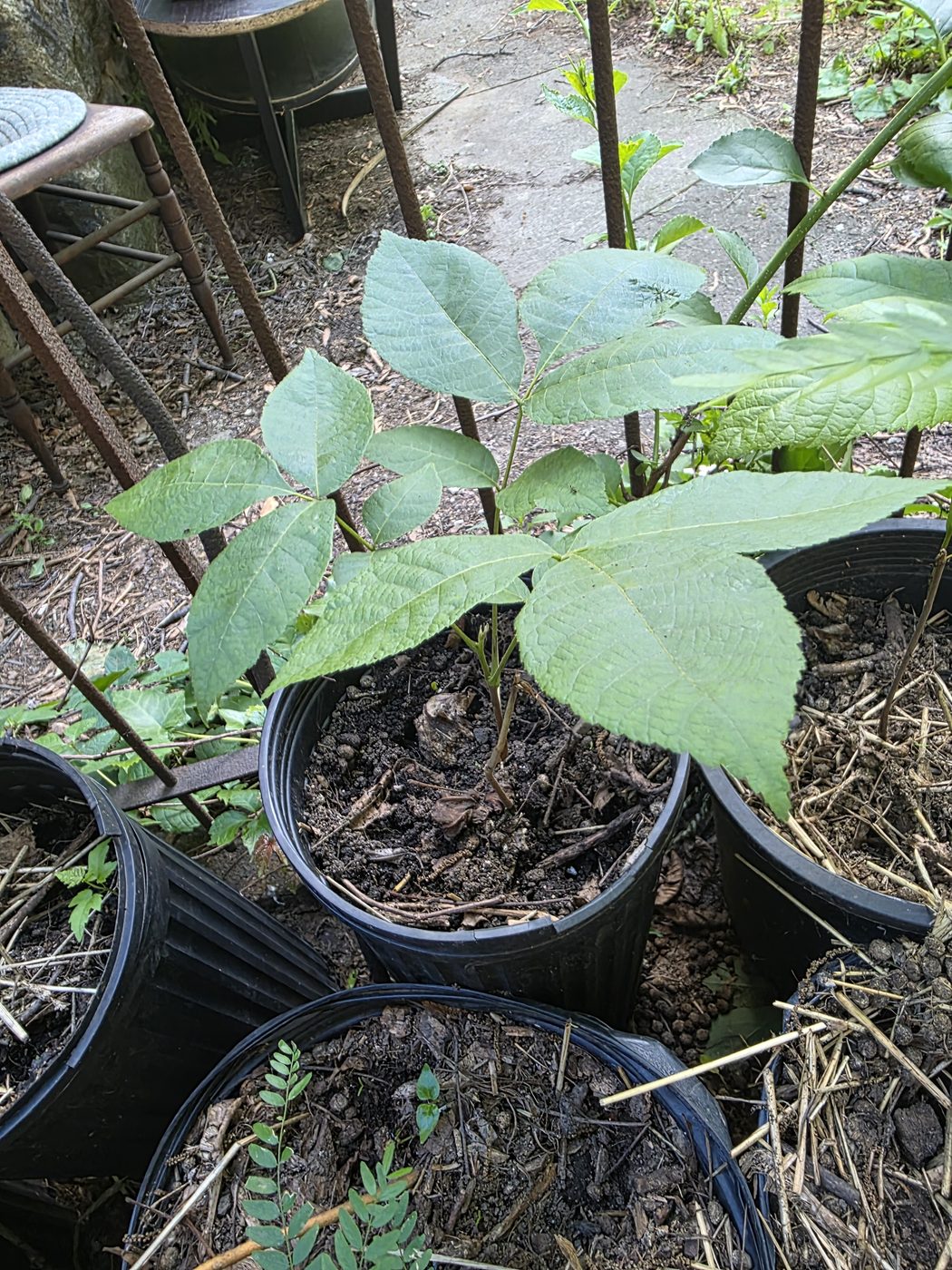
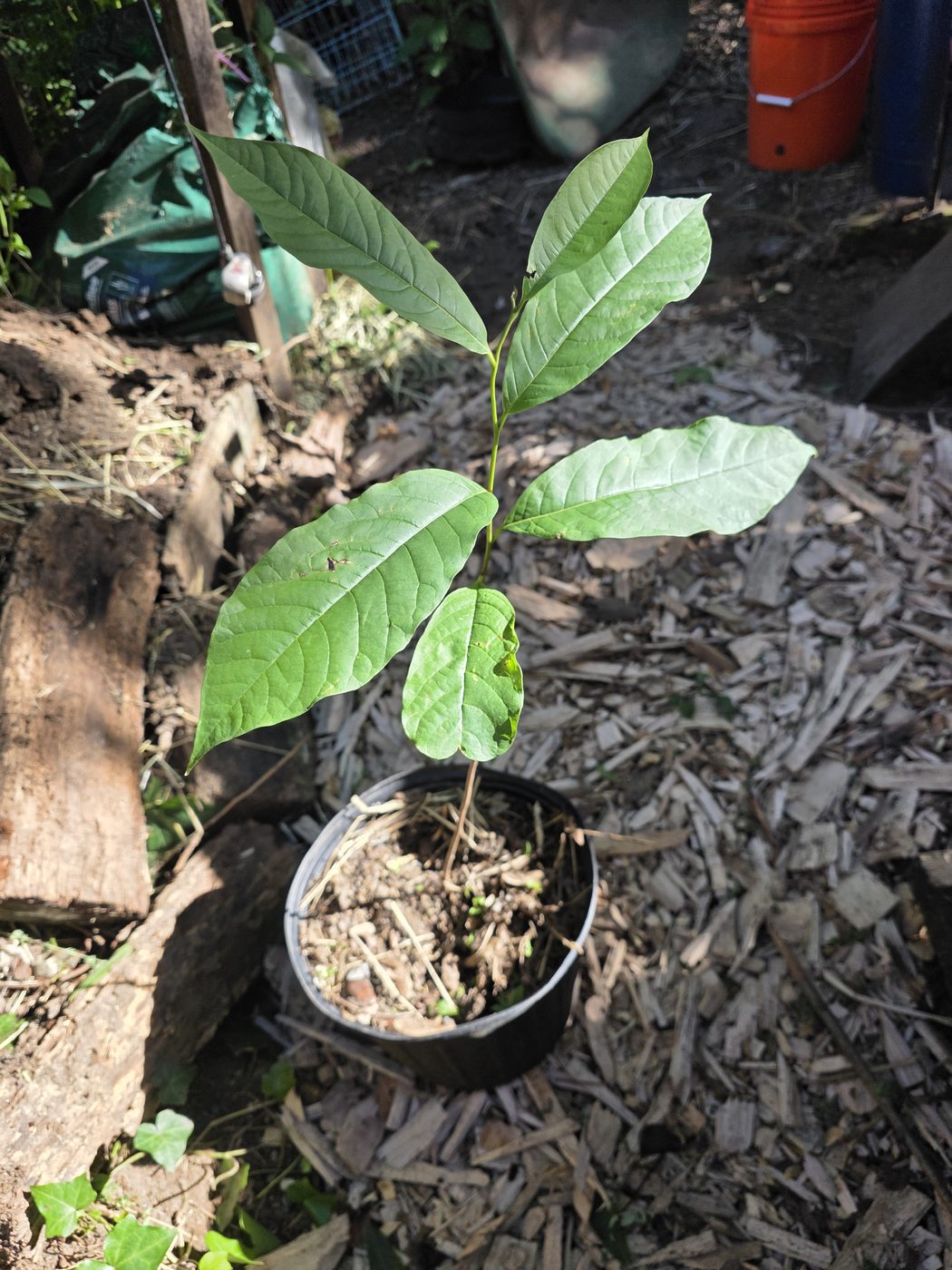
Pawpaw seedling in a black nursery pot, large drooping tropical-looking leaves
In our beds Pawpaw seedling — note the big, glossy, drooping leaves clustered at the shoot tips.
Mature pawpaw cultivars in fall color at a Michigan orchard
🌿
Mature pawpaw
Asimina triloba
Grown out Mature pawpaws in fall color at the Marc Boone orchard, Michigan — the classic short, broad-crowned pawpaw habit displayed by the shorter trees in the front. Photo: Cbarlow, CC BY‑SA 4.0, via Wikimedia Commons.

The largest edible fruit native to North America, and the only temperate member of a tropical family (Annonaceae). The fruit is custard-textured, tasting of banana, mango, and pineapple at once — the “Hoosier banana.” Pawpaw is a clonal, patch-forming understory tree: left alone it spreads by root suckers into a thicket — so be prepared to mow around it, or be happy with a “PawPaw Patch!” Hershey's circle still makes pawpaw mead from the Downingtown trees, and the fruit is good enough that there's a real case for a local pawpaw festival.

Spacing
8–15 ft for a thicket; 15–25 ft for specimens. Plant 2+ unrelated seedlings.
Mature size
15–25 ft tall & wide (rarely 35 ft)
First fruit
5–8 yrs from seedling (grafted, sooner)
Soil
Deep, fertile, moisture-retentive, well-drained; slightly acidic (pH 5.5–7)
Sun
Mature: full sun fruits best, grows in shade. Young: already midday-sun grown — just stretch the hours

Ecosystem functions

The sole larval host of the Zebra Swallowtail butterfly. Fills the understory/shrub layer, and its suckering thickets become dense wildlife cover. Bark contains acetogenins (natural insecticide), so foliage is rarely browsed.

Special needs

Deep taproot — hard to transplant, so plant young and don't let it sit rootbound. Self-incompatible and fly/beetle-pollinated (not bees) — plant in clusters; some growers hang overripe fruit or set compost nearby to draw pollinators. Seedlings are sun-sensitive at establishment.

Permaculture niche

The shade-tolerant understory fruit layer of an Eastern food forest — happy beneath a high oak/hickory canopy, then craving more light as it matures. Deer-proof, so it anchors edges where other fruit would be eaten.

Wildlife

Ripe fruit feeds opossums, raccoons, squirrels, foxes, box turtles, and birds in early autumn. Foliage hosts Zebra Swallowtail caterpillars. Low-fuss, high-value mast for a wet woodland edge.

🦌 Deer Deer-resistant

One of the few fruit trees deer leave alone — the acetogenins make the foliage distasteful, so you can usually plant it unprotected. Still cage against voles/rabbits at the base and guard the trunk from buck rub in its first couple of winters.

How to plantPlanting your pawpaw
  1. Already sun-hardened — just stretch the hours. These were grown in air-pruning beds getting direct midday sun (~10–2), the most intense part of the day, so the leaves can already take strong light. Going to an all-day spot just adds duration, not intensity — a few days' transition is plenty, no long shade ritual needed.
  2. Water is the real first-season job. More sun-hours mean more water drawn up while the roots re-establish, so keep it consistently moist the first summer; a little afternoon shade helps but isn't required. From year two on, the more sun, the more fruit.
  3. Be gentle with the taproot. Pawpaws resent root disturbance — don't tease the roots apart; plant the whole rootball at the same depth it sat in the pot, and water it in well.
  4. Plant a friend. Pawpaws are self-incompatible, so set two or more unrelated trees within ~30 ft for fruit.
  5. Mulch, don't cage. Deer leave the foliage alone, so no tube needed — but mulch the root zone and guard the base from voles/rabbits.

Suggested guild — the Pawpaw Thicket

Tuck pawpaws on the south side of your tall-nut canopy where they get bright, broken light. Underplant a moist-soil understory and let them colonize.
Canopy: oak / hickory (high, dappled light) Shrub: spicebush, currant, gooseberry N-source: groundnut (Apios) twining vine Ground: ramps, ostrich fern, wild ginger Accumulator: comfrey ring
02

Hershey Improved Honey Locust

Gleditsia triacanthos
John C. Hershey selection
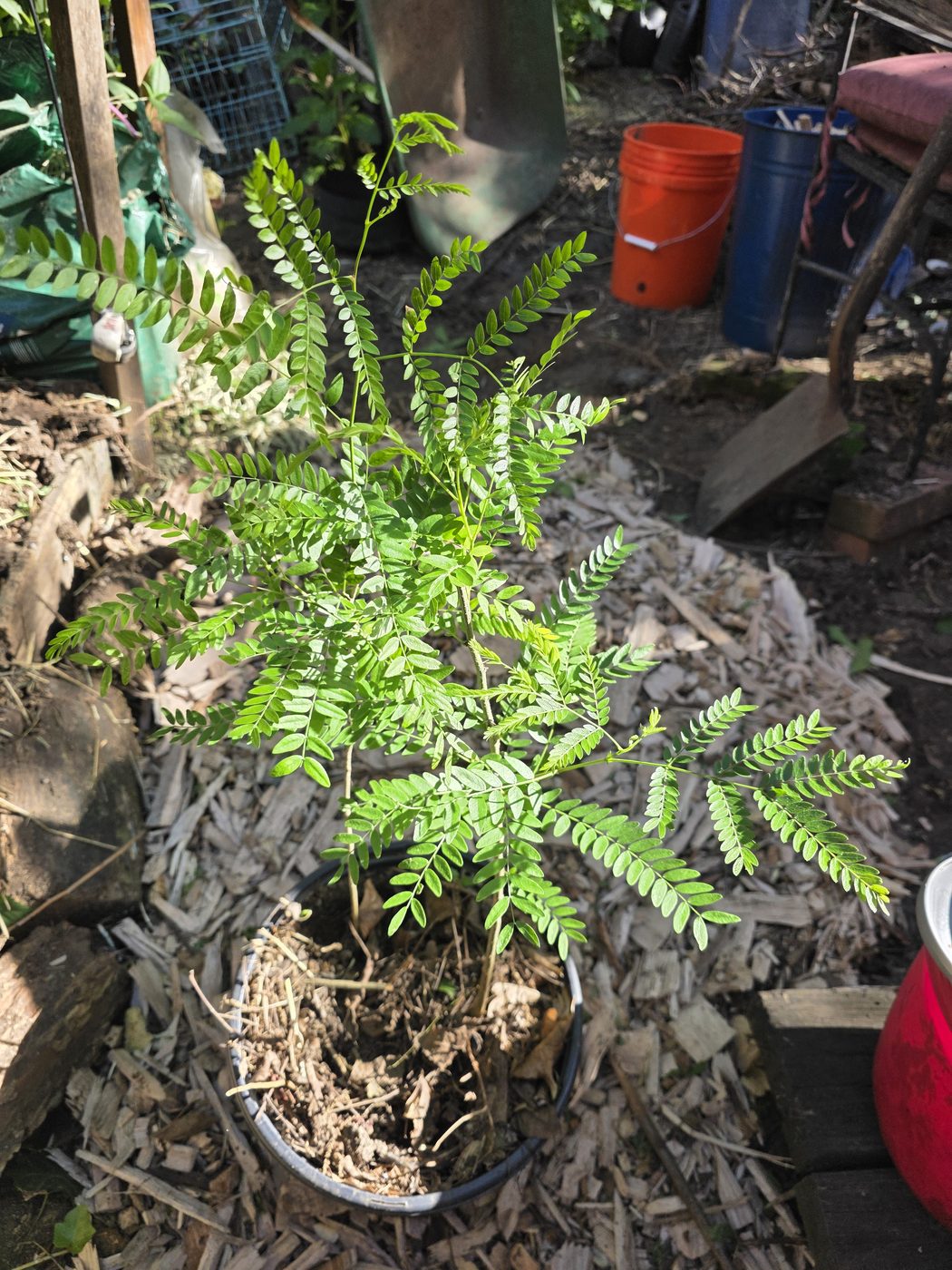
Honey locust seedling with fine, fern-like pinnately compound leaves
In our beds Honey-locust seedling — the airy, fern-like pinnate (and bipinnate) leaves that cast “delicate” shade.
Old-growth honey locust tree with man for scale, USDA Forest Service archive
🌳
Mature honey locust
Gleditsia triacanthos
Grown out An old-growth honey locust, USDA Forest Service archive — height made visible by the man standing at the base. Photo: William R. Barbour / USDA Forest Service via the NRCS PLANTS Database, public domain, on Wikimedia Commons.

Hershey hunted down honey locusts with the sweetest pods and the fewest thorns, and grafted them forward. The pods of his selections run to roughly 35% sugar — “pigs will sell their souls for these things,” as Dale Hendricks puts it in the Philadelphia magazine profile of Hershey — and he aimed for a “kinder, gentler honey locust… without thorns so long they pop tractor tires.” These are open-pollinated seedlings from that improved stock: fast, tough, and forgiving, though seedlings can throw thorns and variable pod-sugar, so graft the best later if you want certainty.

Spacing
20–35 ft as a pasture mast tree; ~15 ft as fodder hedge
Mature size
30–70 ft, comparable spread
First pods
3–5 yrs to begin; heavy by 8–10
Soil
Almost anything — compaction, drought, flood, salt, high pH; juglone-tolerant
Sun
Full sun (shade-intolerant)

Ecosystem functions

A silvopasture cornerstone: its filtered, “delicate” shade lets grass keep growing underneath while the sugar-rich pods (30–45 cm) fatten livestock and wildlife. Flowers feed pollinators; fast growth builds early structure and leaf litter.

Special needs

Not a nitrogen-fixer — it's a legume but forms no rhizobial nodules, a common myth; its gift is light shade and pod mast, not free N. Watch for thorny watersprouts/suckers (rootstock genetics). Self-sown seedlings can become weedy in ungrazed ground — graze or mow them.

Permaculture niche

The classic Tree Crops pasture-improvement tree (J. Russell Smith leaned on Hershey's plantings). A light-shade nurse and fodder producer — the over-story of an alley-cropped or silvopasture system.

Wildlife

Pods are sought by deer, squirrels, and small mammals; flowers draw bees and other insects. Wild thorny forms also give birds protected nesting — a trade-off against the thornless habit.

🦌 Deer Protect young trees

Deer love the pods (a feature on a mature tree) but will also browse tender seedlings to the ground. Protect with a 5 ft tree tube or welded-wire cage and a solid stake until the leader is well above the browse line; mature bark looks after itself.

Siting: place where its light shade helps forage rather than shading out a sun crop. It interplants well — Rising Locust Farm, in the Hershey article, set 800 trees across a 20-acre pasture with every fourth a timber or nut tree.

How to plantPlanting your honey locust
  1. Full sun, almost any soil. This is the easy one — it shrugs off compaction, drought, flooding, salt, and high pH. Just give it open sun; it won't tolerate shade.
  2. Protect the seedling from deer. Deer will browse a tender young tree to a stub. Use a 5 ft tree tube or welded-wire cage with a solid stake until the leader is well above the browse line.
  3. Water the first season, then leave it — it's fast and self-reliant once rooted.
  4. Manage thorny suckers. Seedlings can throw thorns and root-suckers; mow or prune them out, and graft a known-sweet, thornless selection later if you want certainty.
  5. Don't expect free nitrogen. It's a legume but doesn't fix N — its gift is light shade and sugar-rich pods, so still feed the system from other sources.

Suggested guild — Silvopasture

Honey locust over managed pasture, with periodic nut/timber trees woven in and staggered mast partners nearby.

Over: honey locust (light shade + pods) Floor: cool-season grass + clover Every 4th tree: nut / timber (hickory, oak) Staggered mast: persimmon, mulberry Stock: pigs, cattle, sheep
03

Shellbark Hickory

Carya laciniosa  ·  “Kingnut”
Improved cultivar seedling
Shellbark hickory seedling with compound leaves of five broad toothed leaflets
In our beds Shellbark seedling — compound leaves, 5 broad leaflets with the terminal three largest. Grown from select cultivar nuts.
Mature shellbark hickory in winter habit against blue sky
🌳
Mature shellbark hickory
Carya laciniosa
Grown out Mature shellbark hickory in winter — the long straight trunk and high, open crown a 60–80 ft canopy nut tree settles into. Photo: Plant Image Library, CC BY‑SA 2.0, via Wikimedia Commons.

The “Kingnut” — the largest nut of any North American hickory, and the largest native nut on the continent. These seedlings are grown from improved cultivar genetics (open-pollinated nuts from grafted orchards) selected for crackability, size, flavor, and productivity — the Pennsylvania lineage of Fayette Etter selections: Fayette, Hoffeditz, Henry, Keystone, Stauffer, Longenecker, Parker. A majestic, slow, long-lived bottomland tree — the one you plant for your grandchildren.

Spacing
30–40 ft — a big tree
Mature size
60–80 ft (to 100+), 40–60 ft crown
First nut
10–15+ yrs seedling (grafted ~6–10). “First they creep, then they leap.”
Soil
Rich, moist to wet bottomland; tolerates spring flooding; deep
Sun
Full to part sun; very shade-tolerant young, full sun to bear

Ecosystem functions

Premier hard mast for squirrels, deer, turkey, foxes, ducks and muskrats. Larval host for luna moth and the hickory horndevil (regal moth), among many. Deep taproot anchors soil; dense, shock-resistant timber; a long-lived carbon store.

Special needs

Fungal soils, not pioneer ground. Hickories are ectomycorrhizal and want living, fungus-rich forest duff — plant into woodsy soil or inoculate, and mulch heavily with wood chips/leaves to build that fungal layer. Deep taproot → transplant young, minimize root disturbance, never let it get rootbound. Leafs out late; don't assume it's dead in spring.

Permaculture niche

The climax overstory — the long-term canopy nut tree of the system. Plant a few for cross-pollination (wind-pollinated, partly self-incompatible) and give them decades.

Wildlife

High-fat, high-protein nuts are sought across the food web; the late-falling mast bridges autumn into winter. Mature shaggy bark also shelters roosting bats.

🦌 Deer Protect for years

Slow, late-leafing seedlings are vulnerable a long time: deer browse the tender growth and bucks rub the trunk. Use a 5 ft tube or sturdy caged stake and keep it on until the trunk is well above browse height. Mature trees need no protection.

⬆ N

North side of the property. At 60–80 ft this is a true canopy tree — site it on the north edge so its eventual shadow falls away from buildings and from the sun-loving crops to its south. Put pawpaw and persimmon in the light shade on its southern flank.

How to plantPlanting your shellbark hickory
  1. Feed the fungus — it's the secret to fast growth. Hickory roots partner with ectomycorrhizal fungi (on shellbark, the one identified species is Laccaria ochropurpurea; it also forms arbuscular associations) that act as a second root system, ferrying water and nutrients to the tree. These fungi are also wood decomposers — they colonize woody debris and feed the roots from it. That's why a hickory in a bare, tilled, or pasture field (where the fungal network has died off) creeps along, while one in fungal forest-floor conditions takes off. Yours arrives already partnered, raised in decayed woodchip topsoil with biochar — so don't undo it.
  2. Planting in an open field? Re-create the forest floor. Don't just chip a ring and walk away — that's the slow-growth trap. Lay a wide, deep mat of arborist wood chips (a 4–6 ft circle, 4–6 in deep; chips, not bark or sawdust — bark has too little energy for the fungi) and keep it topped up every year so there's always woody material decaying. Mycorrhizal spores arrive on their own once the habitat is right (“if you build it, they come”), but in dead pasture or row-crop ground you can stack the deck at planting with an ecto-type root-dip inoculant. Keep the chips back a few inches from the trunk, and never let the mat dry out the first couple of years.
  3. Protect the taproot. It sends a deep taproot down fast and hates disturbance — plant it young, keep the rootball intact, set it at pot depth, and never let it sit rootbound.
  4. Don't panic in spring. Hickories leaf out late — a bare stem in May is normal, not a dead tree.
  5. Cage it for years. Slow, late-leafing seedlings are browsed and buck-rubbed for a long time — a tube/cage and stake stays on until the trunk clears browse height.
  6. Plant two or three. Wind-pollinated and partly self-incompatible, so a small group nut-sets far better than a lone tree. And be patient: “first they creep, then they leap.”

Suggested guild — Climax Canopy

A fungal-soil grove on the north edge, grading down to fruit understory on its sunny south side. Don't till around it; feed it chips.

Over: 2–3 shellbark (cross-pollination) Understory (south): pawpaw Sunny edge: persimmon (tall, narrow) Shrub: hazelnut, elderberry Ground: ramps, mayapple, wild ginger Soil: heavy chip mulch + mycorrhizal inoculant
04

Hican

Carya illinoinensis × C. laciniosa / ovata
Hickory × pecan hybrid
📷
Seedling photo coming soon
A photo of this hican seedling will be added here.
In our beds Photo to follow — drop the image in as images/hican.jpg and swap this placeholder.
Mature open-grown pecan tree showing full crown
🌳
Pecan parent
Carya illinoinensis
The pecan parent A dedicated hican photo is essentially unavailable under an open license, so here is the pecan side of the cross — open-grown habit. Photo: Bruce Marlin, CC BY 3.0, via Wikimedia Commons.

A hican is a hickory × pecan hybrid — the name is literally hickory + pecan. The nuts are often larger than either parent and easier to shell than pure hickory, with a flavor poised between the two. This lineage runs through the famous named hicans — McAllister (shellbark × pecan, long billed as “the largest nut in North America”), Burton and Dooley Burton (shagbark backcrosses), Bixby, Fairbanks, Beaver. There's a lovely local thread here: a towering McAllister hican stands in Hershey's old Downingtown food forest in the Philadelphia magazine profile — the very same shellbark×pecan cross your seedling descends from.

Spacing
30–40 ft — large, pecan-influenced
Mature size
60–100 ft (pecan parent pushes it taller)
First nut
8–12+ yrs, variable; larger but often fewer nuts
Soil
Deep, rich, moist, well-drained bottomland; clay OK; acid or alkaline
Sun
Full sun — more sun-demanding than pure shellbark

Ecosystem functions

Large hard-mast and timber tree with the same moth-host value as its parents, plus heavy autumn leaf-fall for soil building. A serious long-term canopy and wildlife producer.

Special needs

Hybrid variability: seedlings segregate — some favor the pecan parent, some the hickory, some land in between. Like all Carya: fungal soils (not pioneer ground), deep taproot, late to leaf out, hard to transplant. In our latitude, give it a warm microclimate so the nuts have season enough to fill; pecan weevil can be drawn to hicans, so watch the crop.

Permaculture niche

A climax canopy nut tree aiming for pecan-quality nuts on a tree hardier than pecan. Best with a hickory or pecan partner nearby — they're wind-pollinated and shed pollen and receive it at different times (dichogamy), so a partner lifts the nut set.

Wildlife

Squirrels, deer, and turkey work the mast hard. (Weevils do too — manage if you want the crop for yourself.)

🦌 Deer Protect young trees

Same as the hickory: tube or cage the seedling and stake it well until the trunk clears browse height, and guard against buck rub. Patience for many years.

⬆ N

North side, warm pocket. Another tall nut tree for the north edge — but give the hican the warmest, most sheltered north-side spot you have (a south-facing slope or a wall's reflected heat) so a pecan-leaning seedling can ripen its nuts this far north.

How to plantPlanting your hican
  1. Treat it like a hickory. Same ectomycorrhizal partnership and the same open-field rule (see the shellbark hickory note: wide, deep arborist-chip mat, kept topped up; inoculate in dead ground). Deep taproot so plant young and undisturbed, and it leafs out late — don't write it off in spring.
  2. Give it the warmest spot you have. The pecan parent needs a long season; a pecan-leaning seedling ripens its nuts far better in a sheltered, sun-soaked pocket — a south-facing slope or reflected wall heat.
  3. Plant near a pollen partner. Set it within pollen range of a hickory or pecan; they shed and receive pollen at different times, so a partner lifts the nut set.
  4. Cage it for years, same as the hickory — tube/cage and stake against browse and buck rub until the trunk is tall.
  5. Expect variability, and watch for pecan weevil on the crop. Seedlings segregate — some lean pecan, some hickory; graft the standouts forward.

Suggested guild — Climax Canopy + Pollinizer

Plant within pollen range of a hickory or pecan; otherwise the same fungal-soil canopy grove as the shellbark.

Over: hican + a hickory/pecan pollinizer Understory (south): pawpaw Sunny edge: persimmon (tall, narrow) Shrub: hazelnut Soil: chip mulch + mycorrhizae, no tilling Microclimate: warm, sheltered aspect
05

Hershey American Persimmon

Diospyros virginiana
John C. Hershey selection
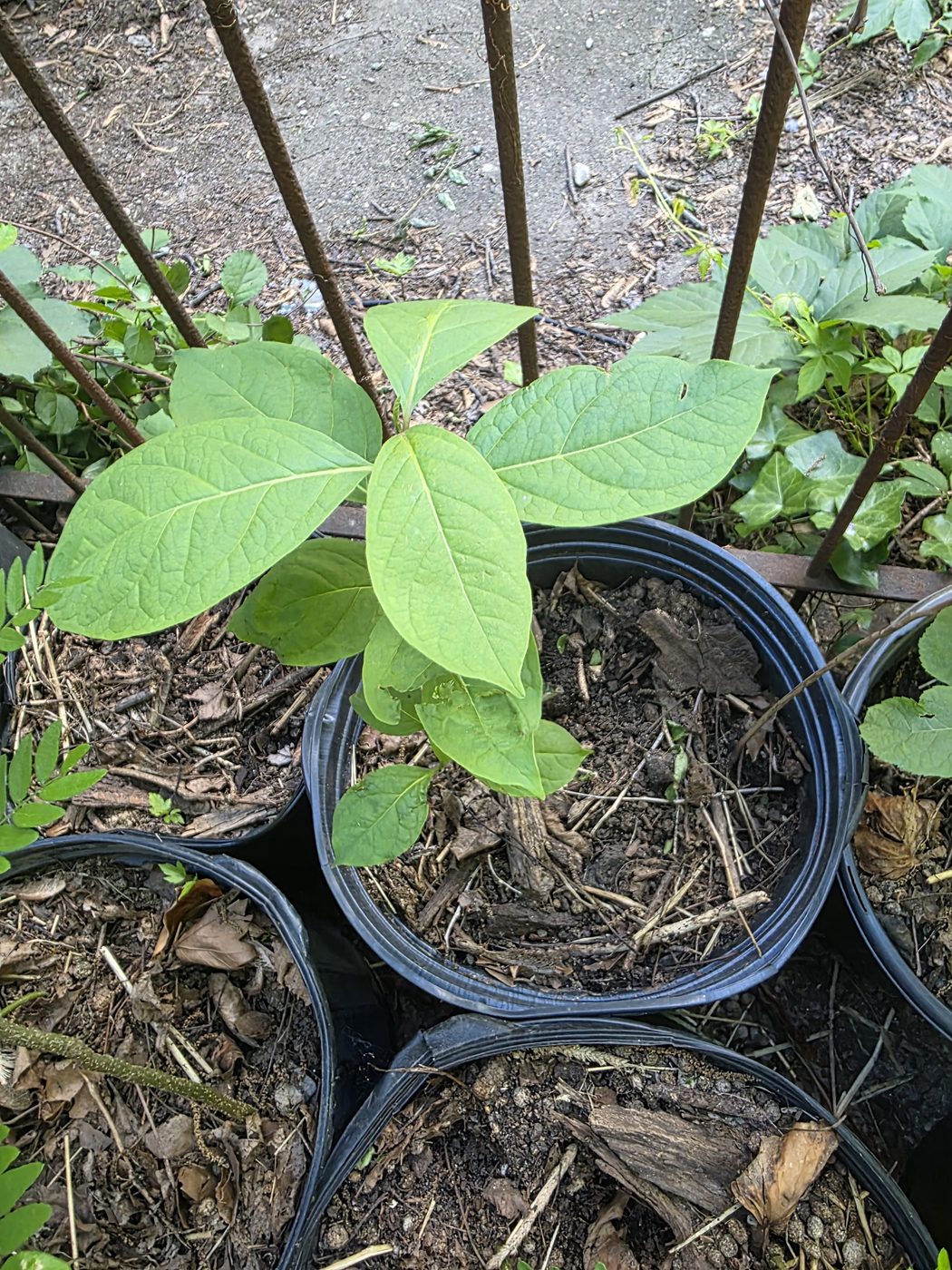
American persimmon seedling with simple smooth-edged glossy leaves
In our beds Persimmon seedling — simple, smooth-margined glossy leaves, two-tone in the light.
Giant American persimmon tree with person at the base for scale, USDA archive 1935
🌳
Mature American persimmon
Diospyros virginiana
Grown out A giant American persimmon, USDA Forest Service archive (Indiana, 1935) — height made visible by the person at the base. Note the tall, narrow crown the species takes when grown out. Photo: USDA Forest Service via NRCS PLANTS Database, public domain, on Wikimedia Commons.

Diospyros means “food of the gods.” Hershey ran contests for the best-tasting persimmons and grafted the winners forward; the persimmons in his Downingtown food forest still drop their fruit from August into November — “we pick them up off the ground,” and the surplus becomes mead. These are seedlings from that improved selection: sweet and luscious when fully soft-ripe (mouth-puckeringly astringent before), and bred toward reliable ripening this far north.

Spacing
15–25 ft. Dioecious — need a male + female (or a parthenocarpic type)
Mature size
30–50 ft open-grown (to 80 ft in forest)
First fruit
~6 yrs from seedling
Soil
Very adaptable — sandy loam best, but takes dry, poor, clay, urban, varied pH
Sun
Full sun to part shade; full sun fruits best

Ecosystem functions

A pioneer — it suckers into groves and thrives on disturbed, old-field, even poor ground (the opposite of the fungal-demanding hickory). Its soft mast ripens late, feeding wildlife when little else is left. Larval host for luna and regal moths; fragrant flowers feed pollinators.

Special needs

Dioecious — you need both a male and a female tree (or a known self-fruitful/parthenocarpic cultivar) to get fruit. Deep taproot → plant young; suckering is a feature for groves but manage it in tidy settings. Fruit is edible only when fully soft — don't judge it green.

Permaculture niche

The pioneer fruit tree — a nurse and old-field reclaimer that establishes on rough ground and tolerates part shade. Use it at the sunny southern edge of the hickory/hican canopy, or as a suckering wildlife hedge.

Wildlife

“Possumwood” for good reason — opossum, raccoon, fox, skunk, deer, bear, and many birds gorge on the fallen fruit. One of the most valuable late-autumn/early-winter soft-mast trees in the East.

🦌 Deer Foliage resistant Fruit is a magnet

The foliage rates as fairly deer-resistant, but the fruit is a powerful draw and young seedlings still get browsed and rubbed. Tube or cage the young tree; once it's tall, let the deer have the windfalls — that's the wildlife dividend.

How to plantPlanting your persimmon
  1. You need a male and a female. American persimmon is dioecious — plant at least one of each (or a known self-fruitful/parthenocarpic type) or you'll get a handsome tree and no fruit.
  2. Almost anywhere works. It's a tough pioneer — dry, poor, clay, or urban soil, varied pH, full sun to part shade. Full sun gives the most fruit.
  3. Plant young, mind the taproot. Like the nut trees it sends down a deep taproot and resents transplanting — set it at pot depth and water it in.
  4. Cage the young tree against browse and buck rub. The foliage is fairly deer-resistant, but the fruit is a magnet and seedlings still get hit.
  5. Wait for soft. The fruit is mouth-puckering until fully soft-ripe (often after frost) — then it's sweet and date-like. Don't judge it green. Suckering is a feature for a grove; mow it back in tidy settings.

Suggested guild — Old-Field Pioneer

A sun-edge grove that builds soil on poor ground while you wait on the slow nut trees. Pair male + female.

Tree: persimmon ♀ + ♂ (for fruit set) Mid: sumac, hazelnut, elderberry N-fixer: clover / groundnut groundcover Accumulator: comfrey ring Edge: sunny south side of the nut canopy
06

Black Locust

Robinia pseudoacacia
Pioneer N-fixer · Nurse tree
Black locust seedling with pinnate compound leaves
📷
Seedling photo coming
Drop in images/blacklocust.jpg
In our beds Black locust seedling — pinnate compound leaves and a leader that runs hard once the taproot sets.
Mature black locust in full late-May flower, full crown against blue sky
🌳
Mature black locust
Robinia pseudoacacia
Grown out Mature black locust in late-May flower — the peak honey-flow week of the East, and the tree's full open-grown habit against the sky. Photo: AnRo0002, CC0 (public domain), via Wikimedia Commons.

The Appalachian pioneer that fixes its own nitrogen. Robinia pseudoacacia is a true legume with active Rhizobium nodules on its roots — the distinction the honey-locust profile above is at pains to make. Its gift to a planting is fourfold: it grows hard on poor ground, it puts nitrogen into the soil where its roots reach, its dense rot-resistant heartwood becomes fenceposts that outlast pressure-treated lumber by decades, and its late-May flower racemes drive one of the strongest spring honey flows in North America. Here it's grown as a nurse tree for the slow climax canopy — paired tightest with hickory and walnut — and as a coppice rotation for fenceposts on the agroforestry sites Cedar Water is developing in South Jersey.

Spacing
3–4 ft nurse for hickory; 4–6 ft coppice (posts); 8–12 ft nurse for open-field-tolerant climax; 25–35 ft saw logs
Mature size
50–80 ft tall, 20–30 ft spread (open-grown)
First yield
Flowers 4–6 yrs; coppice posts 6–10 yrs; saw logs 25–40 yrs
Soil
Sandy, dry, poor, eroded; pH 4.6–8.2. Intolerant of wet feet.
Sun
Full sun (shade-intolerant)

Ecosystem functions

A true nitrogen-fixer (Rhizobium nodules — unlike honey locust). Pioneer on disturbed, depleted, and eroding ground; binds slopes with its suckering root system. Late-May flower racemes drive a heavy nectar pulse — "locust honey" is light, clear, and prized. Larval host for the silver-spotted skipper. Rot-resistant heartwood: 50+ years in the ground untreated — the post material for chestnut orchards across the Mid-Atlantic.

Special needs

Wet feet kill it — drainage first, fertility never. Locust borer (Megacyllene robiniae) targets stressed trees; vigorous stands on suitable soil mostly shrug it off. Suckering is aggressive — a feature on rough ground or in a coppice block, a weed in tidy settings; manage by mowing or coppicing on rotation. Young growth carries stipular spines.

Permaculture niche

The textbook Appalachian nurse tree: fast, N-fixing, easy to coppice, then quietly retired when the climax canopy has caught up. Tightest pairing is with hickory and walnut (3–4 ft for real root-zone overlap); wider as a nurse for oak, persimmon, and other open-field-tolerant climax species (8–12 ft). Doubles as a coppice fencepost lot — the regenerative replacement for treated lumber.

Wildlife

Massive pollinator nectar pulse in late May — honeybees, native solitary bees, hummingbirds, butterflies. Birds nest in the thorny young growth. Seeds eaten by squirrels and game birds (less heavily than honey-locust pods).

🦌 Deer Foliage resistant

Foliage is fairly deer-resistant — stipular spines and bitter compounds — but young seedlings still get tested in their first winter. Cage the first year against deer, voles, and rabbits; mature bark is left alone.

Siting depends on the job. Black locust isn't a north-side-only tree. As a nurse, plant it on the same side as the climax tree it's feeding (3–12 ft, depending on the species). As a coppice block, give it a sunny lot of its own. Just don't put it where the soil stays wet.

How to plantPlanting your black locust
  1. Full sun, well-drained — non-negotiable. Locust shrugs off compaction, drought, sand, and depleted ground, but it dies in wet feet. Drainage first, fertility never.
  2. Decide the role before you site it. Nurse tree for a hickory or walnut → plant 3–4 ft from the climax tree (root-zone overlap is the whole point — that's where the N and the rhizobial/mycorrhizal exchange actually reach the slow tree). Nurse for an oak, persimmon, or other open-field-tolerant climax → 8–12 ft is enough. Coppice block for fenceposts → 4–6 ft on center. Saw logs → 25–35 ft.
  3. Cage the first year. Deer test the foliage even though they don't love it, and rabbits/voles always go for the bark. A 4 ft tube with a sturdy stake is enough.
  4. Plan the coppice. When the climax tree catches up (year 4–6), cut the locust at the stump. It throws a sheaf of vigorous shoots from the stump — let them run for the next post rotation, or thin to a single trunk for saw timber. For a coppice lot, plan on cutting every 6–10 years for 3–5 in diameter posts.
  5. Inoculate if the ground hasn't grown legumes recently. Soils that have carried clover, alfalfa, or beans in living memory already host Rhizobium; long-tilled or chemically-treated row-crop ground often doesn't. A bagged Rhizobium inoculant at planting closes the gap.

Suggested guild — The Nurse Tree

Plant the locust tight against the slow climax tree it's feeding; let it shade, fix N, and lift humidity for 4–6 years, then coppice it down once the climax has caught up.

Nurse: black locust (N-fix + light shade) Climax pair: hickory / walnut / oak (3–12 ft) Sub-canopy (later): pawpaw (takes the shade niche once locust is coppiced) Mid: elderberry, comfrey ring Ground: clover / groundnut (more N) Yield: nectar → posts → soil N