Chien-Shiung Wu
(1912–1997) — Chinese-American nuclear physicist whose precision experiments transformed our understanding of radioactive beta decay.
Photographed March 20, 1963 · Columbia University, New York City Science Service / Smithsonian Institution Archives
If a substance loses half its mass every 30 years, after exactly 15 years:
Many materials — such as radioactive elements or large molecules — naturally break down over time at a rate proportional to how much of the material remains. The amount left is described mathematically using exponential decay.
To compare how stable materials are, scientists measure each material's half-life — the length of time it takes for half of a sample to remain.
Uranium-235
704 million years
half-life
Cobalt-60
5.27 years
half-life
Bismuth-212
60.6 minutes
half-life
5 min total for warm-up (slides 2–4). Students read the context independently — no teacher launch script needed. Advance to the task slide after 20–30 seconds of reading time. Do not pre-explain half-life; students encounter the definition through the text, then confirm understanding during synthesis. The concept of half-life is the key context for both Activity 1 (Nigeria population) and Activity 2 (Waiting for Waste) — a solid intuition here pays off throughout the lesson.
Warm-Up5 min
Do Now
The half-life of a radioactive material is the time it takes for half of the material to remain. Here are the half-lives of three radioactive materials:
Material
Half-Life
Uranium-235
704 million years
Cobalt-60
5.27 years
Bismuth-212
60.6 minutes
Complete on your own. Then confirm your answers with a partner.
Which of these materials takes the longest to break down?
If you had a sample of 8 grams of cobalt-60, how long would it take for it to break down into only 1 gram left? Explain your reasoning.
5 min. Students work independently, then pair-share before whole-class discussion on the next slide.
Problem 1: Watch for students who compare the raw numbers without checking units — a student may rank Bismuth-212 (60.6) above Cobalt-60 (5.27) without noticing one is in minutes and the other in years.
Problem 2: Listen for students who trace each halving step-by-step. Students who try a single division or multiply the half-life by 8 likely do not yet understand that each half-life halves the current amount, not the original. Ask: "What is half of 8? What is half of that?"
Warm-Up · Synthesis5 min
Radioactive Decay — Discussion
Students share their solutions and build a shared understanding of half-life — why its length reflects how stable a material is and how long it will remain a hazard.
“Looking at the half-life, what could be a problem with radioactive waste containing uranium-235?”It will take more than 700 million years before it is reduced by half, so it will remain radioactive for an extraordinarily long time.
“Which is the more stable material, cobalt-60 or bismuth-212?”Cobalt-60, because it takes longer to break down into half of the starting amount — its half-life is 5.27 years compared to 60.6 minutes for bismuth-212.
click to advance discussion ▶
Try Saying
I think ___ is a problem because ___.
Try Saying
The half-life of ___ means ___.
Try Saying
I notice that ___ is more stable because ___.
Try Saying
___ and ___ are different because ___.
5 min total for warm-up. After independent work, cold-call 2–3 students before posing the synthesis questions. Listen for: students who connect a longer half-life to greater stability, and students who reason from repeated halving rather than multiplying the half-life by the number of grams. Common difficulty — students may confuse "more stable" with "breaks down more" — redirect toward the time required to reach half the original amount. Transition prompt: "In Activity 2, we will write an exponential function to model how a material with a specific half-life decays over time."
Class Business
Desmos Art — Hand In
Please hand in a screenshot of your Desmos Art project.
Waiting on screenshots from…
Bill
Yasir
Samirah
Maria
Jesus
Isis (initials)
Kimora (initials)
Honesty
Cierra
Adrian
Activity 1 · Launch10 min
Population of Nigeria
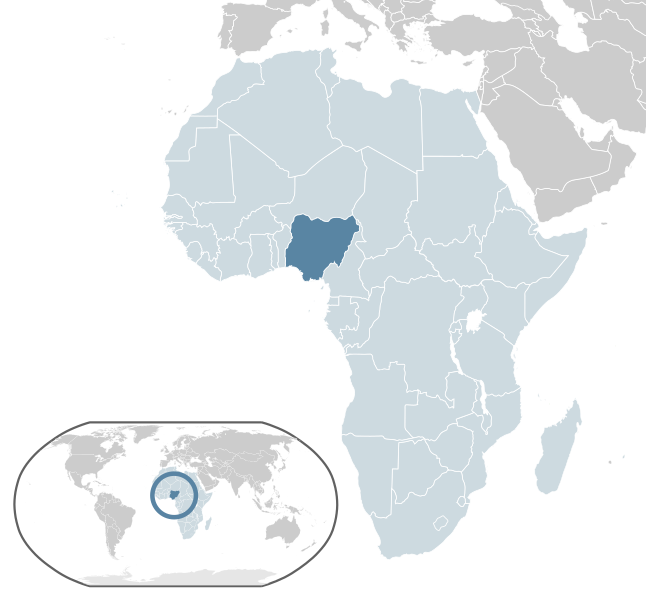
Nigeria (highlighted) — West Africa
Nigeria is one of the most populous countries in the world. It has grown at a fairly steady (and relatively high) rate since 1980.
What do you know about Nigeria?
Launch (2–3 min). Project this slide and cold-call 2–3 students: "What do you know about Nigeria?" Accept any response — geography, culture, economics, current events. The goal is curiosity and buy-in before the math context is introduced. Keep it brief.
After sharing, pivot: "Nigeria has been one of the fastest-growing populations in the world. In this activity you will build an exponential model for that growth — and then work out how to convert a decade-level growth rate into an annual rate. The two rates are not simply related by dividing by 10. That distinction is the core idea of today's lesson."
Watch for: Students may assume that a 28.4% increase over a decade means dividing by 10 to get the annual rate. Allow this misconception to surface during work time — it is addressed directly in Problem 5. Do not correct it during the launch.
Activity 1 · Work Time10 min
In 1990, Nigeria had a population of about 95.3 million. By 2000, there were about 122.4 million people — an increase of about 28.4%. During that decade, the population can be reasonably modeled by an exponential function.
Problems 3 – 5
Express the population of Nigeria \(P(d)\), in millions of people, \(d\) decades since 1990.
Write an expression to represent the population of Nigeria in 1996.
A student said:
“The population of Nigeria grew at a rate of 2.84% every year because \(28.4\% \div 10 = 2.84\%\).”
Explain or show why the student's statement is incorrect.
Find the correct annual growth rate. Explain or show your reasoning.
🧑🏫 10 min · Activity 1 Work Time. Students work independently, then compare with a partner.
Problem 4: Watch for students substituting \(d = 6\) (years) instead of \(d = 0.6\) (decades). Ask: “What unit does \(d\) measure in this function?”
Problem 5a: Accept any argument that identifies the error as applying linear (not exponential) reasoning — the growth percent cannot simply be divided by 10.
Problem 5b: The annual growth factor \(r\) satisfies \(r^{10} = 1.284\), so \(r = 1.284^{1/10} \approx 1.0253\) and the annual growth rate is approximately 2.53%.
If students are stuck on 5b
Ask: “What would the annual growth factor need to be so that applying it 10 times gives the same result as multiplying by 1.284 once?”
Amplify · Activity Builder
Components (once per answer): Text → Math Response → Note </>. Name responses answer3, answer4, answer5b.
Problem 5a → Text Response only; no CL feedback is possible for open explanations.
Format examples (in Text component above each Math Response):
answer3 → Example: 95.3(1.284)^d ·
answer4 → Example: 95.3(1.284)^0.6 ·
answer5b → Example: 2.53
Problem 3: Express P(d), in millions of people, d decades since 1990.
content:
  when answer3.submitted and answer3.latex = "95.3(1.284)^{d}"
    "Correct! P(d) = 95.3 · (1.284)^d."
  when answer3.submitted and answer3.latex = "95.3 (1.284)^{d}"
    "Correct! P(d) = 95.3 · (1.284)^d."
  when answer3.submitted and answer3.latex = "95.3\cdot(1.284)^{d}"
    "Correct!"
  when answer3.submitted and answer3.latex = "95.3 \cdot (1.284)^{d}"
    "Correct!"
  when answer3.submitted and answer3.latex = "95.3\times(1.284)^{d}"
    "Correct!"
  when answer3.submitted and answer3.latex = "95.3 \times (1.284)^{d}"
    "Correct!"
  when answer3.submitted and not isBlank(answer3.latex)
    "Good start — check your initial value and growth factor. In 1990 there were 95.3 million people, and 122.4 ÷ 95.3 ≈ 1.284. What should P(d) look like?"
  otherwise ""
Problem 4: Write an expression for the population in 1996.
content:
  when answer4.submitted and answer4.numericValue > 110.4 and answer4.numericValue < 111.0
    "Correct! P(0.6) = 95.3 · (1.284)^0.6 ≈ 110.7 million. (1996 is 6 years = 0.6 decades after 1990.)"
  when answer4.submitted and answer4.latex = "95.3(1.284)^{0.6}"
    "Correct! P(0.6) = 95.3 · (1.284)^0.6."
  when answer4.submitted and answer4.latex = "95.3 (1.284)^{0.6}"
    "Correct!"
  when answer4.submitted and answer4.latex = "95.3\cdot(1.284)^{0.6}"
    "Correct!"
  when answer4.submitted and answer4.latex = "95.3 \cdot (1.284)^{0.6}"
    "Correct!"
  when answer4.submitted and answer4.numericValue > 424 and answer4.numericValue < 430
    "You're close — it looks like you used d = 6 years. Remember d is measured in decades: 1996 is 0.6 decades after 1990, not 6."
  when answer4.submitted and not isBlank(answer4.latex)
    "Not quite — 1996 is how many years after 1990? Convert to decades (divide by 10), then substitute into P(d)."
  otherwise ""
Problem 5b: Find the correct annual growth rate.
content:
  when answer5b.submitted and answer5b.numericValue > 2.52 and answer5b.numericValue < 2.55
    "Correct! The annual growth rate is about 2.53%. The annual growth factor is 1.284^(1/10) ≈ 1.0253."
  when answer5b.submitted and answer5b.numericValue > 0.0251 and answer5b.numericValue < 0.0255
    "Correct! As a decimal, about 0.0253 — or approximately 2.53% per year."
  when answer5b.submitted and answer5b.numericValue > 2.83 and answer5b.numericValue < 2.85
    "I see what happened — dividing 28.4% by 10 gives 2.84%, but that only works for linear growth. For exponential growth, the annual factor r must satisfy r^10 = 1.284. Try r = 1.284^(1/10). What do you get?"
  when answer5b.submitted and not isBlank(answer5b.latex)
    "Almost! The annual growth factor r satisfies r^10 = 1.284, so r = 1.284^(1/10) ≈ 1.0253. Subtract 1 and convert to a percent to find the growth rate."
  otherwise ""
Activity 1 · Synthesis5 min
Population of Nigeria — Discussion
Students recognize that the growth factor for a one-year interval is not one-tenth of the decade growth factor — because exponential growth compounds multiplicatively over each equal subinterval, not linearly.
“How can we determine the growth factor for one year?”Let r be the annual growth factor. It must satisfy \(r^{10} = 1.284\), so \(r = 1.284^{1/10} \approx 1.0253\) — because raising that value to the 10th power returns 1.284.
“How do we express the factor as a growth rate?”\(1.0253 - 1 = 0.0253\), so the annual growth rate is approximately 2.53% — not \(28.4 \div 10 = 2.84\%\). If the population grew by the same amount each year, you could divide by 10 — that would be linear growth. But this growth is exponential, so each year a bigger growth adds to a bigger population.
"Let's look at the actual numbers year by year. What do you notice about the annual growth?"
Year
Population (millions)
Added that year (millions)
1990
95.3
—
1991
97.7
+2.41
1992
100.2
+2.47
1993
102.7
+2.54
1994
105.3
+2.60
1995
108.0
+2.67
1996
110.7
+2.73
1997
113.5
+2.80
1998
116.4
+2.87
1999
119.3
+2.95
2000
122.4
+3.02
click to advance discussion ▶
Try Saying
The annual growth rate is not 2.84% because ___.
Try Saying
To find the growth factor for one year, I need to ___ because ___.
Timing: ~5 min (activity total: 10 min). Purpose: Students articulate that for an exponential function, finding the growth factor for a shorter interval requires taking a root — not dividing. Push past "divide by 10" by asking: if the annual factor were 1.0284, what would the decade factor be? Is it 1.284?
Anticipated difficulty: Students may conflate linear and exponential scaling. Press them to connect \(r^{10} = 1.284\) to the idea that each year applies the same multiplicative factor — not the same additive amount. Listen for students explaining that 10 equal multiplicative intervals compound to give the full-decade factor.
Activity 2 · MLR6 · Three Reads20 min
Waiting for Waste
If we start with 100 grams of radioactive waste, how much do you think is left after 90 years?
Cesium-137 is a radioactive material found in the waste of nuclear reactors. It has a half-life of about 30 years. There are 100 grams of cesium-137 as part of some nuclear waste.
Read 1
What is this situation about?
click to reveal ▶
Try Saying
This is about ___ and ___.
Read 2
What quantities can be counted or measured?
click to reveal ▶
Try Saying
I see the quantities ___ and ___.
Read 3
What are some ways we might get started on this?
click to reveal ▶
Each of these expressions describes the amount of cesium-137 in the nuclear waste some number of years after it is produced. For each expression, find the number of years it would take to have that much cesium-137 left.
[Expressions could not be recovered from scraper data — see lesson PDF]
Try Saying
I think ___ works because ___.
Ask students to close their books or devices before starting. Display only the context box — do not reveal any question until Read 3.
Pre-read hook: Poll the class on "100 g after 90 years" and record estimates visibly on the board. Students will revisit these estimates at the close of the synthesis discussion.
Read 1 — Read the problem stem aloud. Ask: "What is this situation about?" (nuclear waste, radioactive decay) Clarify "half-life" using the warm-up context if needed. Do not elaborate on the math yet. Read 2 — Ask: "What quantities can be counted or measured?" Listen for: the half-life of the material (30 years), the starting amount (100 grams). Record student responses. Read 3 — Click to reveal the Read 3 column and the first question. Ask: "What are some ways we might get started?" Listen for: compare the expression value to the original 100 g; use the half-life to reason about timing; find ways to reason without computing the expression value. Give ~2 min partner discussion before transitioning to work time.
Reference · How ToActivity 2 · Work Time20 min
Reference · How To
Step
What to do
Example
1
Identify the known growth (or decay) factor b and the length of the interval it describes.
Cesium-137 has a half-life of 30 years. Decay factor per 30-year period: \(b = \tfrac{1}{2}\).
2
Determine n: the number of subintervals of the desired size that fit in one known interval.
Subinterval = 1 year. 30 ÷ 1 = 30, so n = 30.
3
Raise b to the power \(\tfrac{1}{n}\). This is the nth root of b — the subinterval growth (or decay) factor.
Decay factor per year:
\[\left(\tfrac{1}{2}\right)^{\!1/30} \approx 0.977\]
4
Write the exponential function using the subinterval factor. Adjust the exponent to convert the new time unit to the original interval unit.
\(f(t) = 100\cdot\!\left(\tfrac{1}{2}\right)^{t/30}\), where t is years. The exponent \(t/30\) converts years to 30-year periods.
★
The subinterval factor is the nth root of b — not b divided by n.
\[\left(\tfrac{1}{2}\right)^{1/30}\;\neq\;\frac{\,1/2\,}{30}\] Division of the base gives the wrong result.
Activity 2 · Work Time
Cesium-137 is found in nuclear waste with a half-life of about 30 years. Suppose there are initially 100 grams.
Part 1 — Expressions and Time
Each expression below describes the amount of cesium-137 remaining some number of years after production. Find the number of years each represents.
Write a function \(g(t)\) for the amount of cesium-137 remaining, where t is years after production.
The function \(f(n)\) represents the amount remaining after \(n\) 30-year periods. Write an equation for \(f(n)\).
Explain why \(g(30) = f(1)\).
20 min · Leave this slide on screen during work time. Part 1 (3–4 min): the exponents represent 1 period, 3 periods, 1/30 of a period, and t periods — so items 1–4 describe the amount after 30 years, 90 years, 1 year, and 30t years respectively. Part 2 (10–12 min): circulate and listen for students dividing ½ by 30 instead of taking the 30th root — that is the central misconception and the synthesis focus. For Part 2c, if students are stuck, ask: "What does g(30) mean? What does f(1) mean? Why should both give the same amount?" to help them see that one 30-year period is the same elapsed time as 30 years.
Activity 2 · Work Time20 min
Cesium-137 is a radioactive material found in the waste of nuclear reactors. It has a half-life of about 30 years. Suppose nuclear waste contains 100 grams of cesium-137 when first produced.
Problem 8
Each expression below describes the amount of cesium-137 in the waste some number of years after it is produced. Find the number of years each amount represents.
Write a function \(g(t)\) to represent the amount of cesium-137, in grams, left in the waste \(t\) years after it is produced.
The function \(f(n)\) represents the amount of cesium-137 left in the waste after \(n\) 30-year periods. Write an equation for \(f(n)\).
Explain why \(g(30) = f(1)\).
🧑🏫 20 min. Keep the How To slide (s10) visible while students work.
Problem 8 — students should multiply the exponent by 30 to convert periods to years (a: 30 yr, b: 90 yr, c: 1 yr, d: 30t years (variable)). Common error: reading the exponent directly as the year count.
Problem 9c is the conceptual payoff. \(g(30)\) uses the years-based function with input 30 — it gives the amount after 30 years. \(f(1)\) uses the periods-based function with input 1 — it gives the amount after 1 thirty-year period. Both describe the same physical state (one half-life elapsed), so \(g(30) = f(1)\). Watch for students who try to substitute rather than reason about what each function input represents.
If stuck on 9c:
Ask: "What does \(g(30)\) mean in context — what is happening to the cesium after 30 years? What does \(f(1)\) mean — how many periods is that?"
Amplify · 7 inputs
Order per problem: Text → Math Response (name: answerN) → Note (CL in </>). Problems 8d and 9c: Text → Text Response → Note.
Problem 8a: 100·(1/2)^1 — find the years
content:
  when answer.submitted and answer.numericValue > 29.995 and answer.numericValue < 30.005
    "Correct! The exponent 1 means one 30-year period — that is 30 years."
  when answer.submitted and answer.numericValue > 0.995 and answer.numericValue < 1.005
    "Not quite — 1 is the exponent (number of periods). Each period is 30 years. What is 1 × 30?"
  when answer.submitted and not isBlank(answer.latex)
    "Good start — multiply the exponent by 30 years per period to find the number of years."
  otherwise ""
Problem 8b: 100·(1/2)^3 — find the years
content:
  when answer.submitted and answer.numericValue > 89.995 and answer.numericValue < 90.005
    "Correct! Three 30-year periods is 90 years."
  when answer.submitted and answer.numericValue > 2.995 and answer.numericValue < 3.005
    "Not quite — 3 is the number of periods, not years. Each period is 30 years. What is 3 × 30?"
  when answer.submitted and not isBlank(answer.latex)
    "Almost! Multiply the exponent by 30 years per period to find the total years."
  otherwise ""
Problem 8c: 100·(1/2)^(1/30) — find the years
content:
  when answer.submitted and answer.numericValue > 0.995 and answer.numericValue < 1.005
    "Correct! The exponent 1/30 means one thirtieth of a 30-year period — that is 1 year."
  when answer.submitted and answer.numericValue > 29.995 and answer.numericValue < 30.005
    "I see what happened — 30 is the period length, not the answer. The exponent 1/30 represents a fraction of one period. What is (1/30) × 30?"
  when answer.submitted and not isBlank(answer.latex)
    "You are close — multiply the exponent (1/30) by 30 to find the number of years."
  otherwise ""
Problem 8d: 100·(1/2)^t — interpret in years (t is in 30-year periods)
content:
  when answer.submitted and not isBlank(answer.content)
    "Thank you — share your reasoning. The expression 100·(1/2)^t represents the amount after t 30-year periods. In years, that is 30t years."
  when answer.submitted and isBlank(answer.content)
    "Please write your answer before we discuss."
  otherwise ""
Problem 9a: Write g(t) — amount in grams, t years after production
content:
  when answer.submitted and answer.latex = "100\\left(\\frac{1}{2}\\right)^{\\frac{t}{30}}"
    "Correct!"
  when answer.submitted and answer.latex = "100\\cdot\\left(\\frac{1}{2}\\right)^{\\frac{t}{30}}"
    "Correct!"
  when answer.submitted and answer.latex = "100(0.5)^{\\frac{t}{30}}"
    "Correct!"
  when answer.submitted and answer.latex = "100\\left(0.5\\right)^{\\frac{t}{30}}"
    "Correct!"
  when answer.submitted and not isBlank(answer.latex)
    "Check three things: initial amount 100, base 1/2 (halves each period), and exponent t/30 (converting years to 30-year periods). What does your exponent look like?"
  otherwise ""
Problem 9b: Write f(n) — amount after n 30-year periods
content:
  when answer.submitted and answer.latex = "100\\left(\\frac{1}{2}\\right)^{n}"
    "Correct!"
  when answer.submitted and answer.latex = "100\\cdot\\left(\\frac{1}{2}\\right)^{n}"
    "Correct!"
  when answer.submitted and answer.latex = "100(0.5)^{n}"
    "Correct!"
  when answer.submitted and answer.latex = "100\\left(0.5\\right)^{n}"
    "Correct!"
  when answer.submitted and not isBlank(answer.latex)
    "Almost! Here n is the number of 30-year periods, and the amount multiplies by 1/2 each period. What is your exponent?"
  otherwise ""
Problem 9c: Explain why g(30) = f(1)
content:
  when answer.submitted and not isBlank(answer.content)
    "Thank you — share your reasoning during the class discussion."
  when answer.submitted and isBlank(answer.content)
    "Please write your explanation before we discuss as a class."
  otherwise ""
Activity 2 · Synthesis~8 min
Before the task, you estimated how much cesium-137 remains after 90 years. Return to that question — then examine why functions f and g represent the same decay using different input units.
"How much cesium-137 is left in the waste 90 years after 100 grams is produced?"90 years is 3 periods of 30 years, so the amount is halved 3 times: \(\displaystyle 100 \cdot \left(\frac{1}{2}\right)^3 = 12.5\) grams.
"What decay factor did you use to write function f? What is the approximate decay factor per year?"Raise \(\dfrac{1}{2}\) to the exponent \(\dfrac{1}{30}\): \(\left(\dfrac{1}{2}\right)^{1/30} \approx 0.977\), so the decay factor is about \(0.977\) each year.
"Why not divide \(\dfrac{1}{2}\) by 30 to get the annual decay factor?"When the annual decay factor is raised to the 30th power, it must equal \(\dfrac{1}{2}\).
Only \(\left(\dfrac{1}{2}\right)^{1/30}\) satisfies \(\left[\left(\dfrac{1}{2}\right)^{1/30}\right]^{30} = \dfrac{1}{2}\).
"What equation shows the relationship between f(ta) and g(t) as defined?"\(g(t) = f(t_a)\) where \(t_a = t/30\) — because t in g counts 30-year periods while ta (annual) in f counts individual years, so 1 period for g corresponds to 30 years for f.
"How do we show that \(f(t_a) = 100 \cdot \left(\tfrac{1}{2}\right)^{t/30}\) is equivalent to \(g(t) = 100 \cdot \left(\tfrac{1}{2}\right)^t\)?"We know \(t_a = \dfrac{t}{30}\). Substituting into f: \(\displaystyle f(t_a) = 100 \cdot \left(\frac{1}{2}\right)^{t/30} = 100 \cdot \left(\frac{1}{2}\right)^{t_a}\). And \(g(t) = 100 \cdot \left(\tfrac{1}{2}\right)^{t}\) — same form, evaluated on its own input. The two expressions describe the same decay with different input units.
click to advance discussion ▶
Try Saying
I think the annual decay factor is ___ because ___.
Try Saying
Dividing \(\tfrac{1}{2}\) by 30 does/does not give the annual decay factor because ___.
Timing: ~8 min. Begin by returning to the opening estimate — cold-call 2–3 students before revealing 12.5 g. If short on time, prioritize questions 3 and 4 (why division fails; the g(t) = f(t_a) relationship) and cut the equivalence-proof question. Time permitting, display both cesium-137 graphs and ask: "How are these graphs alike and different?" (same curve shape, same vertical intercept at 100; horizontal scales differ — 1 unit on g equals 30 units on f); "What does the point (1, 50) on g mean, and what is the corresponding point on f?" (50 g after one 30-year period; corresponds to (30, 50) on f). The "MASL · What's a subscript?" button (right side of slide) opens a popup card-trio — open it during question 4 if the t_a notation needs unpacking; close when finished. Watch for students who claim the annual growth rate is simply 1/30 of the 30-year rate — this is the central misconception to surface and correct.
Math As A Second Language
Subscripts
Math · We Say · Meaning
★ Math (given)
\(t_a\)
▲ We Say
“t sub a”or“t subscript a”
● Meaning
A subscript is a small letter or number written below and to the right of a variable. It labels a specific version of that variable. Here ta means “t measured in annual units (years)” — different from t, which counts 30-year periods.
More examples:\(x_1, x_2, x_3\) — we say “x sub one, x sub two, x sub three” (a sequence of related x-values)\(v_0\) — we say “v sub zero” or “v naught” (initial velocity)\(H_2O\) — we say “H two O” (the 2 counts hydrogen atoms, not a different version of H)
Press Esc or click outside the card to close
Lesson Synthesis
Sometimes we want to know how a quantity is changing over intervals that are not whole numbers. Consider a population of a town \(P\), in thousands, modeled by \(P(t) = P_0 \cdot 1.5^t\), where \(t\) is the number of centuries since 1800.
“What is the growth rate or percent increase each century for this population?”50% — the growth factor is 1.5, which means the population is multiplied by 1.5 every century.
“There are 10 decades in a century. Is 5% the growth rate each decade?”No. With a 5% rate each decade, the growth factor per decade would be 1.05, and \((1.05)^{10} \approx 1.63\) — not 1.5. Because the function is exponential, the percent increase per decade is not one-tenth of the century rate.
“How do we find the growth factor for each decade? How do you know?”When the decade growth factor \(b\) is raised to the 10th power, it must equal 1.5. So \(b = 1.5^{1/10}\), because \(\bigl(1.5^{1/10}\bigr)^{10} = 1.5\).
“What is an approximation of the growth rate or percent increase each decade?”\(1.5^{1/10} \approx 1.04\), so the growth rate is about 4% per decade.
click to advance discussion ▶
Try Saying
The decade growth rate is/is not 5% because ___.
Try Saying
I find the growth factor for a subinterval by ___ because ___.
I Can…
Interpret fractional inputs for exponential functions in context.
Calculate the growth or decay factor of an exponential function for different input intervals.
Lesson Synthesis (~5 min). Display the model \(P(t) = P_0 \cdot 1.5^t\) and cold-call through each question. The key misconception to surface: students may say the decade rate is 50% ÷ 10 = 5%, which applies linear reasoning to an exponential function. Press them to articulate why we need the 10th root — if \(b\) is the decade factor, then \(b^{10} = 1.5\), so \(b = 1.5^{1/10}\). Watch for students who say “multiply the factor by \(\tfrac{1}{10}\)” — this is the same error. Connect back to Waiting for Waste: the same logic applied when converting the cesium-137 decay from 30-year periods to annual periods.
Cool-Down5 min
Iodine-131 Decay
Iodine-131 is a radioactive material used in medical treatments. It has a half-life of 8 days. A patient receives a dose containing 200 mg of iodine-131.
Problems
Write a function \(A(t)\) to represent the amount of iodine-131, in mg, remaining in the patient's body \(t\) days after the dose is given.
What is the approximate daily decay factor? Round to the nearest thousandth.
Cool-Down · 5 min. Students apply the lesson's core skill in a new context: converting a half-life-based exponential into a function of individual time units. Circulate and look for:
Problem 1: Target form: \(A(t)=200\cdot\!\left(\tfrac{1}{2}\right)^{t/8}\). Common errors: exponent written as \(8t\) (direction inverted); denominator of 30 instead of 8 (confusing with cesium-137 from Activity 2); omitting the initial value 200.
Problem 2: Target: \(\left(\tfrac{1}{2}\right)^{1/8}\approx0.917\). Common errors: entering 0.5 (the 8-day factor, not the daily factor); entering \(0.5\div8\approx0.063\) (dividing linearly rather than taking the 8th root).
Amplify · Cool-Down Setup
Problem 1: Text component (full problem text + Example: 200 · (0.5)^(t/8)) → Math Response named answer1 → Note with CL.
Problem 2: Text component (full problem text + Example: 0.977) → Math Response named answer2 → Note with CL.
Problem 1: Write a function A(t) to represent the amount of iodine-131, in mg, remaining in the patient's body t days after the dose is given.
content:
  when answer1.submitted and answer1.latex = "200\\cdot\\left(\\frac{1}{2}\\right)^{\\frac{t}{8}}"
    "Correct! The initial amount is 200 mg, the decay factor per half-life is 1/2, and the exponent t/8 counts the number of 8-day periods."
  when answer1.submitted and answer1.latex = "200 \\cdot \\left(\\frac{1}{2}\\right)^{\\frac{t}{8}}"
    "Correct! The initial amount is 200 mg, the decay factor per half-life is 1/2, and the exponent t/8 counts the number of 8-day periods."
  when answer1.submitted and answer1.latex = "200\\cdot0.5^{\\frac{t}{8}}"
    "Correct!"
  when answer1.submitted and answer1.latex = "200 \\cdot 0.5^{\\frac{t}{8}}"
    "Correct!"
  when answer1.submitted and answer1.latex = "200\\cdot\\left(\\frac{1}{2}\\right)^{t/8}"
    "Correct!"
  when answer1.submitted and answer1.latex = "200 \\cdot \\left(\\frac{1}{2}\\right)^{t/8}"
    "Correct!"
  when answer1.submitted and answer1.latex = "200\\cdot0.5^{t/8}"
    "Correct!"
  when answer1.submitted and answer1.latex = "200 \\cdot 0.5^{t/8}"
    "Correct!"
  when answer1.submitted and answer1.latex = "200\\cdot2^{-\\frac{t}{8}}"
    "Correct!"
  when answer1.submitted and answer1.latex = "200 \\cdot 2^{-\\frac{t}{8}}"
    "Correct!"
  when answer1.submitted and isBlank(answer1.latex)
    "Enter your function using the variable t. Think about the initial amount, the factor after one half-life, and how the exponent connects t (days) to the 8-day period."
  when answer1.submitted
    "You are on the right track — check three parts: the starting amount, the decay factor after one 8-day half-life, and how the exponent relates t to that 8-day interval."
  otherwise ""
Problem 2: What is the approximate daily decay factor? Round to the nearest thousandth.
content:
  when answer2.submitted and answer2.numericValue > 0.9145 and answer2.numericValue < 0.9195
    "Correct! The daily decay factor is (1/2)^(1/8) ≈ 0.917."
  when answer2.submitted and answer2.numericValue > 0.4995 and answer2.numericValue < 0.5005
    "Good start — 0.5 is the decay factor for one full half-life (8 days). To find the daily factor, ask: what number, multiplied by itself 8 times, equals 0.5?"
  when answer2.submitted and answer2.numericValue > 0.0610 and answer2.numericValue < 0.0640
    "Part of this is right — 0.5 and 8 are both relevant, but dividing gives a linear result. This decay is exponential: what value raised to the 8th power equals 0.5?"
  when answer2.submitted and isBlank(answer2.latex)
    "Enter a decimal rounded to the nearest thousandth. Example: 0.977"
  when answer2.submitted
    "Not quite — start with the 8-day decay factor, which is 1/2. What value, when raised to an exponent of 8, equals 0.5? That is the daily decay factor."
  otherwise ""
Synthesis~5 min
Why do we have to change the growth (or decay) factor when we change the time interval?
“What changes when we change the time interval?”When we change the time interval, we change the number of times we multiply by the factor over a given total time.
“What happens when we multiply MORE times?”When we multiply more times (smaller intervals), the per-interval factor is closer to 1, so the rate per interval is smaller.
“What happens when we multiply FEWER times?”When we multiply fewer times (larger intervals), the per-interval factor is farther from 1, so the rate per interval is larger.
click to advance discussion ▶
Same long-run growth · different intervals
Total (Factor)
Rate
Time Interval
1.5
50% growth
per century
1.041
≈ 4.1% growth
per decade
1.00405
≈ 0.4% growth
per year
All three describe the same population: \((1.5)^{1} = (1.041)^{10} = (1.00405)^{100}\).
Try Saying
When the time interval gets ___, the per-interval rate gets ___ because we multiply ___ times.
Synthesis (~5 min). The big idea: changing the interval changes the number of times we multiply, not the underlying rate of change. Click through the three reveal points in order — pause after each for a partner turn. Use the table to make the same-population/different-interval relationship concrete: \((1.5)^1 = (1.041)^{10} = (1.00405)^{100}\) — same total growth across one century, three different per-interval rates. Watch for the linear-thinking fallback (50% ÷ 10 = 5%); the compounding box on the right is the conceptual antidote. Sentence frame is for partner share-out before practice on the next slide.
Reference · How ToPractice8 min
Reference · How To
Step
What to do
Example
1
Identify the known factor b and the length of the interval it describes.
Population grows 50% per century: \(b = 1.5\) per 1 century.
2
Write the new interval as a fraction (or multiple) of the known interval — call this exponent e.
1 decade = \(\tfrac{1}{10}\) century, so \(e = \tfrac{1}{10}\).
3
Compute the new factor: \(b^e\). Round if asked.
\((1.5)^{1/10} \approx 1.041\) per decade.
4
Convert factor ↔ percent if the question asks for a rate.
Factor 1.041 → about 4.1% growth per decade. If decay, the rate is 1 − factor. Example: factor 0.707 → 1 − 0.707 = 0.293, so about 29.3% decay per hour.
★
Use exponents, not division. \(b^e \neq \tfrac{b}{n}\).
Bacteria. A bacterial population decreases by 75% every 4 hours. Find the hourly decay factor. Round to the nearest thousandth.
Investment. An investment grows by 8% each year. Find the monthly growth factor. Round to the nearest thousandth.
Doubling time. A bacterial culture doubles every 20 minutes. Find the growth factor for 1 hour.
Practice · 8 min. Three transformations of an exponential factor across time intervals. Problems 1–2 convert to a smaller subinterval (root); Problem 3 converts to a larger superinterval (power).
Problem 1: Target \((0.25)^{1/4} \approx 0.707\). Common errors: 0.25 (the 4-hour factor itself); 0.0625 (linear: 0.25 ÷ 4); 0.8125 (linear percent: 1 − 0.75/4).
Problem 2: Target \((1.08)^{1/12} \approx 1.006\). Common errors: 1.00667 (linear: 1 + 0.08/12 — note this is the standard "APR" linearization, very common in finance contexts); 1.08 (the annual factor).
Problem 3: Target \(2^3 = 8\). Common errors: 6 (linear: 2 × 3); 1.26 (inverted: \(2^{1/3}\)); 2 (the 20-minute factor).
Amplify · Practice Setup
Three problems, each one: Text component (problem text + format example) → Math Response → Note with CL. Math Response names: answer1, answer2, answer3.
Format examples on each Text component: Example: 0.707 (Problem 1), Example: 1.006 (Problem 2), Example: 8 (Problem 3).
Problem 1: A bacterial population decreases by 75% every 4 hours. Find the hourly decay factor. Round to the nearest thousandth.
content:
  when answer1.submitted and answer1.numericValue > 0.706 and answer1.numericValue < 0.708
    "Correct! The hourly decay factor is (0.25)^(1/4) ≈ 0.707."
  when answer1.submitted and answer1.numericValue > 0.249 and answer1.numericValue < 0.251
    "That is the 4-hour decay factor (1 − 0.75 = 0.25), not the hourly factor. What value, raised to the 4th power, equals 0.25?"
  when answer1.submitted and answer1.numericValue > 0.061 and answer1.numericValue < 0.064
    "You divided 0.25 by 4 — that uses linear logic on an exponential process. Try (0.25)^(1/4) instead."
  when answer1.submitted and answer1.numericValue > 0.811 and answer1.numericValue < 0.814
    "Almost — you divided the percent (75% ÷ 4 = 18.75%) then subtracted from 1. That is linear thinking. Take the 4th root of 0.25 instead."
  when answer1.submitted and isBlank(answer1.latex)
    "Enter a decimal rounded to the nearest thousandth. Example: 0.707"
  when answer1.submitted
    "Not quite. Start with the 4-hour decay factor (0.25). What value, raised to the 4th power, gives 0.25? That is the hourly factor."
  otherwise ""
Problem 2: An investment grows by 8% each year. Find the monthly growth factor. Round to the nearest thousandth.
content:
  when answer2.submitted and answer2.numericValue > 1.0063 and answer2.numericValue < 1.0066
    "Correct! The monthly growth factor is (1.08)^(1/12) ≈ 1.006."
  when answer2.submitted and answer2.numericValue > 1.0066 and answer2.numericValue < 1.0068
    "Close — you computed 1 + 0.08/12 ≈ 1.0067 (linear approximation). For exponential growth, use (1.08)^(1/12) ≈ 1.006."
  when answer2.submitted and answer2.numericValue > 1.079 and answer2.numericValue < 1.081
    "That is the annual growth factor, not the monthly factor. Take the 12th root: (1.08)^(1/12)."
  when answer2.submitted and answer2.numericValue > 0.0079 and answer2.numericValue < 0.0081
    "0.008 is the annual rate (8% as a decimal). The monthly factor should be a number slightly greater than 1."
  when answer2.submitted and isBlank(answer2.latex)
    "Enter a decimal rounded to the nearest thousandth. Example: 1.006"
  when answer2.submitted
    "Not quite. The annual factor is 1.08. What value, raised to the 12th power, equals 1.08? That is the monthly factor."
  otherwise ""
Problem 3: A bacterial culture doubles every 20 minutes. Find the growth factor for 1 hour.
content:
  when answer3.submitted and answer3.numericValue > 7.99 and answer3.numericValue < 8.01
    "Correct! 1 hour contains 60/20 = 3 twenty-minute intervals, so the hourly factor is 2^3 = 8."
  when answer3.submitted and answer3.numericValue > 5.99 and answer3.numericValue < 6.01
    "You computed 2 × 3 = 6 — that is linear. Compounding gives 2 × 2 × 2 = 8."
  when answer3.submitted and answer3.numericValue > 1.99 and answer3.numericValue < 2.01
    "That is the 20-minute factor, not the hourly factor. There are three 20-minute intervals in 1 hour."
  when answer3.submitted and answer3.numericValue > 1.25 and answer3.numericValue < 1.27
    "That is 2^(1/3), the cube root of 2 — the inverted exponent. Here 1 hour is 3 times the original interval, so use 2^3."
  when answer3.submitted and isBlank(answer3.latex)
    "Enter a number. Example: 8"
  when answer3.submitted
    "Not quite. There are 60 ÷ 20 = 3 twenty-minute intervals in one hour. The hourly factor is 2 raised to that exponent: 2^3."
  otherwise ""