Teaching Approach
MASL scaffolds for multilingual learners
Sentence frames, glossaries, spoken-English versions of every equation, structured peer talk, visual supports — built into every lesson, not bolted on.
IM-aligned, ESL-first
Every lesson uses Illustrative Mathematics' Launch → Work → Synthesis architecture, threaded with WIDA-informed Mathematical Language Routines.
Permaculture-framed context
Math problems sit inside real systems — disaster survival, recovery, and redesign for regeneration — so students see why the math matters.
Sense-making over silent compute
Students learn to read, say, and explain math — not just compute it. Worked examples are models, not problem sets.
Featured Graphic Organizer
Multiplying with a Log Table
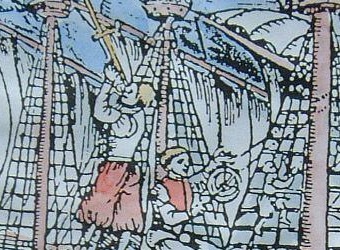
Students meet the logarithm the way navigators did. A sailor sights Polaris with a cross-staff, reads one angle off the horizon, and pairs it with a height from the nautical almanac to form a triangle that fixes the ship's position — but solving that triangle means multiplying long decimals by candlelight on a moving deck. Napier's 1614 insight, that 10a × 10b = 10a+b, turns an hour of multiplication into a look-up and an addition. The organizer walks students to that idea before it ever asks them to manipulate a symbol.
- Narrative + diagram launch — historical passage and a labeled SVG of the sighting triangle (horizon, sight line, angle θ, calculated distance).
- Word-bank summary — students restate the method in their own words with scaffolded vocabulary, an ESL support built into the page.
- Worked example, then transfer — 500 × 2 is modeled step by step against a real log table, then students run two products themselves.
- Tier 3 vocabulary — math and navigation terms defined where they are used.
- Teacher answer toggle — one button reveals every answer inline for projection or grading; hidden by default for students.
Beginning-of-Year Writing Assessment
Dear ______________, — A Thank-You Letter
A first-week baseline. Students write to one real person who made their summer better and thank them for one thing that person did — deliberately not a survey of the whole summer, which produces a list instead of writing. The letter supplies a purpose and an audience that are not “the teacher, for a grade,” and it gives me a writing sample to measure against for the rest of the year. It is scored, but it is not a grade in the gradebook. Nobody starts the year behind.
- It measures two things at once — this is a writing assessment and a check on how precisely a student follows a multi-step direction. The task has five required parts, a stated length, and a two-step narrowing activity that has to be done in order. A student who writes warmly but skips “why it mattered” tells me something very different from a student whose sentences wobble but who lands all five parts.
- An example on the front — my own letter, with the five parts labeled down the margin and the details that carry the moment highlighted, so students see the structure sitting on real prose before they write.
- Their turn on the back — the narrowing activity, feeling-word and time-order banks, and a writing frame with all five parts numbered, prompted, and ruled.
- Three traits, scored separately — content, letter structure, and language, reported on their own so language errors never swallow a strong piece of content.
- Two reading levels — a Grade 6 version, and a Grade 5 version with simpler wording and shorter sentences. Same letter, same moment.
Unit 5 · Exponential Functions
Exponential Functions, Half-Life & Logarithms
Section A explores growth, decay, half-life, and rational inputs. Section B introduces logarithms as a name for the unknown exponent — the move L7 and L8 set up.
Redesigned Arc · Lessons 6–18 Math as a Tool for Agency
A redesign of the back half of the unit — three exponential lessons that set up the logarithm, then the logarithm lessons themselves. Exponential models are usually taught as descriptions of nature — decay, half-lives, isotopes. These lessons reframe them as descriptions of political choices that compound: CEO pay pulling away from worker pay, solar adoption rates that differ four-fold by state, a strike fund draining, soil carbon returning after a burn. The IM learning objectives are untouched; the context is what shifts. Students fit the model, extrapolate honestly, decide whether the trajectory is acceptable, and defend a counter-trajectory.
Unit 4 · Complex Numbers
Imaginary & Complex Numbers
Anchored on MASL card sorts: every new notation gets a Math · We Say · Meaning trio so students can read and pronounce expressions before they manipulate them.
Featured Research
Project-Based Instruction in High School Environmental Science: Integrating Permaculture Design Challenges and an Indigenous Knowledge Lens
A literature review of six studies (Krajcik et al., Matindike & Ramdhany, Akram et al., Nakano & Yamori, German et al., Lebo & Eames) examining whether the research base supports a Project-Based high school environmental science curriculum structured around Permaculture design challenges (disaster response, redesign, recovery) with Indigenous knowledge as a substantive lens, not decorative reference.
The synthesis lands on three sustained findings: affective engagement must precede cognitive transmission; genuine Indigenous-knowledge integration requires sustained, named partnership with knowledge holders rather than attribution; and assessment must measure engagement and identity alongside content mastery. The paper also names a real tension — high-fidelity curriculum design (Krajcik) versus localized practitioner adaptation (Lebo & Eames) — and resolves it as "fidelity on the driving question, openness on the local content."
Pedagogical Foundations
Teaching Math to Multilingual Learners
A WIDA-, NCTM-, and Stanford-Understanding-Language-grounded synthesis of evidence-based strategies for language-aware math instruction. BICS vs. CALP, Mathematical Language Routines, translanguaging as a mathematical asset.
Illustrative Mathematics — Pedagogical Foundations
The research base behind Illustrative Math: problem-based learning (Hiebert, Piaget, Vygotsky), the Launch → Work → Synthesis architecture, all eight Mathematical Language Routines, and how MASL vocabulary cards fit inside the IM lesson cycle.
Classroom Tools
🎲 Visibly Random — Group Generator ↗
Free browser tool for transparent random grouping. Smart roster parser, absence tracking, 70+ subject-themed group names, fullscreen smartboard reveal. No login, no data stored.
☢️ Radioactive Dating Lab
Custom drag-and-drop simulation for an Algebra 2 exponential decay unit. Real artifacts (Ötzi, T. rex skull, Ishango bone), live half-life curve, and a 3-page scaffolded recording sheet.
⏱️ The 40-Minute Spine — Repeatable Lesson Structure
A single repeatable lesson structure for a 40-minute period: daily review, one modelled step, structured pair work with defined roles, and a synthesis that builds a running anchor chart. Grounded in Rosenshine's principles of instruction, the opportunities-to-respond research, and observable "what to do" directions. Prints to a one-page clipboard card.
📊 Exponent & Roots — Visual Reference
Interactive visual reference covering the full exponent and roots unit. SVG factor-tree diagrams, semantic color coding, keyboard navigation.
Background
📄 Teacher Resume — Matt Bennett
Educator and curriculum developer with 10+ years across program management, workforce development, and environmental education. Project Manager & Lead Trainer at PowerCorpsPHL (curriculum for 100+ opportunity youth), former Permaculture Design faculty at Cornell, B.S. Mechanical Engineering from Boston University.